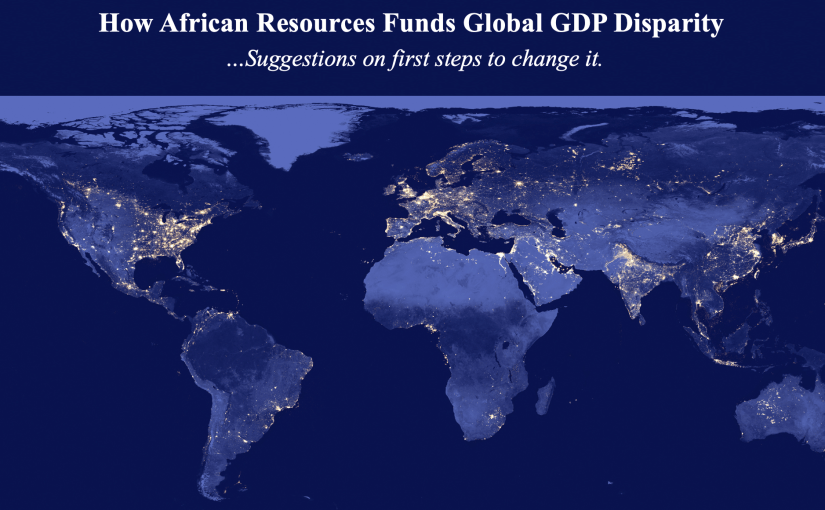
I wish to address, via a case study, how African resources fundS the global GDP disparity between continents. Then I will share some suggestions (of many others) that African governments can consider to begin strategically addressing this disparity.
INCOME DISPARITY (Estimated 2023 GDPs)
1) Asia: $42.7 trillion USD
2) North America: $30.4 trillion USD
3) Europe: $25.2 trillion USD
4) South America: $4.1 trillion USD
5) Middle East: $4 trillion USD
6) Africa: $3.1 trillion USD
THE ISSUE
It is estimated that Africa only benefits 2-8% of the value of raw materials from Africa, with most of the economic benefits being realized in countries where the processing and final product manufacturing take place.
COCOA INDUSTRY EXAMPLE
The global cocoa market value is about $130 billion, and Africa (Ivory Coast & Ghana) produces about 70% of the world’s cocoa beans yet it retains only about $5 billion USD from this market (3.84%). The price of raw cocoa beans exported from Africa is about $2,400 per ton, while a ton of chocolate processed from cocoa can sell for an estimated $25,000 to $30,000 USD. Consider this with EVERY mineral and resource Africa exports that gives rise to the global income disparity above!
THE QUESTION
How can African governments start transitioning to local production to capture a greater value of the market for all its minerals and resources?
A SOLUTION (of many)
African governments should no longer issue licenses or sign contracts for only mineral/resource extraction and exportation, but should condition the issuance of licenses with building manufacturing/industrial plants for their conversion into finished products on African soil. The 80-20 rule: 80% of raw materials must be processed locally, and only 20% are eligible for exports (and even then it should be intra-African). An audit of all prior mineral/resource licenses issued should be conducted, and a fair timeline should be given for their transition to domestic production. If the license holders do not meet the timeline, their license should be terminated.
For balance, the African government must provide significant investment perks and incentives and ease the process of investment and development for multinational firms. For example, governments can form SEZ (Special Economic Zones) and EPZ (Export Processing Zones) to allow freer economic activity, and can also subsidize infrastructure linking these zones with certain market centers and ports.
REFLECTIONS
African governments must be strategic and comprehensive in the measures they take to initiate economic growth. African leaders and governments must level up, and visionaries must vigorously drive nation-building to create a supportive framework that will enable the release of the African people’s creative potential into vibrant industry, innovation, and productivity. Then the open wound, bleeding significant income disparity, will eventually close to the prosperity of the African people.
~Dr. Ikenna Ezealah
Sources:

 Nation Upbuilding