Excerpts from “A Bucket of Water”: Reflections on Sustainable Rural Development by Dr. Kanayo F. Nwanze.
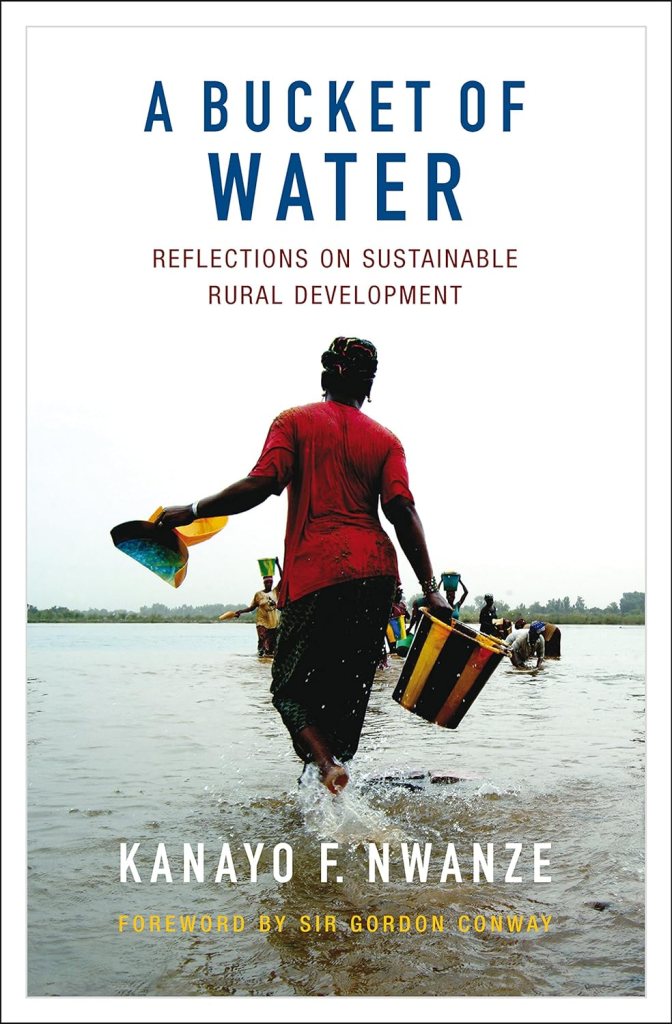
“The three-quarters of the world’s poor who live in rural areas are responsible for up to 80 percent of the food produced in sub-Saharan Africa and parts of Asia (IFAD, 2016c), yet many must buy food for their own table (Christiaensen and Demery, 2007).”
“It is a terrible irony that so many who produce food for others must buy it for themselves. But more than that, it is a travesty because smallholders are penalized at both ends. Lack of access to markets, poor infrastructure, and other causes often prevent smallholder farmers from benefitting from higher food prices. At the same time, they must pay these high prices to feed their own families.”
“Against this backdrop, we must confront the question of how humanity will feed and sustain itself in the future. The world is becoming increasingly urban, yet cities are still fed by people working the land in rural areas. The health of urban dwellers depends on the quality of the water that flows into cities from rural areas. And without strong rural economies that offer decent jobs and dignified living conditions, the exodus to cities will continue unabated, creating social, economic, and environmental instability.” ~(Nwanze, 2017, p. 4-5)
Further Excerpts from “Africa Unchained”: The Blueprint for Africa’s Future by George B.N. Ayittey

“The third, and perhaps the most important, reason for the failure of collective agriculture was the neglect and downright denigration of peasant traditional farmers. These farmers would have responded to the call to increase output had they been given the right incentives. As Times (June 6, 1986) put it:
‘By and large, African peasants are capable farmers. The problem is that … African states provide little incentive to grow more food. The state-set prices are kept low to please city residents, but in many areas they are not high enough to pay farmers for the cost of production. Unable to make a living on the land, farmers join the exodus to the cities, compounding the hunger problem (p.37).’”
“And even the World Bank acknowledged as far back as 1982 in its World Development Report that: ‘Small farmers can be highly productive, typically producing more from each acre than large farmers do, despite the often considerable disadvantages of their limited access to services, markets and production inputs such as fertilizer’ (West Africa, Aug 23, 1982; p. 2147).” (Ayittey, 2005, p. 257)
“… the authorities need to recognize that peasant farmers produce the bulk (over 90 percent) of Africa’s foodstuffs and about 80 percent of these peasant farmers are women.” (Ayittey, 2005, p. 259)
Reflections & Next Steps in relation to African Development by Dr. Ikenna A. Ezealah
A brief overview:
- Three-quarters of the world’s poor who live in rural areas in Africa produce about 80-90 percent of Africa’s food, and the majority are women.
- Despite producing most of Africa’s food, most of these smallholder farmers must still buy food for their own table and, due to a combination of factors preventing them from selling/benefiting from higher food prices, they still pay these higher prices to feed their families.
- Small farmers in Africa can be highly productive and even produce more per acre than large farmers, despite systemic discrimination and considerable disadvantages of limited access to services, markets, and other production inputs.
From this survey, it follows that a well-established agricultural value chain with the foundation of productive smallholder farming in Africa will have the most immediate and comprehensive effect on national economic growth, poverty, and employment of most of the population of African countries. Thus, smallholder farming and rural development must be a primary focus area for national development agendas.
Next Steps for African Governments
The next steps for many African governments is to significantly invest in smallholder farming and build out the various components of the agricultural value chain, with a strategic focus on rural development with linkages to markets. Markets not only within the African country, but also within the continent by leveraging the AfCFTA. The African Union 2003 Maputo Declaration called on member states allocate at least 10 percent of national budgets to agriculture and rural development. Based on the comprehensive effect of the agricultural value chain on the developmental trajectory of African countries, I recommend an allocation of 10-20 percent.
At first glance the recommendation seems high and appears it will encroach on the budgetary allocations for other critical sectors. However, it only appears so until one understands that the entire agricultural value chain embraces other sectors (e.g. roads, transportation, education). An issue with African governance is the lack of long-term national planning and policy coherence between the different sectors, so often money allocated for one sector is not strategically coordinated to have a multiplicity of effects on others! The consequence for Africa is disjointed budgeting, waste, and a bloated and ineffective government with poor implementation. Thus, my recommendation of 10-20 percent investment also presupposes the onset of policy coherence for strategic African nation-building.
Consider roads. Today many African governments concentrate road projects around major cities and often neglect the rural areas. However, as rural areas are the lifeblood of agriculture that feeds Africa, it is important to build road networks (among other things) in rural communities that connect smallholders to markets and which enables parts of the agriculture value chain to easily interact with them. Transporters should not have to battle through hazardous roads just to reach smallholders and deliver their necessary goods to market. If they do, the prices are marked up (officially or unofficially through private payments) which then lowers the margin of smallholders and puts them at an economic disadvantage to sell at a price that may not cover the cost of production. Overtime this issue and others like artificial price suppression, frustrates smallholders and causes many to start leaving farming and pursue other urban opportunities. The consequence is lower food production, higher prices, more agriculture imports, loss of agricultural self-sufficiency, increased urban congestion and slums, higher poverty and unemployment, continual national decline and more!
Roads in a country are analogous to blood vessels in the body, and are networks meant to connect two areas that, once joined, would trigger broader socioeconomic development and have the most wide-ranging effect on the people. Every road build should have a feasibility study that details how it strategically coordinates with and supports the 25–50-year national development plans embracing all sectors. Every action by African government must be both comprehensive and practical. Thus, if the hand that feeds Africa comes from the rural areas, it makes sense to build and maintain effective roads that the hand must pass to figuratively “put food in the urban mouth”.
Summarized Next Steps
—> Ensure effective road networks as linkages of smallholder farmers to the value chain and markets.
—> Invest 10-20 percent of national budget in building the agricultural value chain.
—> Investment should be within the framework of long-term national planning.
—> Ensure policy and strategy coherence between the different sectors in budgetary allocations.
~Dr. Ikenna A. Ezealah, Ph.D., MBA
Builder of the African Future

 Nation Upbuilding