🔥 Africa is in a burning building. The flames are rising, the exits are barred, and the only way out is blocked by a guard who will never move willingly. The question is simple: will we brace for the struggle of liberation, or perish in the fire?🔥
The more I interact with Africans, the more disillusioned I become. Too few grasp the severity of the breaking point that conditions in Africa must finally reach before the people wake up and real change begins. Even the most educated in Africa and in the Diaspora fail to comprehend a hard truth: it is upheaval that is required to trigger the comprehensive reset in many African countries. Too much of our thinking is academic, abstract, and divorced from the harsh realities on the ground.
Let me paint a picture so you understand.
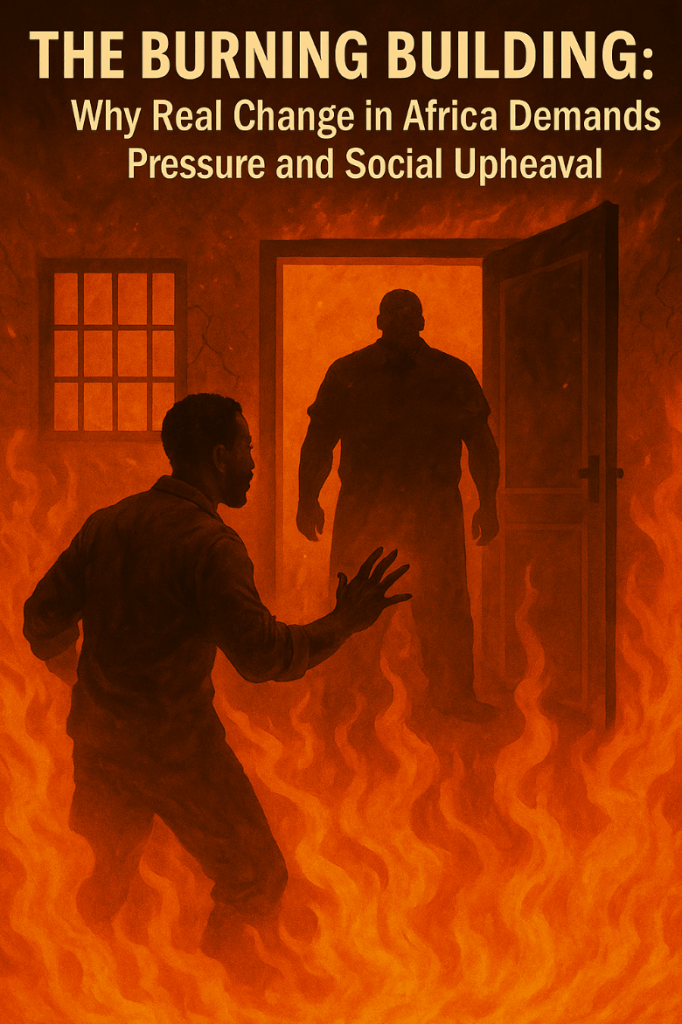
Imagine a man trapped in a room inside a burning building. The windows are locked with iron bars, so there is no escape through them. The only exit is the front door, but a large guard stands there, blocking the way. Every time you move toward the door, he pushes you back, even turning violent. He insists you must remain inside the room. But if you stay, you and the guard will both be consumed by the flames and die. And if you resist and fight, you may die in the struggle. Your options are harrowing: either stay and perish, or brace yourself for battle and fight for your life.
What would any rational and courageous human being do who is committed to liberty?
The only real option is to brace yourself for battle, because survival demands it!
But this scenario is not just a metaphor, it is the exact reality confronting many African countries today. Take Nigeria as an example. In any functioning country, governing institutions should be the arbiters of justice and the last refuge of the people against oppression. But in Nigeria today, nearly every key institution is not only compromised, but has become one of the chief perpetrators of injustice itself.
- Executive Branch – captured by a self-indulgent, tribalistic cabal.
- Judiciary – corrupted by political interference, riddled with paid judgments and contradictions.
- Legislature – infiltrated by self-serving politicians who legislate for their pockets, not the people.
- Security Services – reduced to private enforcers for politicians and the wealthy.
- Electoral Commission – controlled by presidential appointment, producing compromised results.
- Political Parties – operating as pay-to-play platforms, pipelines poisoned by corruption.
Six institutions meant to defend justice, provide succor, and protect the Nigerian people are today crippled by rot. Naturally, good elements still exist within them, but generally they are infected by corruption and have lost their credibility. If these six are the only lawful means of pursuing justice and reform—but are themselves corroded almost beyond repair—then what message is the Nigerian establishment sending to the people?
In plain words: real change can only come from outside the system, through social upheaval that applies pressure to the system and forces comprehensive reset!”
Nigerians face the same choice as the man in the burning room: remain trapped until the flames consume them, or unify as a people and brace for confrontation with the guard.
But let me be clear. I am not calling for war. The “battle” here means social upheaval guided by higher values… an organized, destabilizing pressure that applies force to compel these compromised institutions either to submit to strict order or to collapse, making way for a comprehensive reset. There is no possibility outside of this objective reality.
Africa’s political class do no respect the people, so they must now be taught to fear them. Respect will not come by pleading, nor by theory, but only through the fear of consequences. For most African governments, the path to respecting their citizens runs through the fire of their wrath.
Today, only when African officials fear the wrath of their people more than their selfish interests and the international geopolitical forces that control them, only then will they learn to act consistently in the best interest of the African people.
This respect for the people born from the fear of their wrath will keep African officials in check, and establish a norm of servant leadership that will then enable the natural leaders and visionaries among the people to rise and take possession of government. Those nation-building visionaries whose respect is not born of fear, but of a natural voluntary love for the progress and welfare of their people!
So until African officials can respect their people out of a natural love, they must learn to respect them out of fear of their wrath. But respect must be an established norm!
Yet in this defining hour, too many Africans are still lost in distraction. They debate endlessly, theorize without action, and soothe themselves with illusions. Entertainment, sports, romance, image-polishing, shallow politics, and “influencing”. All have become opiates that provide comfort for the individual, but chains for the collective. None of these distractions will bring liberation and birth a new Africa. None will bend the ruling class. None will save Africa from the flames. So wake up, it is high time for aggressive African nation-building!
Only unity among the people—unity that transcends tribalism, ego, and petty division, and anchors itself in the higher cause of African nation-building—can victoriously engage the fiery metallurgy of struggle. From that furnace, the unified will of the collective will be hammered into firm steel that, when further sharpened by the shared purpose of higher values, will become the Damocletian Sword that will hang inviolably over African leadership…. as a perpetual and threatening reminder that power exists to serve the people, not to enslave them!
Africans must understand: corrupted leaders in power will never relinquish it voluntarily. They must be forced through upheaval. The person gripping a rope will only release it when the pain of holding on becomes greater than the pain of letting go. That is the nature of entrenched power. Titanic pressure must be applied to make holding on unbearable. Only then will the guard give way, the door swing open, and the people finally escape the burning room.
On safe ground, genuine African nation-building can finally begin, not for the enrichment of a tribalistic cabal, but for the collective welfare and prosperity of all. Every true progress demands a real cost. So, African people, will you brace yourselves for the fierce struggle of genuine liberation within and without, or will you remain docile and be consumed by the flames?
The Damocletian Sword hangs over Africa!
~Dr. Ikenna A. Ezealah, Ph.D., MBA
Builder of the African Future
J.D. Candidate ’25

 Nation Upbuilding