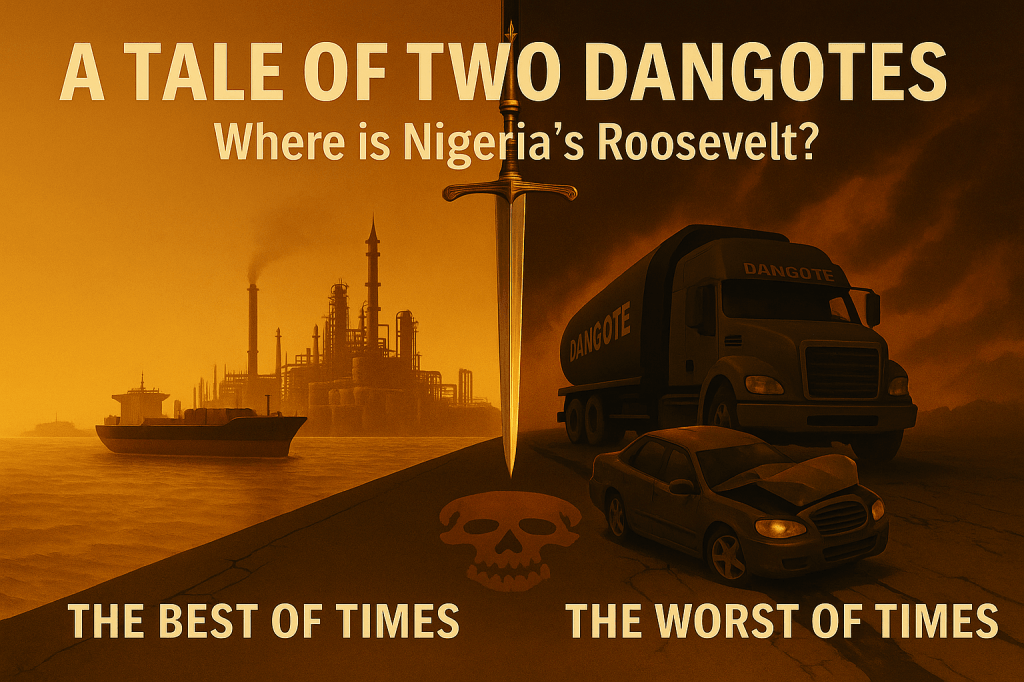
“It was the best of times, it was the worst of times, it was the age of wisdom, it was the age of foolishness, … it was the spring of hope, it was the winter of despair…”
The famous introduction to Charles Dickens’ A Tale of Two Cities that was written to capture the social contradictions in London and Paris before the French Revolution, could just as well describe the Nigerian people’s attitude toward the business activities of billionaire Aliko Dangote. His empire embodies both triumph and tragedy: on one hand, unprecedented industrial achievement; on the other, the daily menace of his trucks, whose accidents leave a trail of injuries and fatalities.
The Best of Times
Dangote is praised as the face of African enterprise. His ventures include the monumental Dangote Refinery, a $20 billion facility with capacity for 650,000 barrels per day, which is Africa’s largest and among the biggest single-train refineries in the world. He has also announced plans to build Nigeria’s largest and deepest seaport in Ogun State, a project set to transform exports of fertilizer and industrial products. To many, these feats symbolize Nigeria’s potential, Africa’s rising industrial base, and the triumph of private capital over chronic state inefficiency.
The Worst of Times
Yet the very name “Dangote” also conjures images of fatalities on Nigerian highways through his trucks. His cement trucks have become a menace, notorious for reckless driving and deadly accidents. Between 2015 and 2025 alone, a report on Dangote truck accidents estimates about 393 deaths and 1,040 injuries. But anyone familiar with Nigeria knows these numbers are drastically underreported. Security services and government agencies, compromised by collusion, coverups, and corruption, shield such abuses from scrutiny. Multiply those figures by at least ten, and one approaches reality. So the paradox is clear: as Dangote builds monumental projects to power Africa’s future, his trucks simultaneously leave a trail of injuries and coffins on Nigerian roads. Who will hold Dangote accountable?
The Role of Leadership
This contradiction highlights the vacuum of political leadership in Nigeria. Visionary governance exists to regulate markets, enforce accountability, and protect citizens from exploitation, while coordinating private achievement toward a national vision. But historically, Nigeria’s leadership has been atrocious… more cabal than custodian, more profiteer than protector.
Where is Nigeria’s Theodore Roosevelt?
Roosevelt’s Example
At the dawn of the 20th century, America faced its own Gilded Age of monopolists and “Robber Barons.” President Theodore Roosevelt confronted them directly, earning the title “Trust-Buster.”
- He used the Sherman Antitrust Act with unprecedented vigor to break monopolies that strangled competition and exploited consumers.
- He targeted giants such as Northern Securities and Standard Oil, forcing courts to dissolve them.
- He distinguished between “good trusts” and “bad trusts,” insisting that government regulate where it could not dismantle.
- His Square Deal promised fairness: balancing corporate power with the welfare of the people.
Roosevelt was not against enterprise; he was against exploitation. His mission was to ensure that no corporation, however powerful, could trample the public interest.
Nigeria’s Missing Guardian
A true Nigerian leader—a nation-building visionary and guardian of the people’s welfare—would never tolerate the impunity of Dangote’s cement trucks. Leadership is not only about setting a vision for industrial growth, for it is also about defending citizens from harm by holding even the most powerful enterprises accountable.
But most of Nigeria’s ruling elite have no such resolve. When leaders themselves are chief exploiters, how can they regulate others? You cannot expect arsonists to serve as firefighters; to do so would be to extinguish the very flames that sustain them. The political class and the oligarchs are in business together, feasting on a climate of underdevelopment that ensures their continued enrichment.
Naturally, this statements do not imply that all Nigerian politicians are ignoble and ineffective or that Dangote trucks always cause harm. Certainly not. For there are promising individuals in the Nigerian political class and Dangote’s enterprise does much good in Nigeria. The statements merely highlight the unchecked status quo: the exploitative political class and the hazards of Dangote cement trucks, both of whom cause harm with little accountability.
Nigeria Needs Its Roosevelt
Nigeria’s story need not remain a cycle of “best of times and worst of times.” With the growth of private enterprise, the country urgently needs leadership strong enough to regulate markets, defend the people, and direct industry toward a common good.
This is not a call to imitate a foreign president. It is a call for the emergence of a new leadership class: men and women who are both builders and guardians, who see government not as personal spoils but as a sacred trust. Leadership that is aggressive in nation-building yet unwavering in defending the Nigerian people against harm and exploitation. And this applies to Africa at large. For without such leadership, the continued hazards of Dangote trucks and all they symbolize may one day become the spark of Nigeria’s own reckoning, just as Dickens’ tale foreshadowed the French Revolution. Nigeria needs its Roosevelt.
The Call for Guardians
If Nigeria wishes to avoid that fate, it must change course. It must raise up a leader who is a servant of God, a builder of the African future, and a guardian of the people’s welfare and prosperity.
May the Lions of Progress hear the call of destiny and step forward for service!
Focused Upward, Forever Onward!
~Dr. Ikenna A. Ezealah, Ph.D., MBA
Builder of the African Future
J.D. Candidate ’25

 Nation Upbuilding