The Disregarded Voices Of Persons With Disabilities In African Nation-Building

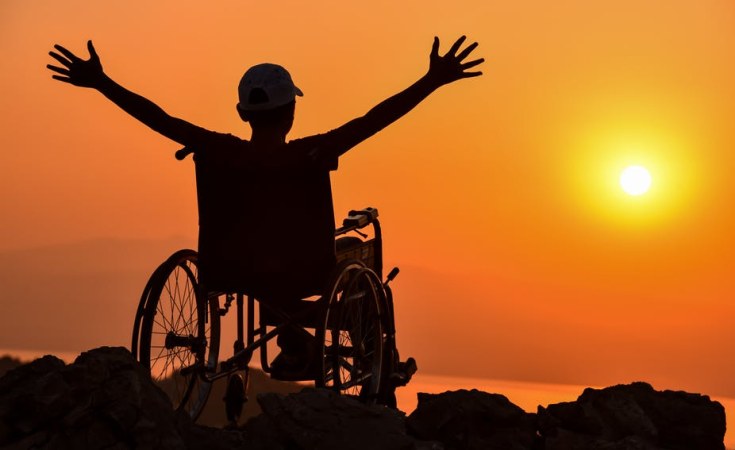
If you are a person with disabilities in Africa (PWD), then be prepared for a miserable life marked by marginalization, social isolation, inaccessibility of public systems, and scant support. If many able-bodied Africans already face severe disadvantages, then you can only imagine the compounded plight of persons with disabilities and vulnerable groups.

In the dialogues and initiatives surrounding African progress, this topic is notably absent. In my personal experience not ONCE in any African Conference, development forum, or strategic planning session have I heard the topic broached! As if the African future is reserved exclusively for the so-called “able-bodied”.

Today I call on the African people and governments to correct this moral and strategic oversight.

And that is why, in my vision and planning for African nation-building, the rights and needs of PWDs are a central pillar that is integrated into all facets of the national development agenda. It is our sacred duty as builders of the African future, to design the policy, institutional frameworks, and community structures that will safeguard and enhance the lives of the vulnerable among us. Any African initiative that excludes the needs of PWDs is defective and must be revised.

Think broadly: architecture, infrastructure, housing, job training, education, public systems, transportation, marketplaces, assistive devices, social services. Every domain must be touched by this inclusion.

A true African leader is one who, guided from above, surveys the full landscape of the people’s needs—including the most vulnerable—and becomes their fiercest advocate. Not for political points but because it is the right thing to do. Because PWDs are citizens too who deserve equal support, investment, opportunity, and the full dignity of living autonomous, productive lives. They too have inner abilities given by the Creator that call for development!

I call upon the advocates of PWDs across Africa to proudly step forward and speak up. You are needed in African nation-building.

If we are to truly build an African future rooted in furthering values, then let leadership and governance in Africa resemble the Good Samaritan. He did not walk past the man crying out in pain on the roadside. He stopped, tended, and restored him. Such must be the honor Cross of African nation-builders!

As the Great Master was reported to say “…whatever you did to one of the least of my brethren, you did it to Me.” If we are to fulfill this Divine Directive, then we must recognize that PWD’s in Africa are among the “least of these”.

Therefore, only that African leader and government who energetically champions and thoroughly integrates the needs of PWDs and vulnerable groups into every layer of national life, is worthy of gaining Divine approval. Only that leader is a Good Samaritan. That noble leader who, in humility, joyfully helps and uplifts ‘the least of these’, thereby proving themselves to be a real helper to the people and a servant of God of earth!

~Dr. Ikenna A. Ezealah, Ph.D., MBA
Builder of the African Future
A Call to Action in Africa

The voices among African people grow louder for change. Many want change, feel ready for change, but unfortunately fail to take the first and biggest step required to effect societal change in Africa today:

… personal involvement in politics to contest for office. 

Many talented Africans at home and in the diaspora conveniently sit on the sidelines, criticizing current leaders, giving policy recommendations, offering internet consultations from the West, attending Conferences, all in the delusion that they are taking “action” and engaging in politics to advance Africa.

The highest involvement of most Africans today is personal business initiatives in Africa that will net them a return on investment. In other words monetary gain for personal enrichment without the responsibility of public service. 

We talk change, yet we ourselves avoid the sacrifice of personal participation and the crucible of public scrutiny that contesting for office demands. 

We say “politics is dirty” so we will stay away to keep ourselves clean. Sounds good, but this is really an excuse. It is self-complacency disguised as self-righteousness. 

Politics is neutral like water, it is who gets involved and the qualities they bring into it that make it dirty or clean.

The older generation is firmly entrenched in office and will remain there! So to expect them to voluntarily give up their positions to allow us and our “fresh ideas” to control and guide the national destiny is unrealistic; it is a disney movie and soap opera disconnected from objective reality. 

If we want it, we have to go get it and be willing pay a personal price. We have to organize and mobilize ourselves to vigorously contest and struggle to take office from them. Nothing will be given easily, so we have to get it. And it will cost us something like every major effort does. 

Our forefathers knew that political organization was necessary to gain mass support and control from the colonial governments, so they organized themselves and pressed ahead. 

Today our generation has more education, international exposure, resources, technology, and the benefit of hindsight. Yet we cannot even be inconvenienced to politically organize ourselves to vigorously contest and earnestly struggle to takeover from the older generation. Yet we boldly talk change in Africa on the internet?

Truth is our words are serious but our actions are not. And it is time to change this. 

So what change do you want in Africa? 

Organize and mobilize yourselves into political action groups, put yourself or others from your group forward, then go and do it! 

Enough talking, it is time for action. 

~Dr. Ikenna A. Ezealah, PhD, MBA

Builder of the African Future

Meeting the Vice President of Botswana

During the World Bank/IMF Spring meetings last week in DC, I attended the Africa Night DC Gala Reception on Wednesday, April 23 2025.

Since I am committed to African nation-building, I prioritize events and professional connections that will advance this life objective. Even personal relationships must directly or indirectly serve the goal of African nation-building.

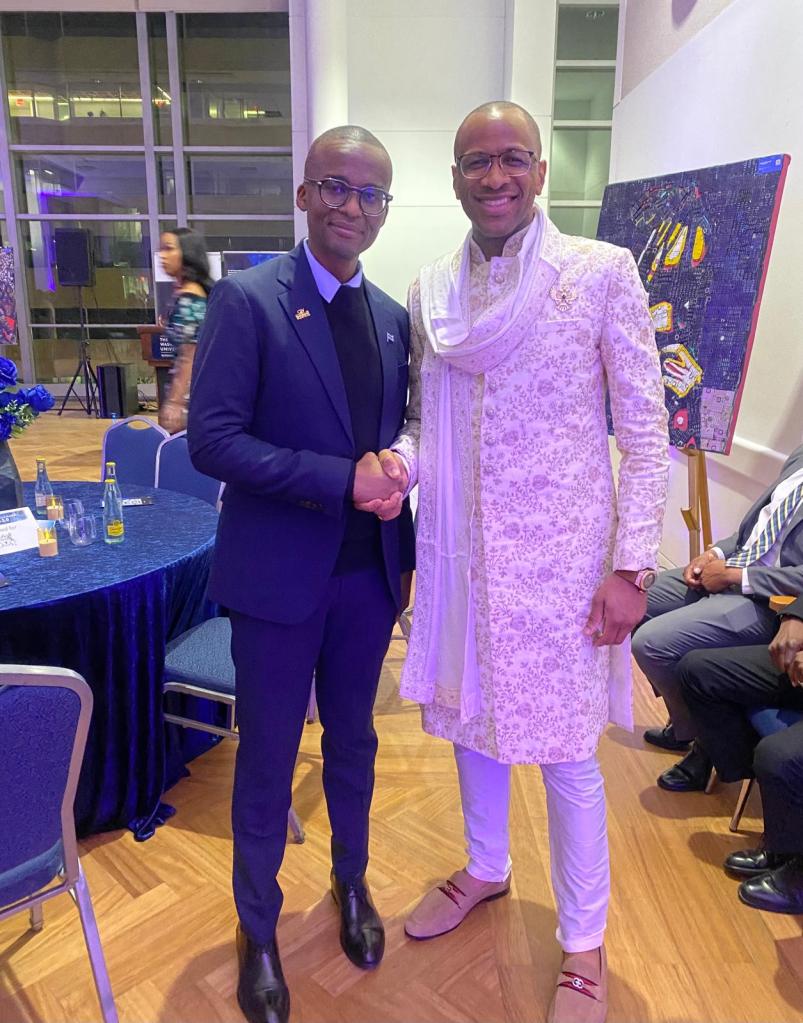
As such, during the Africa Night Gala Reception which was attended by many splendidly dressed people in a convivial atmosphere, I had the pleasure of hearing the Vice President of Botswana, Mr. Ndaba Nkosinathi Gaolathe, deliver a sincere address to the crowd. When he finished, he sat down and was surrounded by his entourage.

My African nation-building antenna picked up an inner signal, so I decided to approach and confidently walked toward him for a personal conversation. As I neared his entourage, they assessed me then soon created an opening for me to pass. I stepped beside the seated VP, extended my arm in warm greeting, and he stood up and reciprocated. Thereupon I introduced myself, thanked him for his speech, and promptly stated my business which was focused on African nation-building in Botswana. I enjoyed our brief dialogue and also informed him that just last month (March 2025) I had met the Botswana President Duma Boko and Minister of Minerals & Energy Bogolo Kenewendo.

See my previous post on meeting President Boko and Minister Kenewendo: https://nationupbuilding.com/2025/03/14/meeting-the-president-of-botswana/

After interacting with the three government officials of Botswana, I am convinced that the future of the country is bright. The young vibrant team is poised to carry and build on the legacy of the first president and transformative leader: Sir Seretse Khama. In the future I hope to also support the developmental agenda of Botswana.

Vice President Ndaba N. Gaolathe of Botswana and Dr. Ikenna A. Ezealah

Onward & Upward!

~Dr. Ikenna A. Ezealah, PhD, MBA
“Builder of the African Future”

Solutions For Nigeria’s Post-Harvest Losses

I appreciate the problem diagnoses of the following article “Nigeria needs 5,000 cold trucks, 100 cold rooms to curb N3.5 trillion post-harvest losses”; but disagree with the approach to the solution.

Why? From the perspective of African nation-building:

Essence is the principle; form is the preference.

A patient with a migraine does not need Tylenol but a solution to their headache which can come in many forms! Solution is the essence; Tylenol is a form. Physicians in Western medical schools are taught to prescribe, so their solutions are typically a “pill-based” reliance on big pharma. Similarly, African people today are taught to buy “ready-made forms” from the West as solutions, instead of developing/exploring different potential forms to address the essence!

The need here is not a “cold truck” (form), but a preserving storage with mobility (essence). Cold trucks are AN option, not THE solution. Cold trucks require inputs that many African countries may not have sufficiently developed (infrastructure, energy, technology etc), so then they rely on Western imports and maintenance.

We first need to see if there are existing indigenous storage systems among the African people that is already suited to the environment and more agile. Next you improve, modernize, and scale it. The people would then own the homegrown technology and not be dependent on imports for their agricultural value chain. Yet I understand there is a transition period which requires a dual approach until you fully build domestic capacity.

More broadly, what Nigeria needs is an aggressive 30-year ASDP—Agricultural Sovereignty Development Plan. A comprehensive plan to domestically buildout all factors of production, inputs, systems, and institutions along the agricultural value chain to establish agricultural sovereignty In Nigeria; whose capacity and productivity will make Nigeria the breadbasket of Africa and the chief supplier of agricultural goods globally.

Such growth can only happen and be maintained when it is built on indigenous systems that come from within the people i.e., when “essence” is developed into indigenous “forms”, and all foreign inputs ( “forms”) are adapted to the cultural context of the African people. However, it takes visionary political leadership with the right concept and approach to development to undertake true African nation-building!

Today Nigerian political leadership is abysmal (and since post-independence has been so with but few exceptions), therefore they are generally incapable of solving this problem. Change will only happen when visionary nation-builders take possession of political office in Nigeria and, with an iron-will for the good and sound strategy, aggressively drive development forward for the complete transformation of Nigeria.

~Dr. Ikenna A. Ezealah, Ph.D., MBA
“Builder of the African Future”

Leaders of Africa, Speak UP!

Many people are discussing Africa as the future—and rightly so, given its immense potential.

Academics, investors, politicians, think tanks, individuals, and governments alike all have something to say about the need to position themselves to benefit from the African growth they believe is coming.

Conferences are held to set global development agendas and define Africa’s role. Others focus on Africa’s place in the geopolitical tensions between the U.S. and China. Some spotlight climate change or other global trends and how Africa can adapt. Still others center on technological innovation and how Africa can catch up. The list goes on.

The voices are loud—talking about Africa, talking for Africa, even trying to set the agenda Africa should follow.

But you know who is silent amid all this clamor? African leaders.

Like palm trees swaying in the wind, many attend conference after conference, adjusting their positions to match whatever the international community is saying.

But no one truly knows the position of African leadership. No one has seen a united front articulating a bold, original vision for the Continent—a vision championed confidently before the world as Africa’s position!

So I ask: African leaders, where do you stand?
What is your conviction?
Where is this continent going under your leadership?
What bold vision have you put forth to shape the future of your people?
What priorities have you established, instead of merely accepting the priorities handed to you by others?

It is with shame, frustration, and fury that I look into the ranks of much of Africa’s leadership—because I am utterly clueless about where the continent is heading. There is no guiding vision.

Everyone is speaking about and for you, Africa. But you, leaders of Africa—why are you silent? Why do you lack conviction and original vision? Why have you become mere followers—puppets—echoing the positions of foreign ventriloquists?

Yes, a few African leaders today stand as exceptions. But most have no business being in office. They should step down and make room for those who do have the capacity and conviction—those ready to serve with their whole heart with an iron-fist for the good, and lead their people forward with original visions brought to life through aggressive nation-building!

Leaders of Africa: Stand up. Straighten your backs.

Speak up. Declare your vision.

Lead your people into a brighter future.

And if you cannot—then respectfully step aside so those whom Heaven has endowed and prepared for these times may step forward to take action!

The African people are tired of lukewarmness and weak leadership, and hunger for something more!

Now is the time for firmness, for strength, for vision, and for bold action.

Leaders of Africa… speak up for your People and Continent!

Leaders of Africa… Speak up!

~Dr. Ikenna A. Ezealah, PhD, MBA
“Builder of the African Future”

African Heads of States: On spending more time abroad than touring Africa…

The brief essay below was a commentary in response to the following article by Nairametrics.

Foreign policy is a necessary part of the Presidency, so I understand the occasional need. However, many African Heads of State and here President Tinubu included, have the bad habit of spending more time traveling abroad than vigorously visiting the different parts of their own countries, their regions, and Africa.

And we wonder why relations between African countries are often so strained, why they can hardly work together like harmonious siblings, and why they struggle to internally resolve geopolitical crisis without consulting Western powers. A Congo lawmaker pitching a mineral-for-security deal with the US to help them against their African brother, then they (DRC & Rwanda) fly to Qatar who has to play referee between them. So much personal humiliation for the collectively poor state of African leadership.

There are always exceptions to the rule, and we understand the need for foreign engagement. But what the African people are calling for now is visionary leaders who prioritize unifying the people of their country, then region, then Africa… in a shared vision for progress that aligns with the words of The Osagyefo Dr. Kwame Nkrumah when he said, “Africa Must Unite!”

I call to my people: Where are the Lions of Africa?

~Dr. Ikenna A. Ezealah, Ph.D., MBA

Builder of the African Future
…i.e., Dr. Juris-Diplomat

“Bad Samaritans: The Myth of Free Trade…” by Ha-Joon Chang

For me, continuous reading, experience, and reflection are essential for professional development and thus for constantly refining the tools necessary for effective African nation-building.

In line with this objective, I finished reading and reflecting on the book “Bad Samaritans: The Myth of Free Trade and the Secret History of Capitalism” by Ha-Joon Chang —a work I highly recommend! And not being too dramatic but, given the rich content, it should have been titled “The Gospel of Economic Development According to Chang”.

The range of topics, the sharpness of his analysis, and his dynamic use of humor made the examination of economic development both insightful and engaging. His work has enhanced my perspective and sharpened my African nation-building toolkit!

Summary:
Using wit, an engagingly personal style, and a battery of examples, Chang blasts holes in the orthodoxy of Thomas Friedman and other liberal economists who argue that only unfettered capitalism and wide-open international trade can lift struggling countries out of poverty. On the contrary, Chang shows that today’s economic superpowers-from the U.S. to Britain to his native Korea–all attained prosperity by shameless protectionism and government intervention in industry.

He argues that the alliance of advanced countries (acting as ‘Bad Samaritans’) have conveniently forgotten this fact, telling the world a fairy tale about the magic of free trade led by the US and mediated by the ‘Unholy Trinity’ of international economic organizations that they largely control—World Bank, International Monetary Fund, and World Trade Organization; ramming policies that suit them down the throat of the developing world.

Unlike typical economists who construct models of how the marketplace should work, Chang examines the past: what has actually happened. His pungently contrarian history demolishes one pillar after another of free-market mythology. We treat patents and copyrights as sacrosanct―but developed our own industries by studiously copying others’ technologies. We insist that centrally planned economies stifle growth―but many developing countries had higher GDP growth before they were pressured into deregulating their economies. Both justice and common sense, Chang argues, demand that we reevaluate the policies we force on nations that are struggling to follow in our footsteps.

Three Previously Completed Books:
✅ Why Nations Fail: The Origins of Power, Prosperity , and Poverty – Daron Acemoglu and James A. Robinson.
✅  Dead Aid: Why Aid Is Not Working and How There Is a Better Way for Africa – Dambisa Moyo
✅ Africa Unchained; The Blueprint for Africa’s Future – George Ayittey

Onward & Upward!

~Dr. Ikenna Ezealah
“Builder of the African Future”

Meeting the President of Botswana

I am earnestly committed to the Cause of African Nation-building. So I focus my energy on what affects the lives of the African people, and prioritize relationships with people who are earnestly committed to this goal, or who enhance my life in varied ways which enables me to better pursue this goal. 

In this process, life naturally orchestrates connections with people at all levels—even the highest professionally—who also share this goal in their own unique way. 

One such encounter recently occurred on Friday, March 7, 2025 at the Embassy of Botswana in Washington DC. There, I had the pleasure of meeting and interacting with two other nation-builders and rising political stars in Africa: the newly elected President Duma Boko of Botswana, and Bogolo Kenewendo, Minister of Minerals and Energy of Botswana. Of course, all discourses had one theme: African nation-building. After meeting them, my confidence in Botswana’s bright future is reinforced. 

President Duma Boko and Dr. Ikenna Ezealah
Minister Bogolo Kenewendo and Dr. Ikenna Ezealah

Photos are great, but I should emphasize that my aim is beyond photo-ops. It is focused on a broader coalition-building of people who are committed to forming strategies and taking energetic actions that will physically manifest in the continent to directly improve the lives of the African people. 

I hope to unite with such people who are focused on building a brighter African present and future. 

~Dr. Ikenna Ezealah

“Builder of the African Future”

…Dr. Juris-Diplomat

Charterhouse Lagos – Primary school

Charterhouse, a 400-year-old leading British independent school, has opened in Lagos (Lekki area), and aims to deliver prestigious British education in Nigeria (video links below). The campus is impressive, but in the spirit of African nation-building we must ask a few preliminary questions:

  1. Who is ensuring their curriculum educates students on their African identity and heritage, instills patriotism, and empowers them to use their abilities to develop Nigeria and Africa?
  2. Are there periodic government curriculum audits to ensure the school aligns with a national educational agenda for Nigerian students? Is there even a national vision?
  3. Why has Nigerian leadership not defined and designed its own unique education system as the national standard—one taught in buildings that reflect ennobled, indigenously designed architecture?
  4. What about most Nigerians who attend dilapidated, underfunded public schools? Where is their help? Who is securing their future?
  5. At ₦42 million per year, how accessible is this education to the average Nigerian, let alone the poor? Did the government mandate a certain number of seats be reserved—via lottery—for underprivileged children from various regions to attend for free?

I appreciate Charterhouse’s efforts, but this is yet again another colossal failure of Nigerian leadership that reflects Africa generally —a leadership always imitating foreign models rather than creatively forming its own indigenous institutions. Additionally, the chronic neglect of public education that leaves most Nigerian children without a level playing field. Where is genuine leadership? We see the problem —now it is our duty to change it!

~Dr. Ikenna Ezealah
“Builder of the African Future”

Charterhouse Lagos Purpose-built Campus
Charterhouse Lagos Campus Highlights
Charterhouse Lagos Launch and Press Conference

A Vision Come True…African Credit Rating Agency

News: The African Union this month [February 2025] has announced the establishment of an African Credit Rating Agency (AfCRA). The AfCRA is set to officially launch in June 2025 as part of the African Union’s broader agenda for financial integration and independence.

A Vision Come True: In October 2023, I published an essay “Seven nation-building suggestions for African governments to use during contract negotiations with foreign companies.” There [see #4 on the link] I recommended the establishment of an African Rating Agency as one of my visions for Africa. Now, almost 1.5years later, it has come to pass.

This is one of several instances over the past few years where this has happened. Here are two other examples:

(1) the African School of Governance that Rwanda’s President Paul Kagame and former Ethiopian Prime Minister Hailemariam Desalegn recently established; also (2) the Africa Connect initiative that the AfDB President, Akinwumi Adesina, announced in 2022 in partnership with the WHO, to leverage Africa’s physicians in the diaspora.

Although my proposals were extensive in both their nature and application, these initiatives mentioned above are promising beginnings and positive developments for Africa, which truly gladdens me. They serve as reinforcement that the other visions I have received and documented—though not publicly shared—are not only real and essential for African nation-building, but will come to fruition—during or after my lifetime.

It is my sincere hope that earnest Builders of the African Future will unite and diligently work to manifest these visions so that, in time, these visions will become a realized blessing for the welfare and progress of the African people!

AU Announcement: https://au.int/en/pressreleases/20250207/african-leaders-convene-establishment-homegrown-solution-africa-credit-rating

Nation-building Article: https://nationupbuilding.com/2023/10/26/african-nation-building-strategies/

Further reading: See also my preliminary suggestions to modify Nigeria’s constitution and restructure INEC. https://nationupbuilding.com/2023/10/24/modifying-constitution-inec/

~Dr. Ikenna Ezealah