In Africa, what type of transportation network is best suited to unlock the free movement of persons, seamlessly connect all parts of the continent, and enable the dynamic movement of goods and services?
Before law school, I read the AfCFTA agreement twice and created a series of charts and flowcharts to make the information easily accessible. I reflected on the AfCFTA’s goal of promoting the free movement of people and its aim to enhance economic integration and unity across Africa, and I noticed how it aligns with the African Union’s Agenda 2063 free movement goals.
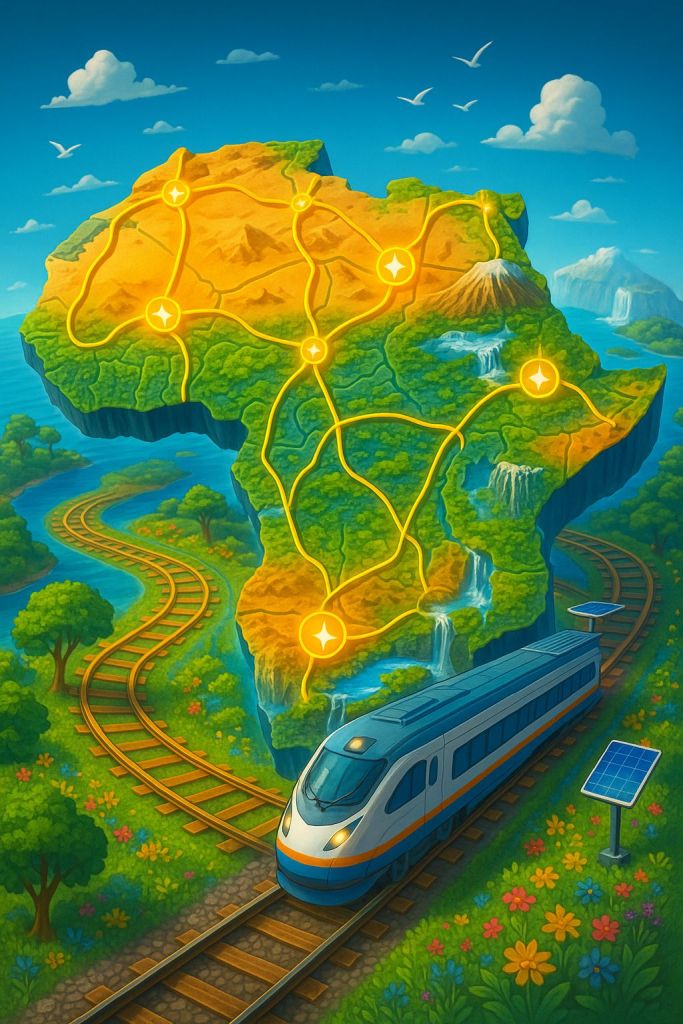
Considering these objectives, I asked myself what form of transportation would best enable the free movement of people across Africa? And I envisioned a comprehensive and fully integrated African Continental Railway System (ACR).
Airplanes are important modes of transportation, but to best unlock the movement of people, goods and services in Africa, it is my conviction that an African Continental Railway System is best suited to the African dynamics and disposition.
African leaders could collaborate to create a framework for a Continental Railway System, linking all regions of the continent and allowing citizens to travel freely between countries. First, a continental network could be established, followed by regional railway frameworks aligned with the ACR for seamless connectivity. National governments could then layer their railways in coordination with these regional and continental plans. The economic, political, and social impact of such a system would be transformative, releasing a socioeconomic sonic boom into the future.
A continental railway would facilitate the movement of people, goods, ideas, and resources, allowing Africans to live in one country and work in another. Imagine a person living in Nairobi (Kenya) who can work in Enugu (Nigeria). Consider a developmental project in Abijan (Côte d’Ivoire) that can be partially staffed by technical experts from Yaounde (Cameroon) who would get there daily through a highspeed railway linking the countries.
But it would also create jobs across countries for Africa’s growing population, sparking continent-wide productivity and skills development. Rail construction, operation, engineering, and logistics would involve an unprecedented transfer of skills and training, contracts, public-private partnerships, allowing African youths to play a central role in building and sustaining a unified infrastructure. The ACR would facilitate industrialization and manufacturing by also igniting the steel industry in Africa. For it would be Continental Law in promoting self-sufficiency that the production of all components of this Railway System must happen in Africa! Regional hubs connecting businesses, factories, industrial sites, cities, schools, and cultural centers would open Africa to itself, fostering a rich and reciprocal exchange of culture, resources, and labor. Africans could experience the continent’s natural landscapes, while work and leisure become truly continental.
Imagine traveling on the ACR from Conakry (Guinea) to Addis Ababa (Ethiopia) or Khartoum (Sudan) to Pretoria (South Africa). On the major pit stops African people from different ethic groups would embark and disembark. Think about the human and cultural connection! Imagine seeing and experiencing the diverse landscapes and natural wonders of Africa as you travel! It is impossible to see and appreciate the natural beauties of the land through air like you would closeup in a railway!
While challenges would undoubtedly arise, such an initiative would require comprehensive planning, precise coordination, tactical execution, public-private partnership, and the continuous engagement of citizens. However, if Africa’s leaders could establish the African Continental Free Trade Area (AfCFTA) to create a single trade market, they can achieve the same framework for the ACR. It just takes a bold vision, firm will, commitment to planning, and a tenacity for execution! The realization of this vision may take some time, but part of a visionary’s work is to establish frameworks for the future. And I believe the African Continental Railway System represents the best means of achieving a connected Africa for the free movements of persons and goods.
Let African leaders, governments, and institutions take note.
Let nation-builders in Africa step forward, bold and courageous, to build the African future! Leaders of Africa, it is high-time to think big and start leading with bold visions and diligent hands that work to realize it for the progress and development of the African people!
Onward & Upward!
~Dr. Ikenna A. Ezealah, Ph.D., MBA
Builder of the African Future
 Nation Upbuilding