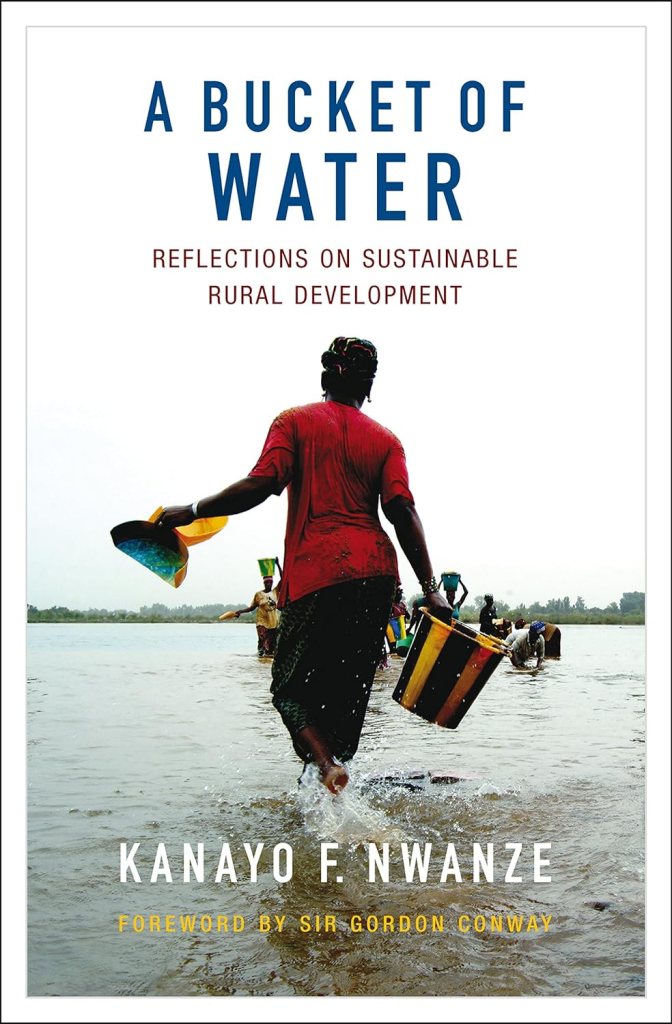
I completed the book “A Bucket of Water”: Reflections on Sustainable Rural Development” by Dr. Kanayo F. Nwanze, my late mentor and former President of the UN International Fund for Agricultural Development (IFAD).
In developing countries, if you want to build a sustainable economy that includes most of the population, ends hunger, tackles poverty, and addresses inequality, what critical area and group of people should you first focus on to achieve lasting results? Three-quarters of the world’s poorest and hungriest people live in rural areas. About 57% of the total population in Sub-Saharan Africa live in rural areas. Hundreds of millions of these rural people work small farms. And even as the world becomes more urban, it still depends on rural areas for food, clean water, environmental services, and employment. Rural people and smallholder farming is thus the baseline.
During the 1960s and 1970s when many African economies were more prosperous, many were net exporters of major food crops and some African governments invested as much as 10% of their budgets to agriculture. The continent had universities with agricultural facilities, research centres, and stations worthy of the name. Across the centuries it was agriculture that has given the first impetus to economic growth for more advanced countries today. Thus, Dr. Nwanze states, “The path to modernity and inclusive prosperity must pass through fields and pastures. That is both metaphor and truth.”
In his book “A Bucket of Water”, Dr. Nwanze harnesses his decades of practical observations and hands-on global experience in agricultural research and rural development to provide rich anecdotes in discussing various themes of rural development, while also reflecting on the work of IFAD. He shows that any genuine effort to achieve the Sustainable Development Goals and 2030 Agenda will fail if it does not include small-scale producers. Dr. Nwanze expands the traditional understanding of agriculture, and touches on the numerous inputs and factors that directly and indirectly affects it. He further discusses how the agricultural sector is not only foundational to developing other sectors in an economy, but that other sectors are closely integrated into the intricate agricultural value chain.
The book should be read by anyone interested in sustainable rural and agricultural development, and who is looking for foundational solutions to addressing poverty and hunger which will spur broader economic development and new opportunities. For those inclined to African nation-building and development, “A Bucket of Water” provides a sound blueprint for practical focus areas and action steps for building a brighter African future.
IFAD’s statement on Dr. Nwanze: https://www.ifad.org/en/w/remarks/statement-on-the-death-of-dr-kanayo-f.-nwanze
AUWCL article that references Dr. Nwanze: https://www.american.edu/wcl/news-events/news/from-vision-to-action-ikenna-ezealah-s-journey-in-nation-building.cfm
Thanks Dr. Nwanze for your mentorship, visionary leadership and passionate advocacy for rural people. Your work will continue!
~Dr. Ikenna A. Ezealah, Ph.D., MBA
Builder of the African Future
 Nation Upbuilding