Today we commemorate the birth of Jesus the Christ who came to Earth to bring the Light of eternal values through His Word that brings redemption and opens the Heavenly Gate, so that we might experience abiding joy and peace. We say thank you to God for this birth of Grace!
On this day I ask, “how can my life be an instrument of service that converts the Light He brought into a furthering activity on earth?” My answer:
“For God so loved the world that He gave His Son…”
Translation: God so loved, He gave the best of Himself and the strongest help to humanity in the birth of His Son. And this Help was the Light of Truth that brings the Light of spiritual development which enables our ascent to luminous heights. When there is love, there is the giving of the best of oneself and the strongest help of service. For one: If we so love, we must give the best of ourselves and the strongest help to bring the light of development to our people!
In departing the Earth, Jesus was reported to say, “I go to prepare a Place for you!” This is Spiritual Kingdom-Building! Then we also recall the words of Scripture, “Thy Will be done on Earth as it is in Heaven”, i.e., we will do below (Earth) what is done above (Heaven).
Conversion: Therefore, Spiritual Kingdom-Building (heaven) through the Light of development above is equivalent to African nation-building (earth), driven by eternal values, through the light of development below. So “I go to prepare a Place for you!” one converts into the service, “I will work to the honor of God to prepare a Place (Nation) for you [Nigerian/African people] in order to follow the example of the Light of God’s Love”.
Therefore, African nation-building driven by eternal values honors the Divine Mandate, as above so below. To me it is just following the Divine Example for the welfare and further development of the African people!
May we each find our Star of purpose and diligently work towards its realization, whose light will be the gift of gratitude we offer back to God for the Grace of the birth of His Son this Christmas Season.
I am wishing everyone light and joy of the Season, also success and goodwill this upcoming New Year.
I encourage every African to watch this captivating and insightful dialogue, “The West’s Unspoken Fear: China as the First Non-white Superpower”, from the perspective of African nation-building. It captures an essential point I usually communicate to Africans, namely that Africa cannot reach its developmental potential through the Western liberal democratic system.
Many Africans, especially the educated ones, have difficulties thinking outside this system and have become so mentally restricted that they can only see African progress through the lens of Western models. They are so “in the box” they cannot fathom other possibilities exist outside of it. The Western model is good for the West, but Africans need something different! Even the US did not just copy the British system, but formed something new for themselves. The Africans who champion copying the Western system like to argue and say “then what model should Africa use?”
In this question is both the problem and the answer. The subconscious admission in this question is, “We do not know how to think for ourselves and form an original developmental model that works for us as Africans, based on our unique heritage, so we need to rely on existing ready-made models from others to copy!” And in this attitude the iron gavel pounds in judgment!
In this thought is also the lack of faith and conviction in one’s own capacity to form something original that can hold its own and be equally successful in its own right. It is mental weakness finding comfort in the familiar that is neatly dressed up as “progress”. Wake up my people!
I say to you: the path to African nation-building and genuine progress lies in building new models of governance and development from the African spirit, that aligns with our heritage, culture, and nature. No matter how uncomfortable it feels, copying will not bring us to the Promised Land but only to a realm of pseudo progress.
China is showing the world it is a different people, so it needs a different system to grow. Even in the same family, each child needs a different path to reach its potential. Races are children born in the same human family. We have differences and need different frameworks to reach our potential! Once we accept this, we will find the strength and creativity to originally build for ourselves instead of copying from others. And this will earn us self-respect and pride in our indigenous capacity!
Anyone who aspires or proposes to be an African nation-builder, but who is only willing to strictly follow the adopted Western liberal model and is not committed to forming a new paradigm is a “person of concern” and cannot be a genuine African nation-builder.
The right African nation-builder will be willing or ready to creatively form a new paradigm, governing framework, and developmental model that works for the African people and enables them to reach their potential in their own way. As Africans we can draw lessons from China’s ascent, but not copy. Our path to progress will look different. It is through creative originality applied to national development that true sovereignty is gained!
Onward & Upward!
~Dr. Ikenna A. Ezealah, JD, PhD, MBA Builder of the African Future
Introducing… Dr. Ikenna A. Ezealah, JD, PhD, MBA Builder of the African Future
Four years ago during the COVID quarantine I did soul searching. I reexamined my life and delved deeply into the culture, history, and rich traditions of my people, the African people. Recognizing the past and present successes, challenges, and current lack of genuine leadership, a question arose within:
“What are you doing to give back and support the development of your people?”
I had no answer and felt ashamed. But I fervently prayed, then firmly resolved to support the African people’s development by focusing my life to fostering economic growth, good governance, indigenous development, and institutional building across Africa.
I then decided to got to law school in order to obtain the skills necessary to be a helper to my people as an international nation-building diplomat. Since then, my professional experiences have been miraculous. Yet I have also faced great challenges I always faced quietly and diligently, unknown to most.
In my darkest hours it was always my faith in God and the commitment to my life’s purpose that gave me strength to keep boldly forging ahead. I only have Plan A and no Plan B; my Plan A is my plan A-Z. For in my heart I believe in only one outcome: unconditional victory!
I spent my first year at Case Western Reserve School of Law. Then, following an inner prompting, I transferred to American University Washington School of Law. My main professional experiences during law school are follows:
UN Immersion for Multilateral Diplomacy; Diplomatic Trainee
International Trade Centre; Int’l Trade Intern (designed model legal framework to establish NECs National Export Councils)
Washington International Diplomatic Academy; Int’l Diplomatic Trainee
Colin Powell Leadership Institute by Black Professionals in International Affairs – BPIA; Fellow
Garvey-Nkrumah Legal Fellowship Program (fostering African/Black leaders to apply Pan-African economic development models); Fellow
Public International Law & Policy Group; Senior Research Associate
Whiteford, Taylor & Preston; Extern (developing an International Investment Manual)
On December 14, 2025, exactly six years to the day I obtained my PhD, I walked across the stage at AUWCL to obtain my JD.
Now through the Grace of God I proudly declare: “It is finished!” To mark graduation, I prepared a short video entitled “A Long Walk to JD (Juris Doctorate)”
I work hard for the opportunity to work harder in service, and know that success is only a Divine loan to be repaid through the service to uplift the African people. I thank God for His Omnipresent Guidance. Also all family, friends, and colleagues who have helped me.
I did it! Now I am ready for the next chapter, focused heavenward and in fulfilling my life’s objective: to be a servant of God, and a helper and guardian of the welfare and further development of the African People!
May God the Father grant me holy power for this work!
💫Onward & Upward!💫
~Dr. Ikenna A. Ezealah, JD, PhD, MBA Builder of the African Future
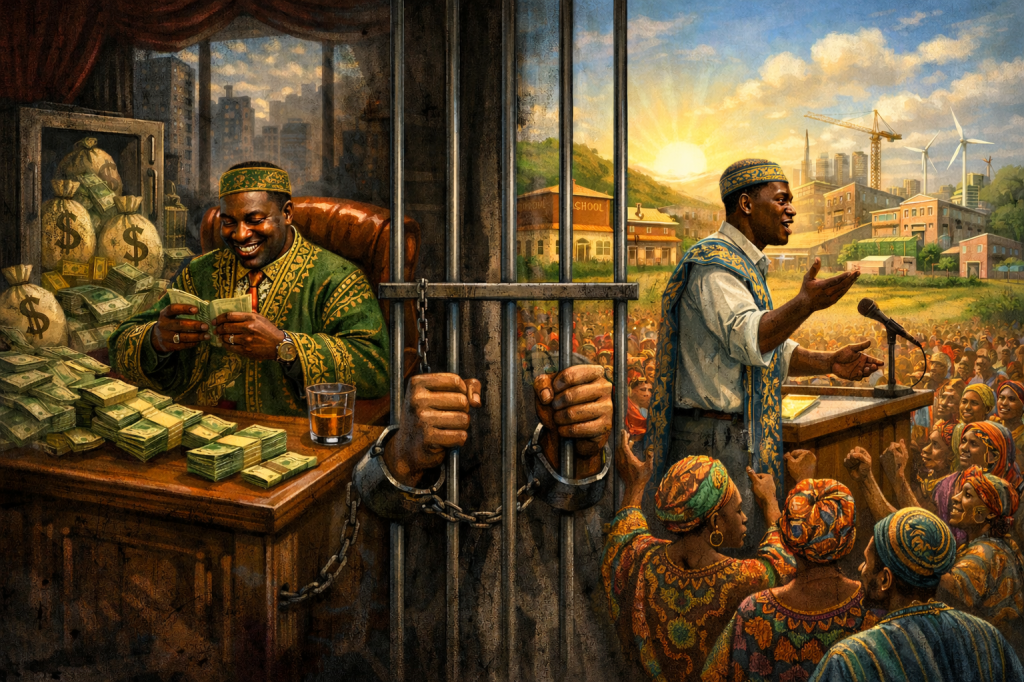
African leaders who covet personal wealth are not fit for leadership in government.
One of the leadership preconditions of every person who aspires to work in African government, and who is committed to properly governing for the welfare of the people is that they must NEVER desire to be rich! To be paid fairly and well, but never to be rich.
The person must be content creating opportunity and wealth for their people, even watching people they govern and help become millionaires and billionaires over them, but they themselves must never personally desire such things.
Their desire must be rooted in building and maintaining the policy environment that enables the collective progress and advancement of their people, over and above personal wealth. They must desire this progress above everything else, otherwise they are not fit for leadership and should remain in the private sector!
The role of leadership and the functions of government are irreconcilable with the accumulation of personal wealth. People should be paid fairly and well, and even somewhat comparable to similar roles in the private sector, but it is impossible for any human being who desires to be rich to properly discharge their duties in government in a way that truly furthers their people. Impossible.
The true wealth in leadership is the advancement of the people through building policies, institutions, systems, frameworks, and social services that bring out the creative best in the people to innovative and drive national progress. Such leadership should be paid handsomely well and fairly, but becoming abundantly rich is not possible unless there is corruption somewhere.
Assessing Africa from this standard, one can conclude that probably 95%+ of people currently working in government have no business being there, and should be terminated and relegated to the private sector. Many even cast and chained in prison.
It is important to have the right mentality for leadership, otherwise one will make big mistakes. The desire for collective progress must always be greater than the accumulation of personal wealth in one who desires to truly lead. Otherwise they are not mature enough and fit for leadership, and should stay far away from government. Every great government leader in history has exemplified this quality of collective progress above personal wealth accumulation, for none became great without it!
Leaders should definitely be paid fairly, and perhaps their pay can even be partially adjusted on commission based on the performance of the economy. But all this negates the mass accumulation of wealth, instead it directs energy to create the environment through which citizens can build wealth and opportunities for themselves and their communities.
Leadership principles.
Onward & Upward!
~Dr. Ikenna A. Ezealah, JD, PhD, MBA Builder of the African Future
I watched a video discussing a root of Nigeria’s developmental problem to be inaccurate census data, whereby the government cannot accurately plan and provide support for those it cannot count. Think infrastructure capacity as an example. In response to this video, someone rejected the premise and instead blamed Nigeria’s developmental woes on the familiar villain “corruption”.
I have long since deeply reflected on this topic. So, stirred by the video and the reaction, I penned my reflections. May the inscribed words open new paths of contemplation for Nigerian’s and Africans to progress toward the ideal!
The lady’s points are valid. However, inaccurate census data is not the root problem, but a factor. Corruption too is not and has never been the root problem, but rather only a symptom of the problem. Let me explain. There are three layers of problem analysis: cause, symptom, and factor.
A root cause is the origin; a symptom is the direct effect of the cause; and a factor is the secondary effect of the cause and a direct effect of the symptom.
So what is the root cause? Simple but fundamental: a lack of genuine love for the people. Most officials in government and the citizens themselves lack a genuine love for the people and country. The burning love that is consuming, infectious, and is directed toward all, and not limited to little family, kin, and tribe! The consequence of this lack of love is the symptom we experience in government as corruption.
Love wants to service and give, lack of love wants to be served and take! Public service turns into the public being at one’s service. Take a simple example:
If a mother has 3 starving children that she loves and you give her $100, what will she do? She will spend every penny to feed them! Because she loves them and wishes only for their welfare. But if she takes it and goes partying, or buys shoes while her children starves, then she lacks real love for them. So the corruption of her extravagance is only because she lacks real love! Then her not keeping up with what the children need (inaccurate data) is only an outgrowth of her extravagance (factor of her corruption). Do you see?
Nigerians have been allowing people (through election or force selection via rigging) in office who do not love the people and are committed to their welfare! The outcome from that is bound to be corruption.
We should not chase factors or symptoms, but go to the root: genuine love! Nigerians should find and support people who have this genuine love that burns within them like a surging ocean of flames 🔥. A love that only desires to serve with whole heart, for the welfare of that which is loved (the people). In love is light and development, just like the rays of the Sun brings to Nature. In love are the creative visions for collective progress, and the victorious strength for their implementation!
(For a few of many good examples of strong nation-building leaders who governed with a firm love for their people, research the details of Osagyefo Dr. Kwame Nkrumah of Ghana, Sir Seretse Khama of Botswana, and Lee Kuan Yew of Singapore!)
Then there is a separate conversation of the needed fashioning of institutions and systems that separate and check powers once the right person who loves is governing. Essay for another day!
Jesus is written to have said “I am the Way, the Truth, and the Life, no man cometh to the Father but by Me.”
How does this apply here? Jesus is the Love of God, so the way to genuine progress and ascent inwardly and outwardly is through love. For Nigerians to find the way to positive development, they therefore must seek ye first “genuine love”. In love is the way, truth, and the light of progress. This is not an opinion or religious thought, but an explanation of Holy Law governing the Universe and every aspect of human existence for eternity!
So the main thing for Nigerians and Africans to progress is to inwardly turn to God in love, awaken love for their neighbor and country, and support those with a genuine love for the people for leadership. Then the Rays of development, like the luminous rays of the Sun, will shine on Nigeria and Africa, dissolving the impurity of corruption, and leading to a new beginning of robust growth for the welfare of the people.
Then the faces of Nigerians will radiate pride and joy, as a consequence of their own love that is reflected in the deeds of love in leadership. May God grant it!
The Nigerian political infrastructure, with few notable exceptions, has become infected by self-serving, myopic, and low-voltage personalities who govern with callous indifference to the plight and despair of the Nigerian people.
Take a recent example captured in this video!
In Nigeria, amid rising insecurity, escalating terrorist kidnapping of school children, killings of civilians by bandits, the public and humiliating execution of Brigadaire General Musa Uba by ISWAP, the boundless anguish of victimized families, the crippling economic conditions, the diminishing morale of Nigerian soldiers, and the general loss of hope by Nigerian’s for a brighter future…
Amid all of this, what is the priority of the First Lady of Nigeria? Hosting a dinner party for elites! To be feasting and laughing while the people need help and support. How dare you insult the plight of the people with this careless act? And do not gaslight Nigerians by pretending to discuss important matters over “sumptuous dinner”, for the entire historical precedence of the country contradicts this possibility. What we can expect is politicking for 2027 elections!
President Tinubu needs to call himself and the First Lady to order!
One of the few who spoke like a real leader is Senator Abaribe of Abia State at the Senate session, I recommend people watch his speech!
Besides, the “Office of the First Lady” is not even Constitutional in Nigeria, so you have no legal right to use that designation to gather Senators to discuss matters of the State!
But since many Nigerian officials, and also the First Lady have lost recognition of their duty, I am now compelled to speak for the people and remind them!
The First Lady is meant to be guardian of the flame of national values and virtues. She is meant to be the moral compass that points to higher qualities in times of darkness to inspire light, confidence, and hope.
That is the task of a First Lady! Translated to the present context of Nigeria, what can be done is leading a feminine task force with provisions and services to the people in affected areas. If one insists on private dinner, then invite the spouses of soldiers who died fighting terrorism and the families of the kidnapping victims to Aso Rock for an event to honor, commiserate, and strengthen them. To speak life into them and demonstrate that the country sees them, loves them and stands with them! These are two examples how you can ignite the flame of national values in times of darkness. Stand on your duty!
Why do you Nigerian officials forget the people? Why do you not help and protect them? Why are you so numb in the face of such suffering? Wake up and take up your duty or one day the ray of upheaval will reach you! Then, according to the Law of Reciprocity, you will receive the same support you gave Nigerians in their time of suffering … indifference! Remember this and wake up!
In service!
~Dr. Ikenna A. Ezealah, PhD, MBA Builder of the African Future JD loading…
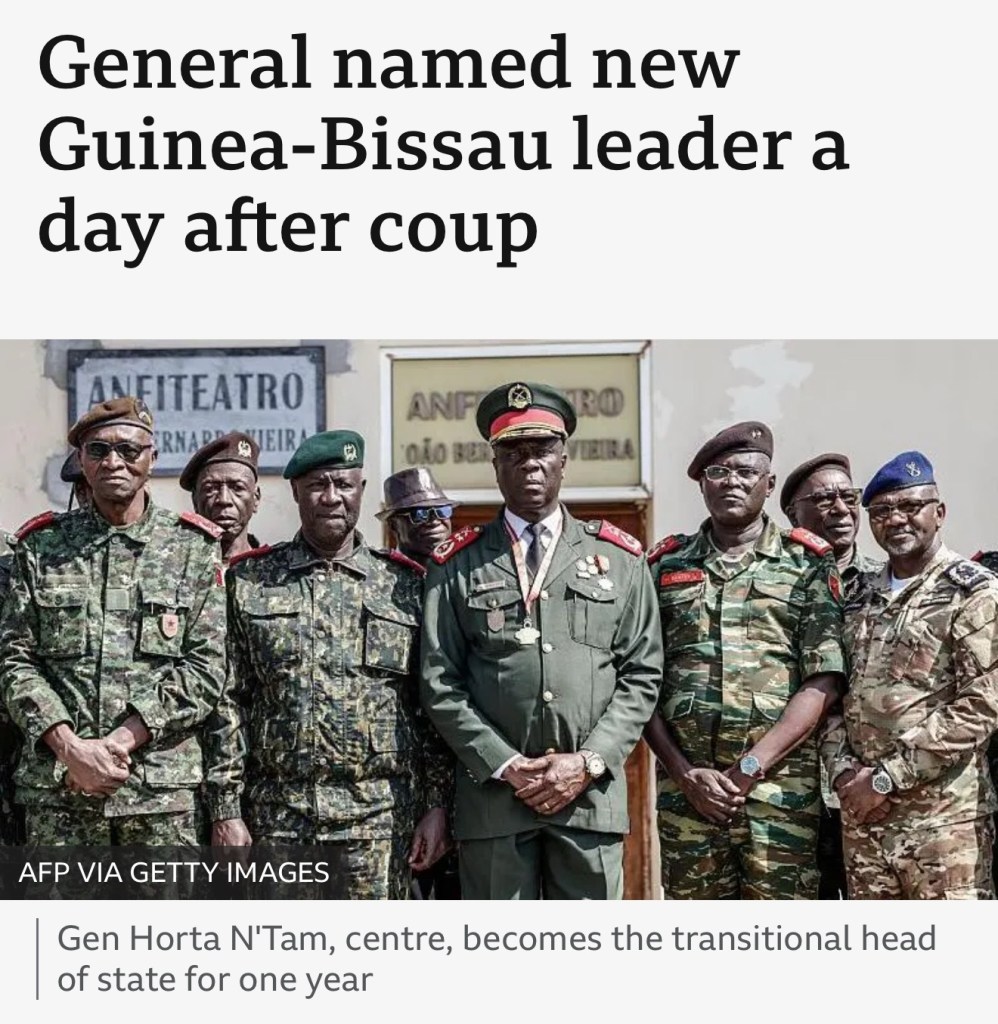
On November 26, 2025 there was a military coup in Guinea-Bissau and, accordingly to reports, General Horta N’Tam has now assumed leadership of the country.
No matter your views, here is the central message for African leaders:
The people of Africa are tired of failed leadership and the excuses why they are not seeing tangible development, yet leaders are living in luxury and comfort. The people are tired of people telling them to just “go to the polls”. Tell me, what are you supposed to do when:
1) The Legislature is self-serving and corrupt. 2) The Executive is nepotistic, exploitative, and king oppressor. 3) The Judiciary delivers judgments for “30 pieces of silver” from the Legislature or Executive. 4) The Security Service are just the paid body guards of the Executive and Legislature who do their bidding unjustly. 5) The electoral commission is rotten, comprised, and rigged. 6) The leadership pipeline is “pay to play” and highly tribalic. 7) Every year conditions keep getting worse. 8) No sector in the national economy is stable and functional. 9) You see generations wasting away in multidimensional poverty. 10) Foreign organizations gaining greater control of minerals and natural resources, shipping the wealth back to their countries, and leaving the locals impoverished. 11) The country drowning in increasing national debt that the generation wasting away is supposed to somehow settle. 12) You pray and hope, take action, try to be civil, but no matter what you do the same government stifles and silences you.
What do you expect the African people to do under these conditions? Just sit there and dissolve? So how dare anyone judge the measures they take to regain control of their country out of dire distress? What boundless audacity to criticize the actions of people who are driven in desperation to near insanity?
I am not advocating coups as the solution. What I am saying is that I understand the motive behind it and sympathize with the feelings. If African leaders continue in wretchedness and incompetence, and fail to come their senses then they should now be prepared for the “Traore effect”.
Enough of this madness in Africa. Something has to give! The people are hungry for development, itching for progress, and ready for aggressive nation-building! Their bones are “rattling for action”.
African Leaders, either rise in leadership or fall by upheaval. Multiple choice option A or B!
Building Africa Onward & Upward!💫
~Dr. Ikenna A. Ezealah, Ph.D., MBA Builder of the African Future JD… loading
I respect the deep and honest reflection of this Ghanaian elder who laments at how much damage his generation has done to Africa!
One of the places he was referring to in Ghana is “Agbogbloshie”, which is the largest electronic dumping site on earth.
The Ghanaian government imports electronic waste of all kinds from other countries. And there every day thousands of men, women, and children live and survive by dismantling electronic waste from the West with their bare hands! In horrifying conditions not even befitting for animals. No protection. No alternatives. Breathing toxic smoke, walking over burnt plastic, searching for scraps of metal to sell for a few coins. African children living in such abominable conditions with little help from their leaders!
African leaders, why do you betray your people?
If you are interested in learning more I recommend the YouTube documentary “Inside the World’s Largest Electronic Graveyard”. https://lnkd.in/evqvrySB
African leaders, look how much damage you have done to the African people! See the corrosive effects of your diabolical neglect that leaves millions to needlessly suffer. You have much to account for! Soon the forbearance of the African people will expire and crisis will break. And if full justice does not reach you here, just remember:
The commerce of God’s Justice in the Universe will always strike a royal balance in the accounting of eternity!
Now to my generation, we must raise our heads upward, confidently and determined to do good and correct the prior wrongs. We must be careful of the same mistakes, for the work before us is about service and not personal aggrandizement.
We must work together and look for solutions to advance Africa. No matter how much damage that has been done, we must now fully embrace it, own it, and clean it up! We must dig our heels in the ground and build a brighter African future! Yes, we “brace ourselves for battle” and accept the challenge!
Such is the work for which destiny calls us to service!
Building Africa Onwards & Upward!
~Dr. Ikenna A. Ezealah, Ph.D., MBA Builder of the African Future JD Candidate ’25
The failure of African leadership is the issue here. As a leader, you are to form policies that will establish and fund original scientific research and innovation institutions which includes testing centers.
Then based on the intensive research and recommendations of your scientific community, you form national polices that set chemical standards for the importation of goods (“sanitary and phytosanitary measures).
Next, you overhaul the border process of verification and entry and institute stricter measures for the testing and clearance of goods at ports. Additionally, you form punitive policies that ruthlessly punishes corporations who weasel products into your country that violate your standards. Such draconian measures would include revocation of licenses, seizure of assets, imprisonment of key officials, brutal fines etc.
Basically any corporation who flagrantly dares to violate the law, and who sends substandard products with harmful additives to Africa that they would never give Europeans, in order thereby to insult the dignity of the African people must be made to feel the iron-fist in cold pitilessness.
As an African leader, all corporations who approach your country to do business should feel the volcanic earnestness you apply to the sacred duty of being a helper and guardian of your people! The steadfastness and vigilance of your attitude toward your people, in addition to the institutions and systems you establish, will then become a shield of honor around your people that will command respect and compliance from foreign corporations to do well by them! Where are the lions of Africa?
African leaders, if the task of leadership is too much for you, if standing by your people and being a helper and protector of their welfare is too burdensome for you… then resign and vanish from office, so another who is prepared to boldly and diligently serve the common good can step forward and take your place!
African leaders, stand by your people!
~Dr. Ikenna A. Ezealah, PhD, MBA Builder of the African Future JD Candidate ‘25
The Framing Nigerian and African leaders, set politics aside and think strategically about the long-term lessons you can draw from the bellicose tweet that Trump recently sent, which can be applied to develop your people and protect your country from potential future geopolitical intrusions. Think like visionary nation-builders! I will help in this, so let us examine the words!
In response to claims of Christian deaths in Nigeria, Trump tweeted the following. I have bracketed words for logical emphasis: “IF the Nigerian Government continues to allow the killing of Christians, [THEN] the U.S.A. will immediately stop all aid and assistance to Nigeria, and may very well go into that …. Country ‘guns-a-blazing’…”
In this essay I will not be addressing the claim of Christian deaths in Nigeria, but rather will focus on the broader principles to be drawn for African nation-building.
The Mechanisms: The claim of the antecedent IF is followed by the threat of the three-part enforcement mechanisms of THEN: aid, assistance, military. Therefore, your task as nation-builders is to form a long-term national developmental strategy that builds domestic institutions which would immunize you from these foreign mechanisms through self-sufficient productivity.
About Aid & Assistance You have been repeatedly warned that so-called foreign aid and assistance is often a cleverly orchestrated reconquest and control of national infrastructure through dependency. It is given to establish leverage, yet you carelessly overlook this and fall into the trap. So, when enforcement time comes, you are in a weak position. Your fault.
Action? List the different sectors of aid: Health, Humanitarian assistance, Security, Economic Development, Loans, Education etc. Next, form strategic action plans to develop domestic institutions that will make you self-sufficient in each of these sectors of US aid!
Health Assistance: Take health. Nigerians are everywhere in the US healthcare system and even drive innovations. Therefore, it is sheer leadership incompetence and wretchedness that Nigeria does not have one of—if not the best—healthcare industries on earth! Your task is to develop a strategy that will harness all the specialized medical skills and experiences of the Nigerian Diaspora to build a formidable and world-leading medical sector in Nigeria! Any Nigerian leader whose vision is not this big and ambitious for nation-building needs to resign and leave office forevermore.
Money/Loans: Think of money. Often you politicians carelessly get loans denominated in USD, embezzle it, then park the funds and assets in the US and Europe. You yoke your people to a foreign power, rob what little crumbs they receive from loans, then reinvest these stolen funds back to the foreign power. Such foolishness is incomprehensible. How are such human beings even a position of leadership? The US government sees all your monies and assets, where they are invested in their economy, so when these geopolitical situations arise, they can use this leverage to sanction and enforce their will against you. Again, it is carelessness of Nigerian leadership, for you have not created a safe economic environment domestically where assets can be protected, so you do not trust the country that you manage, meaning you do not trust yourselves. And this distrust is a proof and admittance of your own incompetence and failure. It is time to make this good.
Therefore, your task is to create the right regulatory environment that is uncompromisingly fair, devoid of corruption, and safe for the storage and protection assets. But this implies you must be absolutely ruthless and govern under the penalty of capital punishment against measures of corruption. Draconian severity is needed to purify governance. You must place the advancement of your country above everything but the Creator! Above tribe, family, children, above everything. Still fulfilling personal responsibilities, but nothing on earth should mean more to you than the fulfillment of duty to advance your people! Absolutely nothing! Such must be the honor cross of those who wish to serve the cause of African nation-building with their life!
About Military Intervention Foreign powers talk big about democracy, but they do not believe in it, they believe in control and force. They respect democracy to the degree it aligns with their national interests, and when it does not then their military is ready to violate territorial integrity for economic and geopolitical purposes under the banner of a moral cause. You must understand this, for history and current events bear witness to this truth. Therefore, let me ask you: which country in Africa has a robust defense industry? Institutions that develop original defense research and innovations, and then manufactures weapons for national and continental self-defense? Answer: NONE. Therefore, your task is clear as nation-builders: make Nigeria the first African country to develop a robust domestic defense industry that produces research and technologies, manufactures them and exports them throughout Africa.
Once you become self-sufficient through these institutions and can supply what you need, no foreign country will think of “invading at will”, because the cost would potentially be too heavy through high precision “missiles-a-blazing”. Additionally, you would have the capability to overwhelm all domestic terrorists and ensure the security of your people, and the peace and territorial integrity of your country. But today you are weak and cannot defend yourself, and that is why foreign countries easily threaten to invade you at will. Do you understand that your “friendship” with them is conditional on you bowing to their will? And if do not, the economic and military enforcement mechanism are unleashed. So you must counteract this through institution-building!
Concluding Message In summary, your response to Trump’s message should be quiet note-taking on the long-term lessons you can draw for national development. Your resolve should be to develop institutions and mechanisms that will make you nationally self-sufficient, so you remove the leverage that a foreign power has to enforce their will against you. Such should be your focus: developing strategies for aggressive African nation-building for indigenous self-sufficiency!
Despite the great opportunity for progress, you leaders have strayed so far away from the African Cause, have betrayed your people, pillaged resources, become foreign dependent, and even stifled visionary leaders from rising because it was not convenient for your tribalistic and selfish personal interests. But now this must change, because global geopolitics is becoming increasingly unpredictable and any country that lacks self-sufficiency is vulnerable for exploitation and control. A country that cannot feed and defend itself is useless and has no right to expect global respect. Friendly foreign gestures during times of “peace” cannot be trusted to hold during times of differences, for then the leverage they have will be used against you. It is your task to eliminate these leverages and become strong through long-term development planning.
The Call: African leaders, focus on long-term institution building that will make your people grow strong, stand tall, and become self-reliant. Develop enough pride for Africa and love for the people that will enable you to work unceasingly to build institutions and systems for their progress, which will free them from foreign control and make them partners of equal value. Become helpers and guardians of the welfare and further development of the African people. Protect and uplift them and future generations.
African leaders, stand up for your people and build institutions!
Onward & Upward!
~Dr. Ikenna A. Ezealah, Ph.D, MBA J.D. Candidate ’25 Builder of the African Future


 Nation Upbuilding