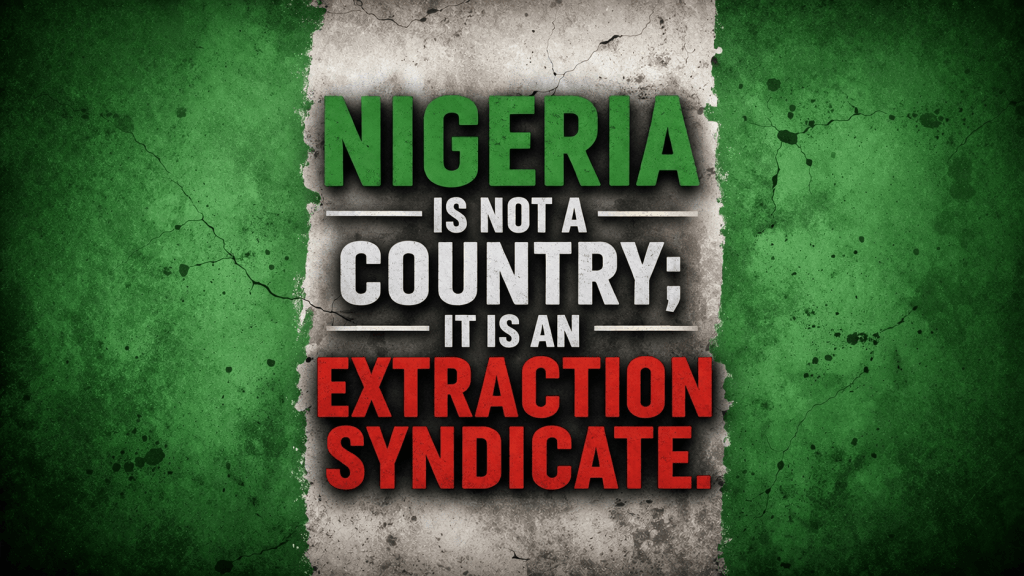
Nigeria is not a Country; It is an Extraction Syndicate

A country is a group of people bound by common laws, with functioning institutions, and a government that harnesses the commonwealth to support the development of citizens and provides a framework to solve collective problems.

The basics human beings need to survive are water, food, shelter, security, and energy. So the first task of any government is to address these needs which are preconditions for other developments.

But since Nigeria’s independence on October 1, 1960, not one of these has been fully solved.

✅ Water system: Is there a reliable water treatment and distribution system? A national water law or 30-year plan? No.

✅ Food: Considering all the arable land, is there agricultural self-sufficiency? A developed agricultural value chain? No. The country is importing food.

✅ Shelter: Is there affordable and accessible quality housing for all classes? A closely monitored national plan? No. Look at the shortages professionals face.

✅ Security: No need to even address this.

✅ Energy: Do Nigerians have reliable energy? No. Since independence, energy has featured in each election, but no government has solved it. Electricity supply is worsening, and even fuel has been an issue.

Leaders and different ethnic groups live under different sets of laws that apply unevenly. Institutions are malfunctioning and unreliable, and leaders extract wealth for themselves, their families, or their ethnic groups. Even citizens participate in this extraction. Here, leaders reflect the collective attributes of the people.

Nigerian people are resilient and promising, and there is much good; but Nigeria as a collective is a complete failure. Thus, unless major changes are made, Nigeria has lost every justification for continuing to exist as a country.

Either upheaval should sweep away the current leadership class and inaugurate a new era of nation-building visionaries, or, from the outside, an iron fist should enforce the dissolution of this country. There can be no in-between, as all half-measures will only be resisted by entrenched interests seeking to keep the country in a low state of development.

And I do not want to hear about colonization and the ghosts of Christmas past, we must take responsibility and stop blaming others for our collective failure.

Everywhere you turn in Nigeria, there is unhealthy extraction and rarely productive value that builds lasting institutions or solves real needs.

It is time for soul-searching and bold action. Those with furthering values and a heart of service need to step forward to help turn the tide. The same also applies to most African countries. The qualities needed to bring lasting changes are:

Noble aggression and righteous fearsomeness.

These qualities, guided from above, are what bears the volcanic heat capable of initiating a collective reset to bring about national transformation.

~Dr. Ikenna A. Ezealah
JD, PhD, MBA
Builder of the African Future

The Missing ₦210 trillion from the financial records of the Nigerian National Petroleum Company Limited (NNPCL)

In Nigeria, the Senate Committee has recently identified an alleged ₦210 trillion discrepancy in the financial records of the Nigerian National Petroleum Company Limited (NNPCL) during the years 2017-2023, when the late President Muhammadu Buhari was in office.

How is ₦210trillion missing? Let us do math to consider the value of that money.

1) Consider that ₦210trillion in today’s exchange rate is ≈ $153.3billion.

2) Nigeria’s 2025 GDP was an estimated $285 billion. So $153.3bil/$285bil= $0.5379. Meaning the unaccounted NNPCL figure is about 53.79% of Nigeria’s 2025 GDP.

3) Nigeria’s total national debt (domestic and international) is about ₦153 trillion (~$104billion). Calculated: ₦210tril ($153.3bil)/₦153tril ($104bil) ≈ 1.47%. So about 147% or $49.3billion MORE than the country’s national debt is missing.

4) Worded differently: enough money is missing to make Nigeria debt free today, with $49.3billion leftover to invest in a 12-year development project involving industrialization/manufacturing, infrastructure, education, research & innovation, healthcare, agriculture, and security that would embrace each region.

5) Nigeria’s population is about is about 230 million people. So ₦210 trillion / 230million people = ₦913,043 per person (≈$655–$660 per person) Meaning every Nigerian would receive almost ₦1million if the missing/unaccounted funds was evenly distributed to the people.

6) And it is possible the shortfall is even modest compared to the reality. Just imagine if a forensic audit was conducted to account for historical missing funds of the Nigerian government from independence, or at least the beginning of the 4th Republic (1999). It would enter many trillions not invested in national development for the welfare of the people.

A clarification is needed with proper tracing of funds to account for the discrepancy and every naira that appears missing. It is unfortunate that Nigeria continues to squander its future. We need to get serious as a country to ensure the right leaders are in position who will responsibly use funds solely for the benefit of the Nigerian people.

I weep for Nigeria and Africa. A change is needed.

~Dr. Ikenna A. Ezealah

JD, PhD, MBA

Builder of the African Future

World Bank Praises Nigeria’s Economic “Reforms”

As an African leader the best evidence that you are failing your people in the long-run, is if the World Bank and the IMF praise your “reforms”.

Recently a World Bank Delegation visited Nigeria and commended President Tinubu’s reform drives, noting that it is now a global reference point in their discussions with stakeholders.

Sounds great, until you examine the realities of Nigerians on ground and not what institutions say. Then you will realize such praises amount to nothing. Going further, I challenge anyone to:

Research the developmental policies of all advanced countries! Not what they SAY, but what they DID historically to get to where they are today! If you are honest in your research and analysis, you will conclude that not a SINGLE ONE of them wholly followed policies akin to what the World Bank and IMF proposes to Global South countries. Also, there are even no real success stories of the latter emerging from their challenges using these institutional models. See “Bad Samaritans: The Myth of Free Trade and the Secret History of Capitalism” by Ha-Joon Chang.

Despite this, many Africans are sheepishly hailing the World Bank’s praise of Nigeria’s “reforms” as something great! As evidence of development and progress! How delusional and illogical many Africans are when it comes to the capacity of calm objective examination against the backdrop of historical evidence.

I say to you: do you know the best way to achieve African nation-building? Listen to EVERYTHING the World Bank and IMF says, then do the OPPOSITE. Then real sovereignty, prosperity and long-term success will be yours!

Do you really believe these institutions want you to reach your developmental peak, to later become a competitor to the Western countries who fund them? Do you not understand the real goal of all their policy proposals? It is to:

1) Provide enough development to keep you mediocre with enough purchasing power to buy the goods and services of advanced countries;

2) Ensure your country becomes a permanent market for secondary goods;

3) Maintain the low prices of raw materials and their exporting;

4) Skillfully undermine every mass industrialization and manufacturing endeavor.

5) Open domestic sectors and critical assets to the mass privatization of foreign capital ownership.

No one can challenge these words without contradicting themselves. For they stand as immovable truth, as ungainsayable facts of objective reality!

African governments even relying on policy reform advice from these institutions is proof of incompetence. Africa, you must use your own brains, think your own original thoughts, and chart your own course to prosperity! Where are your experts, think tanks, and industry specialists locally and in the diaspora? Why the inferiority complex that is so eager to follow the advice of foreigners instead of your own experts? Africa if we wish to progress, we must change this attitude, look within, and follow home-grown developmental policies. Then we will achieve real sovereignty!

~Dr. Ikenna A. Ezealah
JD, PhD, MBA
Builder of the African Future

Tinubu Taxing the Poor While Billions Vanish: Nigeria’s Fiscal Contradiction and 30 Cases of Unaccounted Public Funds Since 2015

In response to Tinubu’s Tax Regime, a Nigerian X user “Olusegun Bakare” listed instances of missing funds due to instances of fraud, and highlighted the contradiction of taxing Nigerians while the looters of the money are walking free. Initially he listed the following:

—128 billion electricity fraud
—210 Trillion CBN fraud
—3 billion on fake airline
—Over N6 trillion missing in NDDC

Next, another X user “SizZzle.” asked Grok (X AI tool) to “name 15 Instances where Massive amounts of money have gone Missing or unaccounted for by Nigerian Govt Parastatals from 2015 till date”. Next, he asked Grok to “Expand it and Add 15 more separate Instances.” Finally, another X user “DePrayze” asked Grok to “give us a sum total of all the 30 instances you listed(naira and also dollar).”

The result: Grok provided 30 instances of reported missing or unaccounted funds, based on public reports which may include estimates, and totaled them using 1 USD ≈ ₦1,440 exchange rate. The list and total amount is as follows:

30 Instances of Missing/Unaccounted Funds by Nigerian Govt Parastatals from 2015 till date

  1. Dasuki Arms Deal: $2.1B (2015)
  2. NNPC Unremitted Oil Funds: $20B (2015)
  3. Ikoyi Apartment Cash: $43M (2017)
  4. Maina Pension Scam: N195B (2017)
  5. JAMB Revenue Fraud: N5.8B (2018)
  6. NNPC Missing Funds: N316B (2018)
  7. NDDC Mismanagement: N81.5B (2020)
  8. COVID-19 Funds Probe: N100B+ (2020)
  9. Humanitarian Ministry Scandal: N585M (2023)
  10. Nigeria Air Project: N85B (2023)
  11. Emefiele CBN Fraud: N1.3B (2023)
  12. $3.4B IMF Loan: $3.4B (2024)
  13. Power Ministry Funds: N128B (2025)
  14. NDDC Missing: N6T (2025)
  15. CBN Alleged Fraud: N210T (2025)
  16. ⁠Malabu Oil Scandal: $1.1B (2017)
  17. Babachir Lawal Scam: N544M (2016)
  18. Ahmed Idris Fraud: N109B (2022)
  19. Fuel Subsidy Scam: N2T (2015-2019)
  20. Excess Crude Account: $2.2B (2015)
  21. NLNG Dividends: $11.6B (2015)
  22. Chinese Loans Diversion: $600M (2015)
  23. Police Pension Fraud: N32.8B (2015+)
  24. Kerosene Subsidy: Billions (2015+)
  25. Immigration Scam: N1B (2015)
  26. Stella Oduah Scandal: N255M (2015)
  27. Farouk Lawan Bribery: $620K (2015)
  28. Ex-AG Fraud: $6M (2025)
  29. Ngige Corruption: Undisclosed (2025)
  30. MTN Bribery Case: N500M (2016)

Total: Approximately ₦890 trillion Naira and $618 billion USD (using 1 USD ≈ ₦1,440 exchange rate).

Bear in mind these are only a few instances from 2015 of publicly reported figures and some estimates, which do not include many other known and unknown cases by government officials at the Federal and State level. Imagine what the figures will be if we do a forensic audit of Nigeria from independence in 1960, through the corrupt military rule, and from the 4th republic till date. The figures across all ministries, governments, and individuals will be a horror show! Perhaps easily exceeding $10Trillion! Nigerian governance is truly a crime scene! Imagine what blessing the Nigerian people would experience and benefit if those funds were responsibly applied for national development for the collective welfare?

What will it take to reverse course? Do people need to go to prison or start entering coffins⚰️? Besides “individual change of hearts”, more incisive means are required. I have consistently repeated that Nigeria cannot properly develop to its potential with Western democracy, but it needs a different home-grown system. People keep arguing about this but the catastrophic results speak for itself!

Besides other measures, Nigeria needs a disciplinarian nation-building visionary who operates with iron-fisted draconian severity in the inviolable imposition of strict national order… whether anybody likes it or not! The harshness of the purification measures that is to deal mercilessly with governing rascality which, to the weak-minded will appear as cruelty, is actually the medicine 💊 of loving service that Nigeria needs to heal and progress on the right path!

So genuine love in servant leadership in Nigeria’s 🇳🇬 current degenerate condition will be experienced as the corrective force of the Hammer of Justice and the Cold Steel of Severity, that is needed to balance and order Nigeria. It is when the hardness of fearsome consequences becomes an enforced norm that a suitable environment will be established for real long-term development and progress in Nigeria.

A change is needed. And while it starts individually from within, bold collective action by progressive-minded citizens with a good volition who are genuinely committed to the collective welfare and progress is needed for Nigeria to change course.

Onward & Upward!

~Dr. Ikenna A. Ezealah
JD, PhD, MBA
Builder of the African Future

Related Links Below:
1) https://x.com/theboyisgreat/status/2008544594179313969?s=46
2) https://x.com/n6oflife6/status/2008676481820749832?s=46
3) https://x.com/n6oflife6/status/2008677157435044031?s=46
4) https://x.com/de_prayze/status/2008923449578696740?s=46

What is the root of Nigeria’s (and Africa’s) problem?

Addressing the root of Nigeria’s problem.

I watched a video discussing a root of Nigeria’s developmental problem to be inaccurate census data, whereby the government cannot accurately plan and provide support for those it cannot count. Think infrastructure capacity as an example. In response to this video, someone rejected the premise and instead blamed Nigeria’s developmental woes on the familiar villain “corruption”.

I have long since deeply reflected on this topic. So, stirred by the video and the reaction, I penned my reflections. May the inscribed words open new paths of contemplation for Nigerian’s and Africans to progress toward the ideal!

The lady’s points are valid. However, inaccurate census data is not the root problem, but a factor. Corruption too is not and has never been the root problem, but rather only a symptom of the problem. Let me explain. There are three layers of problem analysis: cause, symptom, and factor.

A root cause is the origin; a symptom is the direct effect of the cause; and a factor is the secondary effect of the cause and a direct effect of the symptom. 

So what is the root cause? Simple but fundamental: a lack of genuine love for the people. Most officials in government and the citizens themselves lack a genuine love for the people and country. The burning love that is consuming, infectious, and is directed toward all, and not limited to little family, kin, and tribe! The consequence of this lack of love is the symptom we experience in government as corruption.

Love wants to service and give, lack of love wants to be served and take! Public service turns into the public being at one’s service. Take a simple example:

If a mother has 3 starving children that she loves and you give her $100, what will she do? She will spend every penny to feed them! Because she loves them and wishes only for their welfare. But if she takes it and goes partying, or buys shoes while her children starves, then she lacks real love for them. So the corruption of her extravagance is only because she lacks real love! Then her not keeping up with what the children need (inaccurate data) is only an outgrowth of her extravagance (factor of her corruption). Do you see?

Nigerians have been allowing people (through election or force selection via rigging) in office who do not love the people and are committed to their welfare! The outcome from that is bound to be corruption.

We should not chase factors or symptoms, but go to the root: genuine love! Nigerians should find and support people who have this genuine love that burns within them like a surging ocean of flames 🔥. A love that only desires to serve with whole heart, for the welfare of that which is loved (the people). In love is light and development, just like the rays of the Sun brings to Nature. In love are the creative visions for collective progress, and the victorious strength for their implementation!

(For a few of many good examples of strong nation-building leaders who governed with a firm love for their people, research the details of Osagyefo Dr. Kwame Nkrumah of Ghana, Sir Seretse Khama of Botswana, and Lee Kuan Yew of Singapore!)

Then there is a separate conversation of the needed fashioning of institutions and systems that separate and check powers once the right person who loves is governing. Essay for another day! 

Jesus is written to have said “I am the Way, the Truth, and the Life, no man cometh to the Father but by Me.”

How does this apply here? Jesus is the Love of God, so the way to genuine progress and ascent inwardly and outwardly is through love. For Nigerians to find the way to positive development, they therefore must seek ye first “genuine love”. In love is the way, truth, and the light of progress. This is not an opinion or religious thought, but an explanation of Holy Law governing the Universe and every aspect of human existence for eternity!

So the main thing for Nigerians and Africans to progress is to inwardly turn to God in love, awaken love for their neighbor and country, and support those with a genuine love for the people for leadership. Then the Rays of development, like the luminous rays of the Sun, will shine on Nigeria and Africa, dissolving the impurity of corruption, and leading to a new beginning of robust growth for the welfare of the people.

Then the faces of Nigerians will radiate pride and joy, as a consequence of their own love that is reflected in the deeds of love in leadership. May God grant it!

Onward & Upward!💫

~Dr. Ikenna A. Ezealah, PhD, MBA

Builder of the African Future

JD….loading.

First Lady Hosting Dinner Party Amid Nigerian National Crisis

The Nigerian political infrastructure, with few notable exceptions, has become infected by self-serving, myopic, and low-voltage personalities who govern with callous indifference to the plight and despair of the Nigerian people.

Take a recent example captured in this video!

In Nigeria, amid rising insecurity, escalating terrorist kidnapping of school children, killings of civilians by bandits, the public and humiliating execution of Brigadaire General Musa Uba by ISWAP, the boundless anguish of victimized families, the crippling economic conditions, the diminishing morale of Nigerian soldiers, and the general loss of hope by Nigerian’s for a brighter future…

Amid all of this, what is the priority of the First Lady of Nigeria? Hosting a dinner party for elites! To be feasting and laughing while the people need help and support. How dare you insult the plight of the people with this careless act? And do not gaslight Nigerians by pretending to discuss important matters over “sumptuous dinner”, for the entire historical precedence of the country contradicts this possibility. What we can expect is politicking for 2027 elections!

President Tinubu needs to call himself and the First Lady to order!

One of the few who spoke like a real leader is Senator Abaribe of Abia State at the Senate session, I recommend people watch his speech!

Besides, the “Office of the First Lady” is not even Constitutional in Nigeria, so you have no legal right to use that designation to gather Senators to discuss matters of the State!

But since many Nigerian officials, and also the First Lady have lost recognition of their duty, I am now compelled to speak for the people and remind them!

The First Lady is meant to be guardian of the flame of national values and virtues. She is meant to be the moral compass that points to higher qualities in times of darkness to inspire light, confidence, and hope.

That is the task of a First Lady! Translated to the present context of Nigeria, what can be done is leading a feminine task force with provisions and services to the people in affected areas. If one insists on private dinner, then invite the spouses of soldiers who died fighting terrorism and the families of the kidnapping victims to Aso Rock for an event to honor, commiserate, and strengthen them. To speak life into them and demonstrate that the country sees them, loves them and stands with them! These are two examples how you can ignite the flame of national values in times of darkness. Stand on your duty!

Why do you Nigerian officials forget the people? Why do you not help and protect them? Why are you so numb in the face of such suffering? Wake up and take up your duty or one day the ray of upheaval will reach you! Then, according to the Law of Reciprocity, you will receive the same support you gave Nigerians in their time of suffering … indifference! Remember this and wake up!

In service!

~Dr. Ikenna A. Ezealah, PhD, MBA
Builder of the African Future
JD loading…

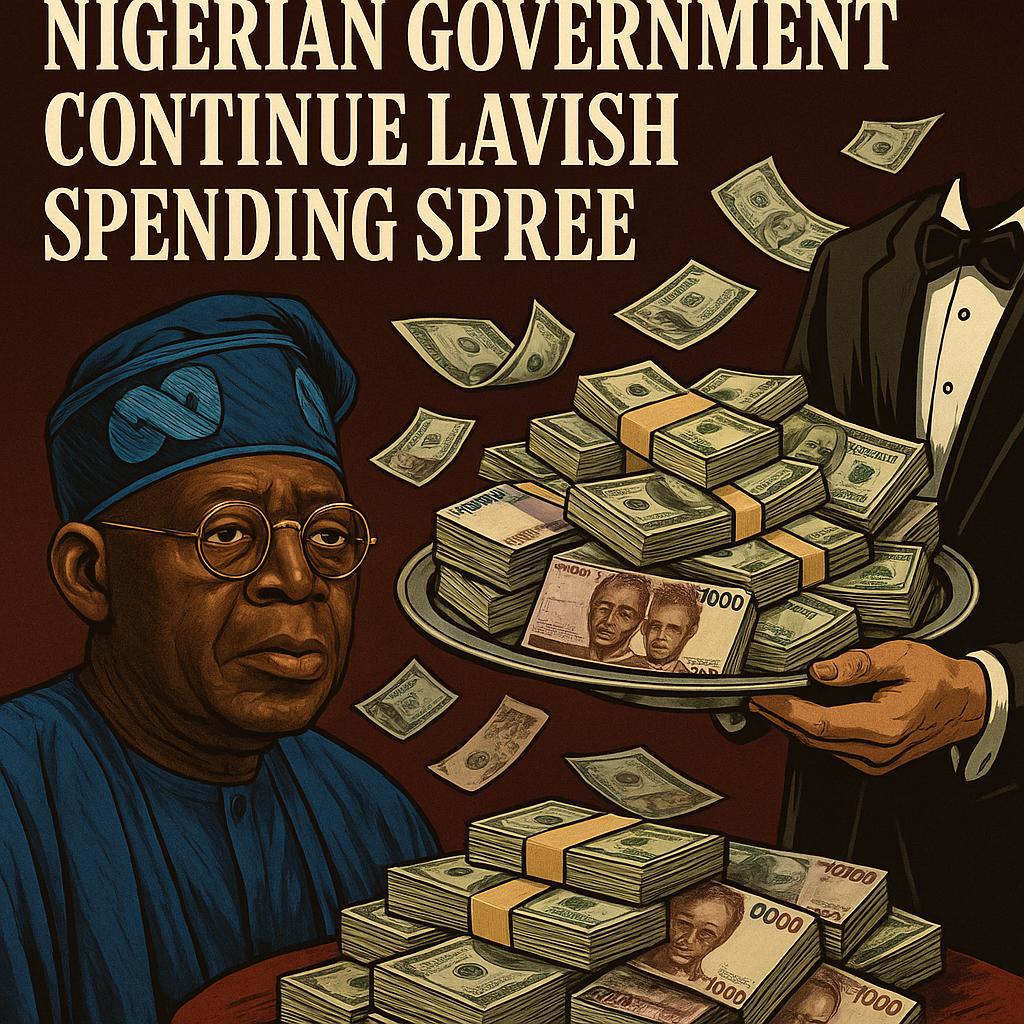
Tinubu Administration and Nigerian Government Continue Lavish Spending Spree

President Bola Tinubu has written to the National Assembly requesting approval for loans totaling N40.5 trillion ($28.93billion USD) for 2025-2026. The borrowing plan is a multi-currency facility which amounts to:
-USD $21.5 billion
-EUR €2.2 billion
-JAP ¥15BN
-EUR €65 million in grants

N40.5 trillion at 1,400/$1 = $28.93billion USD

This comes after he signed the N54.99 trillion 2025 Appropriation Bill into law to become the 2025 National budget, which kept increasing as follows:
—Initial proposal: ₦49.7 trillion (Appropriation bill by Tinubu)
—Increase by Tinubu: ₦4.5 trillion
—Revised proposal: ₦54.2 trillion (by Tinubu)
—Increase by National Assembly: ₦750 billion
—Final Approved Budget: ₦54.99 trillion

But it goes further! All this follows a set of six major World Bank loans requested by the Tinubu government which was approved for Nigeria in 2024, totaling $4.25 billion:
1) June 2024: $2.25 billion
—Nigeria Reforms for Economic Stabilization to Enable Transformation (RESET) Development Policy Financing – $1.5 billion;
—Accelerating Resource Mobilization Reforms (ARMOR) Program-for-Results – $750 million.
2) September 2024: $1.57 billion
—Primary Healthcare Provision Strengthening Program (HOPE-PHC) – $500 million;
—HOPE Governance Project (HOPE-GOV) – $500 million
—Sustainable Power and Irrigation for Nigeria Project (SPIN) – $500 million
3) December 2024: $500 million
—Rural Access and Agricultural Marketing Project – Scale Up (RAAMP-SU)

So the Tinubu Administration is requesting a loan total almost three-quarters of the 2025 national budget (N40.5 trillion/N54.99trillion = 0.737; 73.7%)? And almost seven times the World Bank loans given in 2024 ($28.93b/$4.25b= 6.81).

My collection of two of every animal is almost complete!

Questions:
—Has any regular Nigerian felt the benefits of all these loan monies besides soaring prices and decreasing supplies?
—Do you think Nigerian politicians will use this money to “serve and uplift” or “pack and eat”?
—Is this governance or stockpiling for the 2027 elections?
—Details matter, for example Tinubu getting ₦10 billion ($6.25m) for solar power at his Presidential Villa. Why not invest money to provide power for the people to ease their affliction?
—Why is the Nigerian government so wasteful and greedy?

Maybe Nigerians should lobby the Trump Administration to defund the World Bank just like USAID. To then force the Nigerian government and other African countries to live within their means… or internally collapse. With the tap of milk and honey dwindling, it would then make it easier for true leaders and revolutionaries to take full possession of government and start building a brighter future.

Nigeria has become a jungleocracy with an ineffective National Assembly (few exceptions) that is practically useless. It is a government ran mostly by marauders. People whose idea of public service is to make the public their servants and for public money to be at their service.

A lavish feast is being organized and Nigerian citizens are not invited. The younger generation must brace up to eventually pay back all these loans. Potentially even at the cost of building their own futures. What a high price to pay for allowing vandals today to rob your tomorrow.

What will it take to move Nigeria forward? The answer to this question and what is burning in the spirit cannot be discussed on LinkedIn and WhatsApp. But only in an underground bunker you need a secret password to enter conveyed only by a messenger pigeon. In a dimly lit room encircled by candles with incense burning in the background. And from a dark corner a group of hooded monks chanting cryptic Gregorian hymns just to elevate the spook. Hatching clandestine plans at the beginning of whose execution heavenly trumpets starts blowing from the Eastern cosmos. For Nigeria needs miracles, magic, and exorcisms to progress.

Dramatic yes. Point is a reckoning is coming, because something has to give. And it will. For clearly these people in office are not serious about nation-building.

~Dr. Ikenna A. Ezealah

References:
—People’s Gazette https://gazettengr.com/tinubu-seeks-another-n40-trillion-foreign-loans-as-nigerias-revenue-crashes-amidst-investors-exodus/
—Nairametrics https://nairametrics.com/2025/04/11/nigerias-debt-to-world-bank-surges-by-2-36-billion-in-2024-after-approval-of-six-loans/
—Channels TV: https://www.youtube.com/watch?v=b1emxYhQmRI
—Budgit: https://budgit.org/post_infographics/2025-fg-approved-budget/

Addressing The Recent Change In Nigeria’s National Anthem

Recently, the Nigerian President led a campaign and signed into law a change in the national anthem. The previous national anthem “Arise, O Compatriots”, created by five Nigerians and then was put to music by Benedict P. Odiase, is now replaced by “Nigeria, We Hail Thee”, which was written in 1960 by British expatriate Lillian Jean Williams and was initially adopted as Nigeria’s national anthem when the country gained independence on October 1, 1960.

“It is my priority” the President said, as citizens were given no input or involvement in the process. A minor issue was prioritized, despite major issues and urgent national priorities troubling the lives of the Nigerian citizens such as inflation, skyrocketing cost of food, inconsistent power, insecurity, dilapidating infrastructure, underfunding of education, departure of multinational firms, the downward spiraling economy, and much more. This move, reflecting misplaced priorities, poor timing, and a myopic insensitivity to the historical backdrop of the British colonial legacy by reimposing an anthem on Nigerians that a foreigner created and not the Nigerian people, is tragic evidence of lack of leadership and vision. An anthem is too personal for a people to be outsourced.

The words of “Nigeria, We Hail Three” were touted as being more inspirational and befitting. But no matter how inspirational the words of any chosen anthem are, the real question is: do the actions of the Nigerian political class as representatives of the citizenry reflect it? No! Can you find traces of respectable value system in most from the political class that gives meaning to the words of the national anthem? No! In the now former anthem, the first word is “Arise”, which is to awaken to higher vision, values, and sense of duty. To transcend ethnicity and petty politics, in order to listen to the call of service that, through diligent implementation, furthers the welfare of the whole. How many citizens and political leaders in Nigeria’s history up to the present can say they have even fulfilled this first word? Words change conditions only when practice empowers them to manifestation. The new anthem will not change the behavior of the political class, so instead of changing anthems the right move would have been to look within and change. If this proved too difficult, then it is the poor leadership and the political class that should have been changed, not the anthem.   

Moving beyond constructive criticism and notwithstanding the atrocious timing of the change in national anthem, I will now offer a solution and explain how a change in the national anthem can be approached that would encourage greater inclusive and a sense of collective ownership. Here are the ten recommended steps to properly changing the national anthem:

  1. Host an open townhall with members of the public from all levels of society, government officials, organizations and civil society.
  2. Make a live case to the people. Describe the origin, meaning, parties, timeline, and development of the anthems within the historical context of the country’s history, then share reasons why a change is necessary.
  3. Invite comments, questions, healthy debate, and exchange of diverse ideas so people are included in the purpose and process.
  4. Announce a “National Anthem Rewrite” initiative in which the Nigerian citizens are encouraged to create and submit a national anthem, and a recitation video to a national commission and on social media. The objective is to empower the Nigerian people to take ownership, unleash their creativity, and ensure the recited words of national pride arise from their spirit!
  5. All created anthems will be reviewed, finalists will be selected, then one chosen; or different elements of some can be combined to create one whole anthem. A citizen’s commission will adjoin the national commission to participate in the decision-making process.
  6. The bill introducing a change to the national anthem will then be presented to the National Assembly, where it should be passed after some discussions.
  7. A signing ceremony will be organized with members of the public from all levels of society, government officials, organizations, and civil society.
  8. A band/group comprising different tribes and regions of the country will be composed to sing, record, and perform the national anthem.
  9. The author(s) of the anthem, the public, and others will be invited to Abuja for the first live performance of the group in a day of national unity. The event will also feature performances by Nigerian artists, poets, and comments by civic and academic leaders. The author(s) in a ceremony will be given an award(s) by the President in recognition of their creative contribution to the country. Then, the multiethnic group garbed in their native attires will sing it live for the first time. Their voices, united with the audience, will reverberate proudly through the Nigerian ether!
  10. The lyrics will be engraved in a large plaque and decoratively mounted tall in a wall in the Statehouse Aso Rock Presidential Villa and the National Assembly Complex.

This way, the Nigerian people are involved, centered, and use their own abilities to define the meaning of their anthem instead of a foreigner. It is indolence, lack of vision, and want of creativity that makes African leaders always ready to adopt foreign ideas, systems, and institutions, without the indigenous impetus to harness the abilities of their people, build on their cultural heritage, and create something original.

Here, many will remonstrate, saying “Nigeria was not named by Nigerians, must we change that too?” If we are serious, yes! How did Nigeria get its name? According to Richard Bourne in his book:

“The name ‘Nigeria’ had been coined by his [Frederick Lugard’s] wife and admirer, Flora Shaw, colonial editor of The Times, in a letter she wrote to her paper in January 1897. She used it to define the territories abutting the River Niger that were then being traded in or claimed by the Royal Niger Company” (Nigeria: A New History of a Turbulent Century; p. 3).

Thus, Nigeria was named not with any historical symbolism, rich cultural meaning, or existential ideal for its future development, but based solely on a colonial convenience of grouping people together in relation to a landmark! And you my people conveniently accept that and even defend against any change because you have grown “accustomed” to it? How deep have we sunk in Africa! Now contrast this with the reason that Dr. Kwame Nkrumah gave in his autobiography about renaming the Gold Coast “Ghana”. He spoke about how in the very early days of the Christian era before England was important, his African ancestors had attained a great empire:

“It is said that lawyers and scholars were much respected in that empire and that the inhabitants of Ghana wore garments of wool, cotton, silk and velvet. Thee was trade in copper, gold and textile fabrics, and jewels and weapons of gold and silver were carried.

“Thus we may take pride in the name of Ghana, not out of romanticism, but as an inspiration for the future. It is right and proper that we should know about our past. For just as the future moves from the present, so the present has emerged from the past. Nor need we be ashamed of our past. There was much in it of glory. What our ancestors achieved in the context of their contemporary society gives us confidence that we can create, out of that past, a glorious future, not in terms of war and military pomp, but in terms of social progress and peace.” (The Autobiography of Kwame Nkrumah; p. 195-96)

What a difference of day and night in the naming of “Ghana” and “Nigeria”! One rich in historical meaning and an inspiration for the future, while the other is just a geographic convenience lacking substance. Perhaps the difference is that Ghana has had the fortune of a visionary leader at the head of government, while Nigeria has not! Nigeria has even historically worked hard to ensure its most talented and industrious citizens are deprived of every opportunity of leading government, so that an avaricious cabal of tribalistic, vacuous, and visionless officials can continue plundering the national coffers while pushing the people in penury toward the abyss of infamy. How will a change in anthem effect a change in this rot? A gargoyle that changes its shirt is just a gargoyle in a beautiful shirt. Except here the shirt is now “foreign made”.

To effect change in Nigeria and Africa, our leaders need to become scholars of history in addition to an elevation in values and thinking, so our present actions build from the past. Follow me therefore on a quick diversion to explain the meaning of “Ghana”.

Ghana was a kingdom of the Soninke people, who are the northernmost people of the great Mande family that occupied a territory close to the Sahara desert. To properly situate Ghana in Ancient Africa, we should be clear of ethnic clusters in that the Soninke, Malinke and Bambara belong to a group referred to as Mandingoes or Mande-speaking (The History of West Africa; p. 15-18). This is important because when interpreting historical records, the same kingdom might have been referenced with slightly different names and meanings by the people, only because the descriptions might arise from different languages of ethnic groups in the same or different broader family. This notion applies to Ghana because historically there are two traditions (perhaps more) that mention a great Soninke kingdom of gold with the names Wagadu and Kaya-Magha, which preceded the Mali Empire and its preeminent leader Mansa Musa!

In one tradition, Wagadu was a prosperous kingdom blessed with vast quantities of gold with its capital at Kumbi, and its kings bore the title of Magha or Manga. The other tradition arose out of Ta’rīkhs (Arabic texts) from Timbuktu that mention the kingdom of Kaya-Magha as predecessor of Mali, one of these texts name the capital city Qunbi (like Kumbi), while the other calls it Ghana. Kaya-Magha in Soninke language means “king of gold”. However, in Malinke, Gãna or Kãna means war chief (The History of West Africa; p. 120). Ghana was called ‘the land of gold’ by some Arab geographers. Although people use the name Ghana interchangeably for both the kingdom and capital, al-Bakrī says in his text that ‘Ghana is the title of their kings’. The ‘ghana’ was the “king of gold” and powerful protector “war chief” who ruled the land of gold, with its thriving people, social order, beauty, systems, and advancements!

Do you see the depth of thought the Osagyefo Kwame Nkrumah gave to the choice of name? How the name and concept can awaken pride in the people? Not flippant and superficial, but deep and introspective. Do you see how he insisted and persisted to reclaim the sovereign right to rename his people according to their rich heritage, and as a signpost for continuous progress? So, why does the Ivory Coast, Nigeria and others still bear their names of colonial humiliation? As a country we gain independence, yet we lack the strength, insight, and self-respect to choose our own name with relevant meaning and create our own original systems. Complacent in the comfort that it has become “customary”, we avoid the discomfort of making changes and instead choose the indolent road of either keeping things the same, or to make a change we look abroad for what we can adopt from others!

Look at Nigeria: a British education and legal system complete with judges still wearing the ridiculous colonial wigs. We are black people in Africa, the British have left, and we still insist on wearing white wigs as a symbol of our “colonial legal tradition”, even though US white American descendants of Europeans, who have a greater claim to wig-wearing due to racial homogeneity no longer perpetuate that custom. Yet it is us as black people who thoughtlessly still insist on wigs. Absolutely incredible! If original thinking is too challenging then, being facetious, we can at least wear a black African wig that resembles African characteristics!

In governance Nigeria initially adopted the British parliamentary system, and then to make a change switched to the US governance system. Where are the original systems of Nigerians and Africans? What new institutions and structures? Are we just copycats who must rely on Europe and the US for everything? And with the emergence of China will we copy them too? Under poor leadership and an apathetic citizenry, instead of looking within to produce originally, to make a change we always look abroad to copy as a certified stamp of personal humiliation. We were given free will and a brain, thus the capacity to choose and think for ourselves… it is time to creatively exercise both! We are a great people, so it is time to give life and cultural expression to our vibrant abilities as a people rich in heritage and potential!

How can an African hold the seat of leadership, then simply continue the status quo and not earnestly strive to make a change, but content with an adopted name, anthem, systems and all. Never should you accept it, for your sovereign right and indigenous pride as an African leader should forbid it! Leaders of Africa, stand up and straighten your backs or give way for others who are willing to! It is high time to awaken to high deeds and work diligently… for the self-respect, welfare and indigenous progress of the people!

The issue stated here is beyond naming, but the earnest process of Africans using their own indigenous abilities and heritage to guide all progressive developments connected with themselves and their environment! It includes name, culture, systems, institutions, architecture, theories, and everything else. The people have the right and sacred duty to participate in the forming of all symbols, systems, and institutions of their country. Here, in addition to misplaced priorities, the Nigerian government woefully failed and deprived its people from cooperating by using their own abilities to creatively form a new anthem and thus design a national meaning from their own inner beings.

Wrong and shameful, poor leadership lacking in vision, this is the sentencing of the Laws of Nature and many Nigerians, for which my words are the iron gavel that pounds in judgment! Wake up…Arise O Compatriots!

~Dr. Ikenna Ezealah