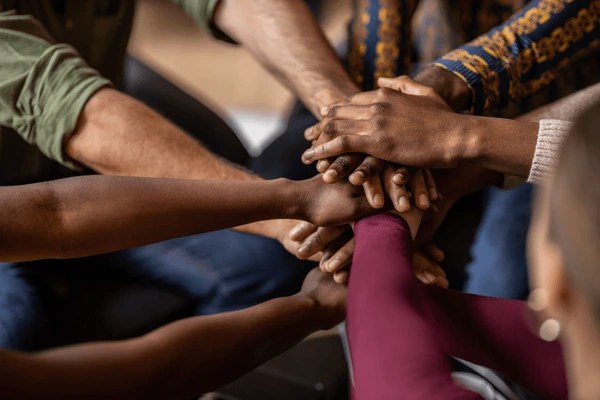
Addressing The Rift Between Mainland Africans And African Americans

The rift between Mainland Africans and African Americans is troubling. Each looks suspiciously and accuses the other of ill-treatment, condescension, ancestral betrayal, underperformance, indifference, ethnic isolation and more.

Whining over small matters like children with wounded vanity and false pride. It is a pitiful game of ego and small-minded petulance in which both sides are missing the bigger picture!

Namely, the rift ensures their continued mutual subservience to the same global order that enslaved one and colonized the other, and which still exercises undisputed suzerainty over both through entrenched systems and institutions. Instead of leveraging their strategic advantages and unique strengths for shared advancement toward a high aim, they prefer bickering and licking their wounds.

Both sides live under a sinister delusion that they can advance and reach their potential without the other! However, let me be clear: neither can fully overcome their challenges and reach their developmental potential without working together. You are brothers and sisters, ancestrally derived from the same ethnic groups, separated by tragedy, shaped by unique experiences, yet connected by the blood from the same creative African spirit that still flows through your veins!

Mainland Africans: African Americans technical skills, experiences, and strategic positioning are needed for Africa’s next stage of development. Some of the issues you have can be resolved by your siblings from across the ocean whose help and cooperation you sometimes stubbornly reject.

African Americans: Africa is the headquarters of your identity, your homeland and powerbase. Approach it with humility and make a serious effort to ethnically integrate while avoiding the savior complex. Recognize that in Africa are the minerals, resources, governments, and organizations that can strengthen your economic and political position. Many of the issues you face can be resolved by coordinating with your siblings in Africa from whom you often disassociate.

Will collaboration be easy? No. Will it have great challenges and setbacks? Yes. But it is necessary for the mutual advancement of both parties. Remember that every great aim has difficulties, but it is the unshakeable commitment to the high goal that enables all trials to be successfully overcome!

Mainland Africans and African Americans, it is time to honestly resolve the rift, set aside petty differences and work together for higher aims. We are interdependent, capable of helping each other overcome challenges and advance if we collaborate with openness, respect, and patient determination. We are one people, consanguineously interlocked by the unbroken thread of a common heritage, our destinies are tightly interwoven. Let us focus on higher goals that unites us and move us forward as brothers and sisters!

And remember, no matter how long the prodigal son was away, when he returned to his father, his time apart did not change his place as a reunited son and sibling—embraced without hesitation, restored to family! Remember this and work together!

Onward & Upward!

~Dr. Ikenna A. Ezealah, Ph.D., MBA
Builder of the African Future

March 6, 1957—The Birth of An Independent Ghana

Happy Independence Day Ghana!

On this momentous day, March 6, 2025, I join the people of Ghana and the Global African community in celebrating the anniversary of Ghana’s independence, achieved under the leadership of the Osagyefo Dr. Kwame Nkrumah! I also honor The Big Six of Ghana (Kwame Nkrumah; Joseph Boakye (‘J.B.’) Danquah; Emmanuel Obetsebi-Lamptey; Ebenezer Ako-Adjei; William Ofori Atta; Edward Akufo-Addo)—and all others who contributed to the struggle for Ghana’s political liberation. Their efforts not only secured Ghana’s independence, but also set a precedence for other independence movements across Africa.  

On March 6, 1957, Ghana became the second African country to gain independence. Although it is widely regarded as the first, historical accuracy gives that distinction to Sudan, which gained independence from British-Egyptian rule on January 1, 1956—making it the first African country to gain independence in the year 1956, before Ghana.

Sudan’s colonial administration was unique —it was governed under an Anglo-Egyptian Condominium (1899-1956), meaning it was jointly ruled by Britain and Egypt, rather than being a direct colony of a single European power. So, while Sudan was the first African country to gain independence in 1956, Ghana (1957) was the first African country to gain independence from direct European colonial rule (British Gold Coast).

As a Garvey-Nkrumah Legal Fellow, our delegation visited Ghana and Rwanda in the Summer 2024. After completing our official business for the trip—including a meeting with the President of Ghana—we visited the Kwame Nkrumah Memorial Park & Mausoleum in Accra. The previous Summer, I had read Dr. Nkrumah’s autobiography and had devoted time to understanding him not just as a leader, but as a person—exploring his deeper aims and motivations. This experience was deeply inspiring and further reinforced my commitment to African nation-building!

On July 19, 2024, I stood beside Dr. Nkrumah’s statue, mirroring his forward-pointing gesture that powerfully embodies his famous words: “Forward ever, backward never.” Then I knelt before his grave, filled with different intuitions. Sometimes in life, the most precious things cannot be shared.

“Osagyefo Dr. Kwame Nkrumah, a thousand thanks for your positive example of visionary African leadership, and your unbending commitment for the welfare and progress of the African people. Most of all, your natural reverence for God. These are noble qualities desperately lacking in African leadership today, and we feel the big gap left by your absence.”

I will carry the torch of African progress forward, working diligently to ensure it burns brighter in this generation—singularly focused on the mission of African nation-building!

Confidently I walk the path of destiny—“Forward ever, backward never”—focused upward, forever onward!

Happy 68th Independence Day Ghana!

~Dr. Ikenna Ezealah
“Builder of the African Future”

The Burkina Connection: Sankara-Compaoré-Traoré

On October 15, 1987 (37yrs ago), Thomas Sankara, then President and transformative leader of Burkina Faso, was assassinated in a coup led by Blaise Compaoré, a close associate. Compaoré assumed the presidency and ruled until 2014, when a domestic uprising forced him into exile in Ivory Coast. Five months after Sankara’s murder, Captain Ibrahim Traoré, Burkina Faso’s current President, was born (March 14, 1988).

Blaise Compaoré has since expressed remorse for his role and asked for forgiveness from the Burkinabe people and Thomas Sankara’s family.

Today, many Africans debate whether forgiveness should be granted and if he should be allowed to return to the country. I believe in the power of forgiveness for healing and the salvation of second chances. However, I also urge African people to consider:

How can this situation be strategically leveraged for effective nation-building? What intelligence could be extracted to strengthen domestic defense operations?

As a condition for considering a presidential pardon or sentencing reduction, Compaoré should disclose critical intelligence, including:

  1. Direct Involvement and Support: Did you act alone? If not, who were your collaborators? List the countries, entities, and individuals involved, including their roles and support given.
  2. Foreign Influence: Which foreign countries or agencies contacted or supported you, and how did they communicate? What role did foreign intelligence play?
  3. Detailed Planning: Provide a complete timeline and coordination details of the plan. Who funded, provided equipment, or orchestrated activities?
  4. Promises and Conditions: What were the promises given to you and your collaborators for a successful coup? What terms were set, and what did you bargain for?
  5. Execution and Modifications: Describe how the plan unfolded, including any last-minute changes. Were foreign agencies involved in any decisions or adjustments?
  6. Post-Coup Roles and Policies: What was the foreign involvement in appointing officials and structuring the government post-coup? Describe any foreign-directed policies or programs aimed at reversing Sankara’s initiatives.
  7. Domestic Influence and Control: How did you identify and manage internal opposition? Were foreign entities involved in tracking or suppressing resistance?
  8. Media and Public Opinion: Was there a strategy to influence public perception? How did media, domestic or international, play a role, and who guided this narrative?
  9. Military and Economic Dependencies: What defense or economic agreements were established with foreign nations? Which sectors or policies were influenced by external interests?
  10. Exile and Contingency: Which countries provided exile, and was it part of an initial arrangement? Were backup plans established in case the coup faced resistance?
  11. Potential Collaboration for Redemption: Are you willing to work with the current administration to rectify past actions?

These preliminary are questions that African people can strategically use to extract intelligence from this situation. In exchange, the current government may consider significant concessions. Such intelligence is invaluable, for it would sharpen vigilance and strengthen the defensive foundations of African nation-building.

Onward & Upward!

~Dr. Ikenna Ezealah

How Can Non-Black People Celebrate Juneteeth?

I have observed recent discussions on this topic and seen the range of proposals people have suggested. I typically avoid these subjects because it can sound patronizing, but today I will make an exception and boldly address the fundamental fact for those who are earnest and sincere.

Juneteeth – June 19, 1865, also known as “Freedom Day”, commemorates the emancipation of enslaved African Americans after the Civil War. While I celebrate this milestone, I also see Juneteeth as a day of false freedom, gross deception, economic disenfranchisement, and systematic neglect by the US government.

In a capitalistic society economic freedom is the central freedom. The point of slavery was the mass exploitation and violence of one race by another, for the purpose of the mass accumulation of economic wealth. After the political, economic, and institutional deck with all its benefits had already been stacked against African Americans in favor of their white brethren, a “freedom” was given but without any strong economic policies to rectify the exploitation and reshuffle the deck to support the economic empowerment and autonomy of African Americans, so they could then leverage this might to influence the formation of the State in accordance with their interests. What a joke, but without the laughter.

Contrast this with the land allocation and benefits the government afforded to the white population through the Homestead Act of 1862. Also, with how the US government cared for white servicemen after WWII through the GI Bill (Servicemen’s Readjustment Act of 1944) that provided a range of benefits from education, home loans, unemployment benefits, business loans and much else. It is a known fact that discrimination prevented Black Americans them from accessing the full benefits enjoyed by their White counterparts.

Dr. Martin Luther King Jr. on Federal Subsidies to White Land Owners

So you have no political will to provide economic support for your black population for Juneteeth to “readjust” after centuries of slavery and economic exploitation, but you find this will for land allocation and also decades later for white servicemen so they can economically “readjust” after war. Do you see how disingenuous and duplicitous this is?

In the US, the absolute and exclusive measure of seriousness is how much economic benefit and incentives you are willing to provide! Everything else is minor or smokes and mirrors!

So how can non-black people celebrate Juneteeth?

Reading books and all that has value, but I have a different suggestion. If you are serious, ask a fundamental question:

“How can I leverage my position, connections, resources, and/or time to create opportunities for the economic advancement and empowerment of African Americans?”

This question is all embracing. Thus, your actions should produce, lead to, or create conditions for tangible economic gain. If you do this, then you would have celebrated what lies at the heart of Juneteeth, and only then would you be a real ally of the African American community.

~Dr. Ikenna Ezealah

The Dikko Affair

In October 1, 1983, Shehu Shagari of the National Party of Nigeria was inaugurated for his second term in the Second Republic, following a shady general election that was suspected of rampant fraud and corruption. With the growing resentment, frustrated mood, and increasing impatience with the mismanagement and incoherence of government, the military used this widow of the volatile public sentiment to seize power. 

On December 31, 1983, Brigadier Sani Abacha announced a coup on the radio. A part of the speech is as follows: 

Continue reading The Dikko Affair

A Timeline of Nigerian Independence

For many centuries, numerous tribes and peoples existed in the territories of what is today called “Nigeria”. Time saw the rise and fall of different kingdoms and states, and the constant evolution and dissolution of porous borders between the different peoples. The collective trajectory of this region has always been influenced by a dynamic confluence of internal and externals factors. To sketch a brief timeline of some of these factors that came together to produce the conglomeration known as “Nigeria”, as well as the march of events that led to the transfer of the political power of attorney known as “independence”, is the purpose of this essay. In view of the immensity of information about this subject, this work is naturally not exhaustive.

Continue reading A Timeline of Nigerian Independence

First elected representation in Nigeria

In 1914, Frederick Lugard amalgamated the Northern and Southern Protectorates into a newly formed country called Nigeria. Shortly afterwards, Sir Hugh Clifford succeeded Lugard in 1919 and was appointed Governor General of Nigeria. In 1922, a few years later, the colonial government setup a new constitution colloquially referred to as the “Clifford Constitution”, that was then implemented in 1923.

Continue reading First elected representation in Nigeria

Decisions and consequences: The Obasanjo—Abacha web of fate

In 1963, Sani Abacha was a second lieutenant in the army, and by 1969 was only a major. As a major in the Federal side, he was the subordinate of his contemporaries such as Murtala Mohammed, Benjamin Adekunle (the Black Scorpion), Yakubu Gowon, Olusegun Obasanjo, and Chukwuemeka Ojukwu, among others. But during the civil war, it is documented that Sani Abacha had a breakdown and almost left the army, but Lieutenant Colonel Olusegun Obasanjo supported him and persuaded him to stay. At one point, Abacha’s dismissal papers were on Obasanjo’s desk during the war (due to his breakdown), but he refused to sign it. 

Continue reading Decisions and consequences: The Obasanjo—Abacha web of fate