Essays

The Leader As A Mirror of the People

What is a leader? And how do they emerge? 

A leader is the plant that grows from the soil of the people. As the composition and condition of the soil determines the nature and quality of the plant, so does the condition of a people determine the quality of the leader that emerges from them. It is a basic principle that, before there is any planting and growth, there must first be tilling of the soil. Consequently, before genuine leadership can emerge, the conditions must first be prepared among the people.

A leader is the plant that grows from the soil of the people.

As plants are first within the soil as seeds before they emerge above ground, so are individuals first within the people before they emerge as leaders. And just as the seed extracts nutrients from the ground it uses to grow into a plant, so does a person extract nutrients from the soil of the people that he uses in leadership. Before leaders emerge, they exist within concentric circles of influences within the broader circle of a country. The innermost circle is the nuclear family; the second circle is the community; the third circle is the township within a state; and the outermost circle is the state within a county. The circles are even colored according to the nature of the cultures in question, which express unique concepts and tendencies. These are all layers of influences and characteristics that creates a collective DNA into which a person is deeply embedded, like the soil composition.

However, we must bear in mind the differences in the use of the free will that enables man to overcome any influences, and thus never makes him a victim of circumstances owing to his ability to guide his actions according to his intuitive sensing…if he so desires. Nevertheless, it is the characteristics of this collective DNA to which a person is inwardly connected (and also his free will) that contributes to influence how they grow, and what they eventually express as leaders. Through the leader, the people receive the ripened fruits of their own collective nature. And that is why it holds: a people can only elect their own consciousness. The people fashion the environment that determines the type of leadership they experience, so the leader is a singular reflection of the collective. Thus, if leadership is blamed for all the ills of society without also addressing the heart of the people, you would have more success growing a different species of plant by only cutting the stem, while leaving the root untouched!

Every seasoned teacher has personally experienced how the nature of each class is different, and that the individual qualities of the specific group of students is what mainly determines the collective nature. With a different group of students, the nature of the class also changes! The “nature” of the class, i.e., the group of individuals, creates an “energy-field” the outsider calls “culture” or “class personality”. The culture, being an energy-field of a collective characteristic, fashions an environment in which certain qualities predominate and are reinforced in their expression. The culture here is analogous to the environment the inner qualities of the people creates which enables certain type of leaders and institutions to emerge.

Another example is to consider are a group of people gathered in a restaurant, and who have a marked superficiality. Should an earnest person join their discussion, it follows that the trivial nature of the group will make the presence of the earnest one an irritation or a “bore”, because their energies do not match. The collective nature of the group is the culture their inner qualities create which reinforce and admit others of a similar disposition, but which repels other earnest qualities. The group, now composed of mismatched energies and is no longer “relaxed”, will disband in either two ways: the earnest one leaving, or the others cooling off and finding a reason to depart early. This simple illustration answers the question why certain leaders cannot easily emerge among certain groups of people.

The leader is the crowning reflection of the predominant tendencies within a people; the leader is a mirror into their own collective nature. Even the institutions that come to govern a people through leadership is a physical build-out of their own inner qualities. In Nature, mushrooms are decomposers of the ecosystem that, during spring, sometimes sprout overnight from the ground. So whenever there is decomposing matter in the soil, mushrooms will sprout in that area as a physical reflection of this process. Similarly, the leadership and institutions that “spring up” around a people directly reflect their inner contents, i.e., the qualities in the soil of their souls.

Thus, the leader mirrors the collective qualities of a people, and the people can only elect and be governed by their own consciousness.

As the leader is only a reflection of the collective consciousness, to truly change the trajectory of a country, you must address not just the type of leader but especially the qualities of the people. The root has to be changed that fashions the environment within which the leader germinates as a plant. Each person must look within and start making serious changes there. It is easy to blame one person for all the ills of a society, but this is the convenient action that avoids the personal responsibility of true self-assessment and change. If we look close enough, we will always discover how our collective qualities creates an environment that allows only certain “species” of plants (leaders) to flourish. Seek and ye shall find. Thus, if we seek inwardly enough, we will always find the relationship and see the connections.

Only when individuals become strong enough in their commitment to furthering values will they collectively become a fertilizing agent in their environment. The composition of the soil, thus transformed, will prepare the environment for a new seed to germinate, i.e., for a strong and noble leader to emerge who, as a nourishing plant with rich qualities, will bear fruit and spread blessing among the people. And in the process, the institutions that govern them will also slowly be transformed. Thus, by the people raising the plant of a noble leader on the soil of their own ennobled qualities, the Divine Law is fulfilled: “you reap what you sow”.

The leader is a mirror of the collective qualities of the people.

In the operation of this universal law lies both judgment and fulfillment!

~Dr. Ikenna Q. Ezealah
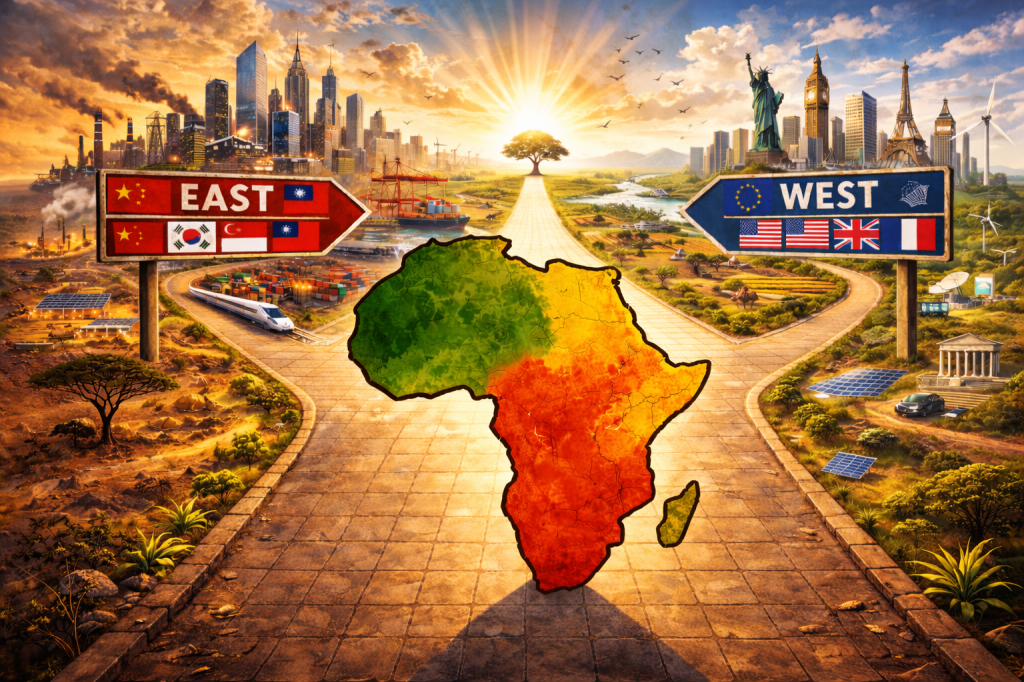
Africa’s Example for Development: East or West?

If Africa wants to lift its population out of poverty to prosperity, who offers a better example to learn from: East or West?

If you want to learn about business, speak to a business owner. If you want to learn how to become a millionaire or billionaire, speak to a millionaire or billionaire. For all three you must not speak to a university professor UNLESS they can show how they applied their theories in REAL LIFE to own a business, or become a millionaire or billionaire.

Over the last four decades, the Asian Tigers + China (China, South Korea, Taiwan, Singapore, Hong Kong) have successfully lifted about 860-880 mil people out of poverty (China alone 800 million).

The US population is about 340mil, Europe about 540mil (minus former Soviet territories). So 340mil + 540mil = 880mil. In Africa, the total population is about 1.5bil people, and the number in poverty is about 500 mil. In real terms, the Asian Tigers and China have lifted about 880mil people from poverty… equivalent to the population of the collective West (880mil) and about 280mil more people than the entire African population in poverty! Also, East Asia is the region of the world with the most countries that have rapidly transitioned from undeveloped/developing to advanced in the last 50-100years!

Thus, if Africa wants to successfully lift its people from poverty to prosperity and transition from undeveloped to advanced, then the evidence shows it should mainly draw lessons from (not copy) the Asian Tigers who are analogous to the business practitioner.

In the last several centuries the West has had every advantage: slavery, colonization, neo-colonization, imperialism, World’s reserve currency, World Bank, IMF, WTO, waged wars, coups, sanctions etc. And the result is still the failure to lift its own people out of poverty in the scale that Asia has achieved. And Asia achieved this primarily without the muchly touted democracy and the other advantages.

Also, China suffered Western (British) imperialism during the “Century of Humiliation” in which, after the Opium Wars, unfair foreign treaties (like the loss of Hong Kong) and forced trade concessions were imposed on them in the dissolution of the Qing dynasty and the loss of sovereignty. And yet China rose and is now a global power. So China can relate to Africa through its experiences with imperialism.

Certainly, there are valuable lessons to be drawn from the collective West, of which is the linkage between development and some form of market liberalization (but closely controlled). However, the Asian Tigers (who initially used ‘Authoritarian’ governments) show that democracy is optional in the march to development. So Africa should not seek democracy per se, but must chart its own course by seeking development through a home-grown form of government that aligns its heritage.

Africa should learn from the East and West, but the East offers a more successful example for Africa’s current context. However, Africa must not copy but learn lessons and chart its own original course!

~Dr. Ikenna A. Ezealah
JD, PhD, MBA
Builder of the African Future

The Basic Principle: Pastor Wins sports betting Then closes church

I saw the following story on my feed and, contrary to my usual interest, I decided to engage it. Whether the story is true or not is not so important, because the basic principle repeats itself in many similar occurrences. My interest is explaining how the Universal Law of Resonance, which operates with mathematical precision in human experiences, can be recognized by the initiated who take time to study and apply it.

Since African nation-building is always my focus and this hypothetical is based in Uganda, I am advancing an approach to assessing events that, if we in Africa endeavor to make a common practice, can help us draw important principles from experiences for self-evaluation (look in the mirror) that will enable us to personally change and thus move Africa forward.

—–

THE STORY: A Ugandan pastor won a large jackpot from sports betting (about 100 million Ugandan shillings) and then suddenly shut down his church. Church members reportedly arrived for service only to find the church locked, leaving them shocked and confused. When contacted, he admitted he was not genuinely called to ministry and had opened the church mainly as a way to earn a living. After the betting win gave him financial security, he said there was no need to continue preaching and abandoned the church ⛪️

—–

THE ASSESSMENT: The Universal Law of Resonance holds that likes attract, so what is within us will draw and hold what is similarly within our neighbor.

Here I pronounced judgment on both Pastor and Congregation. For if the Pastor was not truly called to Ministry and preached only to earn a living, it means his teachings would “lack life” and thus be devoid of intuitive resonance. However, if this lifeless teaching could find resonance by attracting and holding a congregation, then it also means the congregation themselves must be spiritually dead or asleep. Here, the Law of Resonance of lifeless teachings without intuitive sensing attracted and held people whose inner life was lifeless and without intuitive sensing.

If the congregation was “spiritually awake” and had a rich intuitive life, they would be able to sense the lack of intuition within the Pastor and would not be satisfied. Thus, the lack of homogeneity between the genuine need of their soul and the lifeless teachings would inevitably produce a separation since resonance would be lacking. But since this did not occur, then it speaks to the lack of genuine intuition between both parties that formed the basis for resonance.

And herein is the Scripture fulfilled, “Let the dead bury their own dead” (Matthew 8:22), and “one man sows and another reaps” (John 4:37″). So in this collective experience of lifelessness, the dead teachings (no intuitive sensing) buries the dead congregants (lack of intuitive sensing), and one man sows insincerity while another (congregation) reaps deception.

Here the Universal Law of Resonance is fulfilled that magnetically binds both parties together in reciprocal action. And in this… the iron gavel pounds in Judgment!

~Dr. Ikenna A. Ezealah
JD, PhD, MBA
Builder of the African Future

The North Star of Africa

In the following video, Joseph Mapong describes the North Star of Africa:

Ubuntu—I am because we are; knowledge of self.
Sawubona—I see you and I see those that are with you.

This way of living in which your welfare is tied to mine, is the fundamental philosophy of the spirit of African people, that must underlie every policy, initiative, innovation and developmental agenda for it to have long-term staying power and success among the African people.

Moving forward, in all our plans and actions towards Africa, may we imbibe and express the spirit of Ubuntu and Sawubona.

Wishing everyone well!

Onward & Upward!💫

~Dr. Ikenna A. Ezealah
JD, PhD, MBA
Builder of the African Future

The Vicious Cycle – African Governments “shorting” their Currencies

In the following post on LinkedIn, a contributor discussed how African governments are running a “short” on their own currency. He used Ghana as an example and cited how a couple years ago they experienced 52% inflation, and the main contributors were the imports of certain agricultural products since they were brought in dollars. He then urged that Ghana can produce these goods locally to break the cycle.

And the cycle as enumerated by Isaac Marshall in the post was as follows:
→ Sell local currency to import staples in dollars
→ Local currency depreciates
→ Imported goods get more expensive
→ Inflation spikes
→ Banks raise interest rates to combat inflation
→ Local borrowing cost hits 30-40%
→ Domestic companies can’t compete due to high interest rates
→ More imports fill the gap

I reflected on the post above, then drafted the following:

I appreciate the speaker discussing the topic of “African governments…running a constant short on their own currency.” However, he starts this horror movie in the middle and not the beginning! What do I mean? Let’s go to work!

First we must research the loan conditions associated with the World Bank and IMF, which often involve removal of subsidies in key productive sectors of the economy required for self-sufficiency. In agriculture it causes domestic produce to be more expensive than foreign ones (which ironically receive subsidies), thus incentivizing imports. It is only FROM HERE that the horror movie the speaker mentions follows of “selling local currency to import staples in dollars”.

The main issue is not just domestic agricultural production, but especially freeing oneself from the nefarious financial conditions of these institutions who incentivize the vicious cycle. As long as you need money from them, your fate is likely this vicious cycle. We must understand the objective of these institutions is to keep your economy in this vicious cycle!

I recently wrote about these institutions in relation to the praise the World Bank gave the Tinubu Administration in Nigeria for their “reforms”, which will soon be experienced as “deforms”.
https://lnkd.in/gC64cgxc

As revenues from productive sectors decrease, reliance on imports increase. More currencies must be sold, further depreciating its value. Less revenue is less funding for the national budget, so as loans keep increasing as a percentage of GDP, like a cancer the interest keeps metastasizing. If you struggle to pay the loans, you will be compelled to privatize and sell critical national assets and resources for foreign capital ownership. And a weaker currency means more local assets for fewer foreign currencies in a shrewd form of economic colonization. Here we enter stage 2 of this vicious cycle!

We must be perfectly clear: African countries cannot reach their developmental potential by following the policies of these institutions!

You see, us African nation-builders are like a constellation of eyes…we stay watchful!👀

Osagyego Dr. Kwame Nkrumah already saw this decades ago. Ghana was on the path of self-sufficiency. Then some fools overthrew him in a coup, reversed his initiatives, and plunged Ghana into the abyss of economy infamy from which they are today still trying to resurrect. Today some African
governments are taking commendable steps toward sovereignty and self-sufficiency. By the nation-building powers vested in me, I hereby bestow a laurel wreath upon them!

African nation-builders today—those active and in quiet preparation soon to emerge—already understand the assignment! The call is to carefully survey the governance landscape, implement strategy to gain office, and thereafter we know what to do for African nation-building!

Onward & Upward!

~Dr. Ikenna A. Ezealah
JD, PhD, MBA
Builder of the African Future

World Bank Praises Nigeria’s Economic “Reforms”

As an African leader the best evidence that you are failing your people in the long-run, is if the World Bank and the IMF praise your “reforms”.

Recently a World Bank Delegation visited Nigeria and commended President Tinubu’s reform drives, noting that it is now a global reference point in their discussions with stakeholders.

Sounds great, until you examine the realities of Nigerians on ground and not what institutions say. Then you will realize such praises amount to nothing. Going further, I challenge anyone to:

Research the developmental policies of all advanced countries! Not what they SAY, but what they DID historically to get to where they are today! If you are honest in your research and analysis, you will conclude that not a SINGLE ONE of them wholly followed policies akin to what the World Bank and IMF proposes to Global South countries. Also, there are even no real success stories of the latter emerging from their challenges using these institutional models. See “Bad Samaritans: The Myth of Free Trade and the Secret History of Capitalism” by Ha-Joon Chang.

Despite this, many Africans are sheepishly hailing the World Bank’s praise of Nigeria’s “reforms” as something great! As evidence of development and progress! How delusional and illogical many Africans are when it comes to the capacity of calm objective examination against the backdrop of historical evidence.

I say to you: do you know the best way to achieve African nation-building? Listen to EVERYTHING the World Bank and IMF says, then do the OPPOSITE. Then real sovereignty, prosperity and long-term success will be yours!

Do you really believe these institutions want you to reach your developmental peak, to later become a competitor to the Western countries who fund them? Do you not understand the real goal of all their policy proposals? It is to:

1) Provide enough development to keep you mediocre with enough purchasing power to buy the goods and services of advanced countries;

2) Ensure your country becomes a permanent market for secondary goods;

3) Maintain the low prices of raw materials and their exporting;

4) Skillfully undermine every mass industrialization and manufacturing endeavor.

5) Open domestic sectors and critical assets to the mass privatization of foreign capital ownership.

No one can challenge these words without contradicting themselves. For they stand as immovable truth, as ungainsayable facts of objective reality!

African governments even relying on policy reform advice from these institutions is proof of incompetence. Africa, you must use your own brains, think your own original thoughts, and chart your own course to prosperity! Where are your experts, think tanks, and industry specialists locally and in the diaspora? Why the inferiority complex that is so eager to follow the advice of foreigners instead of your own experts? Africa if we wish to progress, we must change this attitude, look within, and follow home-grown developmental policies. Then we will achieve real sovereignty!

~Dr. Ikenna A. Ezealah
JD, PhD, MBA
Builder of the African Future

Tinubu Taxing the Poor While Billions Vanish: Nigeria’s Fiscal Contradiction and 30 Cases of Unaccounted Public Funds Since 2015

In response to Tinubu’s Tax Regime, a Nigerian X user “Olusegun Bakare” listed instances of missing funds due to instances of fraud, and highlighted the contradiction of taxing Nigerians while the looters of the money are walking free. Initially he listed the following:

—128 billion electricity fraud
—210 Trillion CBN fraud
—3 billion on fake airline
—Over N6 trillion missing in NDDC

Next, another X user “SizZzle.” asked Grok (X AI tool) to “name 15 Instances where Massive amounts of money have gone Missing or unaccounted for by Nigerian Govt Parastatals from 2015 till date”. Next, he asked Grok to “Expand it and Add 15 more separate Instances.” Finally, another X user “DePrayze” asked Grok to “give us a sum total of all the 30 instances you listed(naira and also dollar).”

The result: Grok provided 30 instances of reported missing or unaccounted funds, based on public reports which may include estimates, and totaled them using 1 USD ≈ ₦1,440 exchange rate. The list and total amount is as follows:

30 Instances of Missing/Unaccounted Funds by Nigerian Govt Parastatals from 2015 till date

  1. Dasuki Arms Deal: $2.1B (2015)
  2. NNPC Unremitted Oil Funds: $20B (2015)
  3. Ikoyi Apartment Cash: $43M (2017)
  4. Maina Pension Scam: N195B (2017)
  5. JAMB Revenue Fraud: N5.8B (2018)
  6. NNPC Missing Funds: N316B (2018)
  7. NDDC Mismanagement: N81.5B (2020)
  8. COVID-19 Funds Probe: N100B+ (2020)
  9. Humanitarian Ministry Scandal: N585M (2023)
  10. Nigeria Air Project: N85B (2023)
  11. Emefiele CBN Fraud: N1.3B (2023)
  12. $3.4B IMF Loan: $3.4B (2024)
  13. Power Ministry Funds: N128B (2025)
  14. NDDC Missing: N6T (2025)
  15. CBN Alleged Fraud: N210T (2025)
  16. ⁠Malabu Oil Scandal: $1.1B (2017)
  17. Babachir Lawal Scam: N544M (2016)
  18. Ahmed Idris Fraud: N109B (2022)
  19. Fuel Subsidy Scam: N2T (2015-2019)
  20. Excess Crude Account: $2.2B (2015)
  21. NLNG Dividends: $11.6B (2015)
  22. Chinese Loans Diversion: $600M (2015)
  23. Police Pension Fraud: N32.8B (2015+)
  24. Kerosene Subsidy: Billions (2015+)
  25. Immigration Scam: N1B (2015)
  26. Stella Oduah Scandal: N255M (2015)
  27. Farouk Lawan Bribery: $620K (2015)
  28. Ex-AG Fraud: $6M (2025)
  29. Ngige Corruption: Undisclosed (2025)
  30. MTN Bribery Case: N500M (2016)

Total: Approximately ₦890 trillion Naira and $618 billion USD (using 1 USD ≈ ₦1,440 exchange rate).

Bear in mind these are only a few instances from 2015 of publicly reported figures and some estimates, which do not include many other known and unknown cases by government officials at the Federal and State level. Imagine what the figures will be if we do a forensic audit of Nigeria from independence in 1960, through the corrupt military rule, and from the 4th republic till date. The figures across all ministries, governments, and individuals will be a horror show! Perhaps easily exceeding $10Trillion! Nigerian governance is truly a crime scene! Imagine what blessing the Nigerian people would experience and benefit if those funds were responsibly applied for national development for the collective welfare?

What will it take to reverse course? Do people need to go to prison or start entering coffins⚰️? Besides “individual change of hearts”, more incisive means are required. I have consistently repeated that Nigeria cannot properly develop to its potential with Western democracy, but it needs a different home-grown system. People keep arguing about this but the catastrophic results speak for itself!

Besides other measures, Nigeria needs a disciplinarian nation-building visionary who operates with iron-fisted draconian severity in the inviolable imposition of strict national order… whether anybody likes it or not! The harshness of the purification measures that is to deal mercilessly with governing rascality which, to the weak-minded will appear as cruelty, is actually the medicine 💊 of loving service that Nigeria needs to heal and progress on the right path!

So genuine love in servant leadership in Nigeria’s 🇳🇬 current degenerate condition will be experienced as the corrective force of the Hammer of Justice and the Cold Steel of Severity, that is needed to balance and order Nigeria. It is when the hardness of fearsome consequences becomes an enforced norm that a suitable environment will be established for real long-term development and progress in Nigeria.

A change is needed. And while it starts individually from within, bold collective action by progressive-minded citizens with a good volition who are genuinely committed to the collective welfare and progress is needed for Nigeria to change course.

Onward & Upward!

~Dr. Ikenna A. Ezealah
JD, PhD, MBA
Builder of the African Future

Related Links Below:
1) https://x.com/theboyisgreat/status/2008544594179313969?s=46
2) https://x.com/n6oflife6/status/2008676481820749832?s=46
3) https://x.com/n6oflife6/status/2008677157435044031?s=46
4) https://x.com/de_prayze/status/2008923449578696740?s=46

Adinkra Alliance Institute Introduces Dr. Ikenna A. Ezealah, JD, PhD, MBA

The Adinkra Alliance Institute for African Leadership is introducing Dr. Ikenna A. Ezealah, JD, PhD, MBA as a Laureate ADINKRA Fellow 2026.

See original posts:

1) LinkedIn

2) Adinkra website

Dr. Ikenna Awuza Ezealah J.D., Ph.D., MBA, is a Nigerian-American visionary, leader, and developmental policy strategist who is passionate about African nation-building.

As an emerging international nation-building diplomat, he is driven by the question: “How can my life be a service to God that initiates the next developmental epoch of the global African peoples?” 

Dr. Ezealah has designed and advised on policies and institutions that strengthen Africa’s economic and political foundations. Independently, he drafted a practitioner’s guidebook for the AfCFTA. At the UN International Trade Centre, he developed a model legal framework enabling member states to establish National Export Councils for trade development. With the Public International Law & Policy Group he helped design a post-conflict interim government constitutional framework for Sudan. As a Garvey-Nkrumah Legal Fellow, he applied Pan-African economic development models to solve continental challenges and engaged in solution-driven strategy dialogues with the president, policymakers, business leaders, and civil society in Ghana and Rwanda. In Whiteford, Taylor, & Preston he helped design an international investment framework.

Dr. Ezealah further honed his skills in international diplomacy, governance, economic and political tradecraft through Fellowships in Washington International Diplomatic Academy, BPIA Colin Powell leadership Institute, and the UN Immersion Program for Multilateral Diplomacy. He has designed innovative policies and institutions to build a new African society that he is ready to implement.

Previously, Dr. Ezealah spent 15 years in the private sector where he was a co-founder and CEO of a medical enterprise, policy researcher, and a business strategist. As a Builder of the African Future, he states: “What drives me is not personal success, but to achieve my life’s objective: to be a helper and guardian of the welfare and further development of the African People. Onward & Upward!”

~Dr. Ikenna A. Ezealah, JD, PhD, MBA
Builder of the African Future

Reasons for China and the US‘s Positioning for Greenland

Trump recently indicated that the US needs to “own” Greenland to prevent China and Russia from doing so, for national security purposes, and that the US will do it “the easy way” or “the hard way” whether Greenland likes it or not. Hard talk… But why?

What is behind the United States push for Greenland? Why does this country matter so much? How does this relate to China?

What are the reasons China cannot afford to lose Greenland to the United States? How does this relate to China’s history and the “Century of Humiliation”? And how will the control of this country either by China, the United States, or others shape the future power balance of global geopolitics?

These are questions many people in the world cannot clearly answer, because they do not understand the deeper significance of Greenland in relation to global geopolitics, economics, military positioning, and power.

This insightful video by InsightNews361 (YT) brilliantly answers these questions, and gives the listener a broader historic and current context why Greenland matters so much, and why it might inevitably be the next battleground of global powers.

For Africa nation-building, it is important to understand the broader geopolitical developments within which Africa is operating, so that corresponding developmental strategies can be formed to carefully navigate and benefit from these unfolding events.

In all these developments may cooler heads prevail, may countries committ themselves to a collaborative joint prosperity, and thus may the welfare of the global peoples (not just the narrow interests of a country) be kept in mind.

Onward & Upward!💫

~Dr. Ikenna A. Ezealah
JD, PhD, MBA
Builder of the African Future

Original video: https://youtu.be/4-n0EkFS5fE?si=Kq1m0xdZRTQ4uckT

Why China Can’t Innovate Like America (And Why It Doesn’t Need To)

Why China Can’t Innovate Like America (And Why It Doesn’t Need To) … from US-China Global Pulse.

I have started following the insightful and riveting YouTube page “US-China Global Pulse”, which I highly recommend. There are many lessons to draw for African nation-building!

The page uses books, research, long-form storytelling, insights from leading scholars and analysts to explore how economics, geopolitics, technology and ideology interact and collide within the framework of the shifting power balance between the US and China. The episodes brilliantly uses engaging narratives that makes complex global issues easier to understand.

Through this page one can gain a much deeper understanding of the Chinese mentality and approach to global affairs, development, economics, governance and geopolitical strategy in objective contrast to the US approach. Not better or less than, but an objective analysis. It is well done.

Here is a snippet from the above titled video, “Why China Can’t Innovate Like America (And Why It Doesn’t Need To)”… by US-China Global Pulse. The video description is as follows: 

“Everyone says China can’t innovate—they just copy. But what if that’s completely missing the point?”

“In this deep dive, we break down two fundamentally different innovation models: America’s Breakthrough Innovation (0→1) and China’s Application Innovation (1→100). You’ll discover why mobile payments exploded in China while America still debates chip vs. swipe, why the “copycat” narrative is outdated, and how companies like Huawei, BYD, and DJI went from followers to global leaders.”

“We explore why America’s model won’t work in China (and vice versa), the strategic shift forcing China toward original R&D, and what this rivalry means for global tech, supply chains, and your career.”

“This isn’t about who’s “better”—it’s about understanding two systems reshaping the world. Whether you’re an investor, entrepreneur, or just trying to make sense of geopolitics, this framework changes everything.”

Those who are committed to African nation-building must first take time to carefully observe, learn, and experience. Drawing principles from phenomena, confirming them, then gradually applying and integrating them.

Enthusiasm and passion will get Africa nowhere without a disciplined process of personal education and deeper reflection of universal principles operating in human and national experiences. There is a time for action, and a time to study! Both should happen concurrently.

In Africa let us become deeper thinkers and strategists so we can move the continent forward.

Onward & Upward!

~Dr. Ikenna A. Ezealah
JD, PhD, MBA
Builder of the African Future

Speaking at the World Peace Forum as an African Ambassador

By the Grace of God I was recently invited to speak on a panel as an African Ambassador for the World Peace Forum Leadership Series, hosted by the World Mission Society Church of God. The panel was moderated by the talented Chief White House Correspondent for Africa, Hariana Veras, with whom I am now glad to be professionally connected as well as to the other panelists.

I would also like to acknowledge the other talented panelists I had the pleasure to work with: Dr. Joseph Sany, Former Vice President of the Africa Center at the US Institute of Peace; and Johanna LeBlanc, JD, LLM, Partner at The Adomi Group and Adjuct Professor at Howard University.

I am privileged for this opportunity and see the working of higher guidance from the Lord already on my professional path. I will reiterate that I see everything given to me—spiritual abilities, earthy talents and credentials, and all doors that may open—as first and foremost a Divine loan for service to God, and then subsequently as a tool to be a helper and guardian of the welfare and further development of the African people. Everything else is consequential. May God grant me power and guidance for this work, so that in the discharge of my duty, my life may bring honor to Him and help to my People.

Through blessing and guidance from above, and committed people on Earth prepared to diligently work toward the high goal of African nation-building, Africa will resurrect and rise to unprecedented heights. May God grant it!

Here is a summary video of the event. The background song in the video is fittingly “Eyes of Heaven” by Medwyn Goodall. Onward & Upward!💫

~Dr. Ikenna A. Ezealah
JD, PhD, MBA
Builder of the African Future