Essays

Garvey-Nkrumah Delegation Meets The President of Ghana

During our visit to Ghana, the Garvey-Nkrumah Global Legal Fellows—led by Professor Woods of Howard University Law—visited the Jubilee House, the presidential palace in Accra that serves as a residence and office to the President of Ghana.

The Garvey-Nkrumah team of diaspora legal professionals representing institutions from Africa the USA, and Caribbean, then convened with President H.E Nana Addo Dankwa Akufo-Addo, and Mr. Akwasi Awua Ababio—the Directorate of the Diaspora Affairs Office of the President. This meeting centered on Ghana’s diaspora engagement efforts, including the Diaspora Engagement Policy—a flagship initiative launched on December 13th, 2023, which serves to coordinate the activities of various institutions to engage Ghanaians abroad effectively. The Diaspora Affairs Office emphasized the importance of involving the diaspora in national development and leveraging their resources for mutual benefit.

Enclosed are pictures of our visit to Jubilee House with the President of Ghana, which can be viewed on the official Instagram of The Office of the President of Ghana, Diaspora Affairs at the following link.

What a great opportunity and privilege to meet the President of Ghana, the Director of Diaspora Affairs and other governments officials, listen to dialogue on policy initiatives with global implications, then have engaging side chats and make connections! The experience was incredible… I look forward to more!

Onward & Upward!

~Dr. Ikenna Ezealah

African Governments, Be Geopolitically Agnostic And Focus on Economic Development!

A CONTEXT
To develop their countries, African governments must become geopolitically agnostic between East and West, and refrain from being entangled in the historic or current ideological positions of either side. Instead, they must focus exclusively on achieving rapid economic development by taking advantage of the increased market and investment opportunities. More multinational firms with similar skillsets means everyone can be substituted. This gives African governments leverage during negotiations if they can use it.

I will give an example how this can be achieved in the awarding of government contracts to multinational companies!

THE ISSUE
When African governments sign contracts with multinational companies for resource/mineral extraction, a seldom discussed problem is the underreporting of minerals excavated, altered business figures and price points, lack of transparency, and even third-party smuggling. The result is enormous losses of needed revenue year-to-year. To be fair, officials are frequently complicit.

THE QUESTION
How can African governments start creatively addressing these issues of underreported extracted resources/minerals and altered figures by multinational companies? Here are only the broad outlines of an idea.

A SOLUTION
Contracts for mineral/resource extraction should have two companies, preferably from geopolitical rival countries. One does the mining (e.g. Chinese), and the other is paid to directly monitor and audit the mineral quantities and monies/books (e.g. US). Next, as both foreign companies would establish a domestic subsidiary, the contract would require two groups of skilled diasporan professionals from the private sector of the host African country to own a percentage of both companies, and directly work in their management in the performance of the contract. 

The activities of both companies on the contract (owing to the geopolitical rivalry) would produce a checks and balances of information. Also, the placement of skilled diasporan professionals in the ownership and management of both companies ensures a transfer of knowledge, and access to insider information of both activities (mining and auditing).

REFLECTIONS
African governments must be strategic and use the geopolitical climate between West and East to facilitate their own national development agendas. Yet they should be fair, transparent, and trustworthy in the performance of all contracts to ensure there is collective benefit to all parties! Remember, both East and West need African resources and minerals, and initially during independence many African countries lacked and needed their technical expertise. But today many African countries have the technical expertise… only it is slumbering in their scattered diaspora and just requires vision, strategic organization and coordination to be tactically harnessed for investment initiatives to achieve rapid economic growth!

~Dr. Ikenna Ezealah

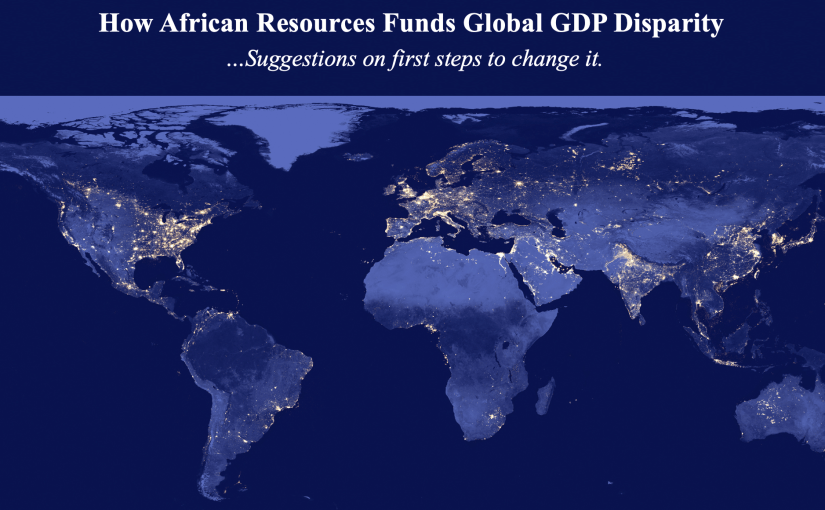
How African Resources Funds Global GDP Disparity… & Suggestions On First Steps To Change it

I wish to address, via a case study, how African resources fundS the global GDP disparity between continents. Then I will share some suggestions (of many others) that African governments can consider to begin strategically addressing this disparity.

INCOME DISPARITY (Estimated 2023 GDPs)
1) Asia: $42.7 trillion USD
2) North America: $30.4 trillion USD
3) Europe: $25.2 trillion USD
4) South America: $4.1 trillion USD
5) Middle East: $4 trillion USD
6) Africa: $3.1 trillion USD

THE ISSUE
It is estimated that Africa only benefits 2-8% of the value of raw materials from Africa, with most of the economic benefits being realized in countries where the processing and final product manufacturing take place.

COCOA INDUSTRY EXAMPLE
The global cocoa market value is about $130 billion, and Africa (Ivory Coast & Ghana) produces about 70% of the world’s cocoa beans yet it retains only about $5 billion USD from this market (3.84%). The price of raw cocoa beans exported from Africa is about $2,400 per ton, while a ton of chocolate processed from cocoa can sell for an estimated $25,000 to $30,000 USD. Consider this with EVERY mineral and resource Africa exports that gives rise to the global income disparity above!

THE QUESTION
How can African governments start transitioning to local production to capture a greater value of the market for all its minerals and resources?

A SOLUTION (of many)
African governments should no longer issue licenses or sign contracts for only mineral/resource extraction and exportation, but should condition the issuance of licenses with building manufacturing/industrial plants for their conversion into finished products on African soil. The 80-20 rule: 80% of raw materials must be processed locally, and only 20% are eligible for exports (and even then it should be intra-African). An audit of all prior mineral/resource licenses issued should be conducted, and a fair timeline should be given for their transition to domestic production. If the license holders do not meet the timeline, their license should be terminated.

For balance, the African government must provide significant investment perks and incentives and ease the process of investment and development for multinational firms. For example, governments can form SEZ (Special Economic Zones) and EPZ (Export Processing Zones) to allow freer economic activity, and can also subsidize infrastructure linking these zones with certain market centers and ports.

REFLECTIONS
African governments must be strategic and comprehensive in the measures they take to initiate economic growth. African leaders and governments must level up, and visionaries must vigorously drive nation-building to create a supportive framework that will enable the release of the African people’s creative potential into vibrant industry, innovation, and productivity. Then the open wound, bleeding significant income disparity, will eventually close to the prosperity of the African people.

~Dr. Ikenna Ezealah

Sources:

  • IMF World Economic Outlook Database (IMF)
  • International Cocoa Organization (ICCO)
  • Oxfam Report on Cocoa and Chocolate Industry (Oxfam)
  • World Bank – Commodity Prices (WB)

Conflict In The DRC

The Democratic Republic of Congo (DRC) is considered the richest country on earth in natural resources and minerals, and yet it has been in continual conflict for centuries. Since first making contact with the Portuguese in the 15th century, this place has been the focus of continental and international interests. The major conflict in that region today has everything to do with its resources and minerals, and nothing to do with democracy.

No one really knows who is operating in that country and where. Organizations are going in and out to do so-called “benevolent work”, airplanes and vehicles with undisclosed contents are entering and exiting, citizens are being displaced in conflicts, local rebel groups are controlling spaces, surrounding countries are engaging in this action, foreign countries and multinational corporations are also involved through agency. Somehow the resources of that country end up as finished products in foreign countries, on a scale contradicting the official trade figures. There is too much going on.

Satellite coverage is needed. I saw that Spacecom provides Satellite coverage for the DRC, but it is a foreign company operated by a foreign government (please correct me if I am wrong). That region needs an independent Satellite system that comprehensively monitors everything in that region and keeps the knowledge locally.

The exact location of minerals and resources should be pinpointed. The location of local groups, international organizations, foreign forces and their movements should be meticulously monitored in relation to the minerals and resources. The inflow and outflow of all airplanes, vehicles, ships etc should be tracked and their contents identified, the information should be closely coordinated with the military for enforcement action. Nothing should enter or exit the borders without close surveillance and comprehensive knowledge of all its contents.

Resource and mineral smugglers can be great helpers. Besides pursuing them, you can put out a reward for smugglers who can give insider knowledge of the real operations of people and organizations (foreign and domestic) in that region. Who can reveal the routes, sources of arms shipments, locations of transfer, quantities of minerals and resources diverted, the players involved, content of the airplanes and ships, and the underground coordinated movements. You then double or triple their reward if they wear spy body cameras to conduct an undercover operation to bring back video recordings of this information.

But all this presupposes you have leaders and people who are committed to bringing stability in the region, in order administer the minerals and resources in the country first for the welfare and benefit of the Congolese people. Also, the DRC cannot do this in a vacuum, but needs the partnership of other African countries. Thus, Africa must unite to bring stability to itself.

Naturally the situation is more complex than this, but these are preliminary thoughts. Finally, we must never lose sight of what is most important here: the security, welfare, and progress of the Congolese people.

~Dr. Ikenna Ezealah

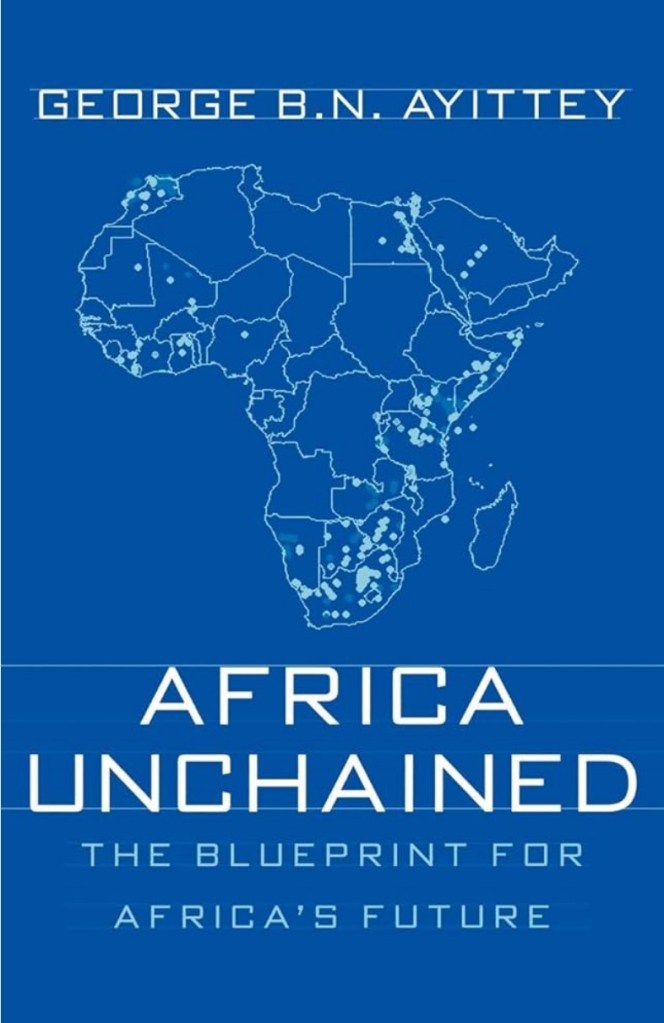
Africa Unchained: The Blueprint for Africa’s Future

I recently finished my Summer reading: “Africa Unchained, The Blueprint for Africa’s Future” by George B.N. Ayittey.

Mr. George Ayittey (late) was a Ghanaian economist, author, president of the Free Africa Foundation in Washington, D.C., a professor at American University, and an associate scholar at the Foreign Policy Research Institute.

For anyone interested in African economic development and nation-building… I highly recommend this book. His straight talk…no nonsense….hard hitting…satirical style is engaging. Ayittey’s comprehensive power of analysis and stratification that situates economics within the comparative context of African contemporary governance and historical cultural practices is incredible.

Mr. George B. N. Ayittey gives a play by play analysis of many African government policies post independence, the interaction with the international community, the role of African traditions in recommended policies, mistakes and successes, African leadership critique, specific ways to address misgovernance, and much more. Naturally when we read we should accept only what resonates within after careful weighing and examination.

His recommendations for African development are practical, and can be applied by those inclined to nation-building. Naturally we should accept only what resonates within after careful examination. The book has received citizenship to one’s personal library. It should be required reading in African schools and among the African diaspora, also in Western countries.

Through this book, my thoughts and approach to African nation-building and governance policies have been enhanced. A thousand thanks to Mr. George Ayittey for the tremendous effort and thought exerted to write this magnus opus. Your insightful thoughts will be part of the foundation for building a brighter African future.

Onward & Upward!

~Dr. Ikenna Ezealah

Africa And The World – GDP

In 2023, Japan’s GDP was $4.23 trillion

In 2023, Africa’s GDP was $3.1 trillion

Africa is 80 times Japan’s size, but the entire Africa is only 73% of Japan’s GDP.

Africa and Japan size comparison

Give that a moment to sink in and do its work.

If you were to take it a step further and compare the GDP of Africa as a continent with Europe, Asia, and even North America, then the colossal disparity might make your mind ache and bones rattle.

In the 2023 Top 20 GDPs, no African country was in the Top 20. However, if you added the African continent as one unit, it would be tied with France at #7. So when the Osagyefo Dr. Kwame Nkrumah said “Africa must unite”, this is not about idealistic notions of cultural oneness, kumbaya, or hakuna matata, but it is a clear recognition of the unavoidable need for economic survival and global competitiveness that comes through continental unity.

Now you see why some earnest Africans who see the big picture are not impressed by most African governments, who often implement an array of small one-off initiatives that, besides being largely ineffective, often lack any coherence with a broader agenda and vision.

Now you see why there is a clarion call for an urgent change in African leadership to chart a new direction in the continent today. For an ambitious drive for African nation-building with a bold vision, comprehensive strategies, tactical plans in all sectors meticulously coordinated and vigorously executed that continuously expands the economies. Daring leaders with big picture plans and long-term policies whose effects are precisely calculated to stretch at least 100years into the future.

Yes there are influences domestic and abroad that resist this. But this is no longer an excuse, for every continent faces resistance both within and without. Resistance is the cost of progress.

Africa is too blessed as a continent and people to tolerate mediocrity any longer, for bold advancement must be the standard. Looking upward, Africans must initiate the earnest striving for the highest possible goal that brings value and buoyant progress to the African collective.

Africans must energetically engage the political process and no longer shy away! Allowing ourselves to be instruments of the change we desire.

We cannot allow the potential of Africa to be wasted without genuine effort for positive change for the welfare of the people, which will also benefit other continents. We must work together to realize the great African potential, and thus be agents of positive change and ambitious growth!

Focused Upward, Forever Onward!

~Dr. Ikenna Ezealah

Just Build

Sometimes we need to stop pursuing time with industry leads, influential voices, even people in high places… and just build!

Build yourself inwardly!

Build your skills

Build your expertise

Build your mentality

Build your experience

Build your conviction in a cause

Build your content

Build your plans

Build your unique voice

Build your focus

As we build, people will be slowly drawn to you and doors will naturally start opening leading to connections and new possibilities. And when we sufficiently advance in our building and reach a higher level, even those people in high places we were pursuing will find us.

So just build!

~Dr. Ikenna Ezealah

The Politican, Leader, Visionary

A politican thinks of the next election

A leader … the next generation

A visionary … the next century

To African people, which of these three mostly occupy office in Africa today? And who are thus empowered in influential positions, making decisions that will affect current and future generations of Africans?

Once this realization sinks in, we recognize that political complacency and apathy is not an option, and is only a license for continual economic captivity and retrogression.

All African governments and leaders must work for the welfare and benefit of the people… for the current, next, and future generations. Otherwise it loses legitimacy and must be changed and replaced. But the African people must first recognize and firmly demand this. From themselves and their leaders.

Focused upward… forever onward!

~Dr. Ikenna Ezealah

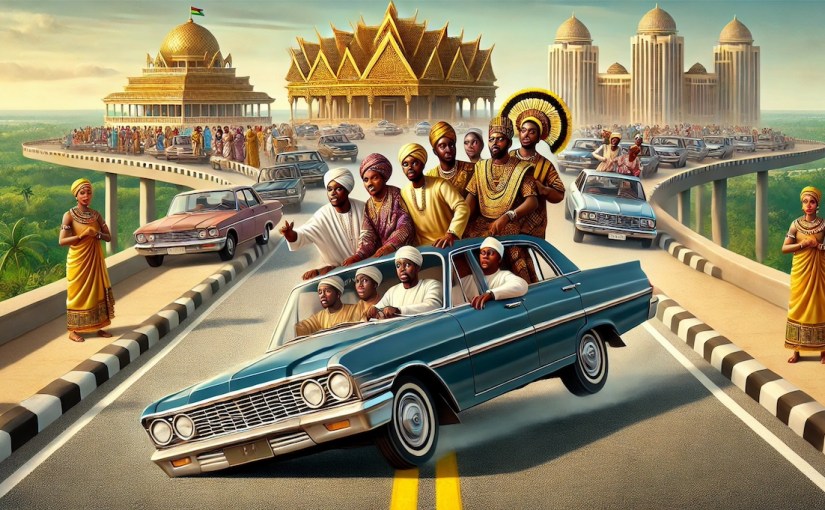
The Drunken Driver And The African Passengers

Imagine a vehicle driven by an inebriated driver, and the passengers are various sober professionals. The vehicle is zigzagging, so the concerned passengers start talking to the drunk driver and giving him elaborate explanations. But to no avail, the car keeps zigzagging, and a crash seems eminent. In response, they increase their explanations, but the inebriated driver fails to take heed because he is under the influence.  

The passengers are too engrossed in their elaborate speeches to simply recognize that because the driver is drunk, he cannot apprehend their words and will continue driving dangerously. So, the solution is clear: the passengers need to talk less, take possession of the steering wheel, and switch drivers. Only then will they avoid a crash and be safe.

The passengers in relation to the drunk driver are Africans in relation to their leaders today. The car represents the country, the wheel is government, seizing the steering wheel is entering into public service and exercising firm influence, and swapping drivers is energetically engaging in the political process to replace the current group of leaders. The drunkenness of the driver (poor leadership) represents the myopic influence of corrupt selfish interests, visionless maladministration, and strategic incapacity. The zigzagging depicts the hazardous swaying of many African economies heading toward a crash.

Africans today have convinced themselves that the skilled, gifted, and good-willing people in their societies should avoid politics and public service. Instead, they prefer being exclusive private sector passengers who leave the driving controls to inebriated drivers, who then run the risk of crashing the car and destroying the lives of everyone in it.

Africans today are doing too much talking and not enough political action to enter governance. Memorandums of Understanding, Policy dialogues, Conferences, Meetings, global forums, investment retreats and so much else. A bunch of talking, big visions and grand plans… while the real conditions on ground keep deteriorating. There is value in these initiatives and there has been incremental progress in Africa that people can be proud. But it has not been near the real potential of Africa because proper leadership in the public sector is an indispensable element for the private sector to reach its potential! These are facts.

The long-term success of all these initiatives will be severely limited unless energy is applied to take possession of the steering wheel of governance! That is, energetically organize into political action groups and vigorously engage in the process to enter office and elect new visionary and “sober” leaders who are prepared to truly serve!

The car is zigzagging, a crash is coming … unless Africans change their mentality and change the drivers, so the vehicle can then progress along the marked lines of the African destiny!

Onward & Upward!

~Dr. Ikenna Ezealah