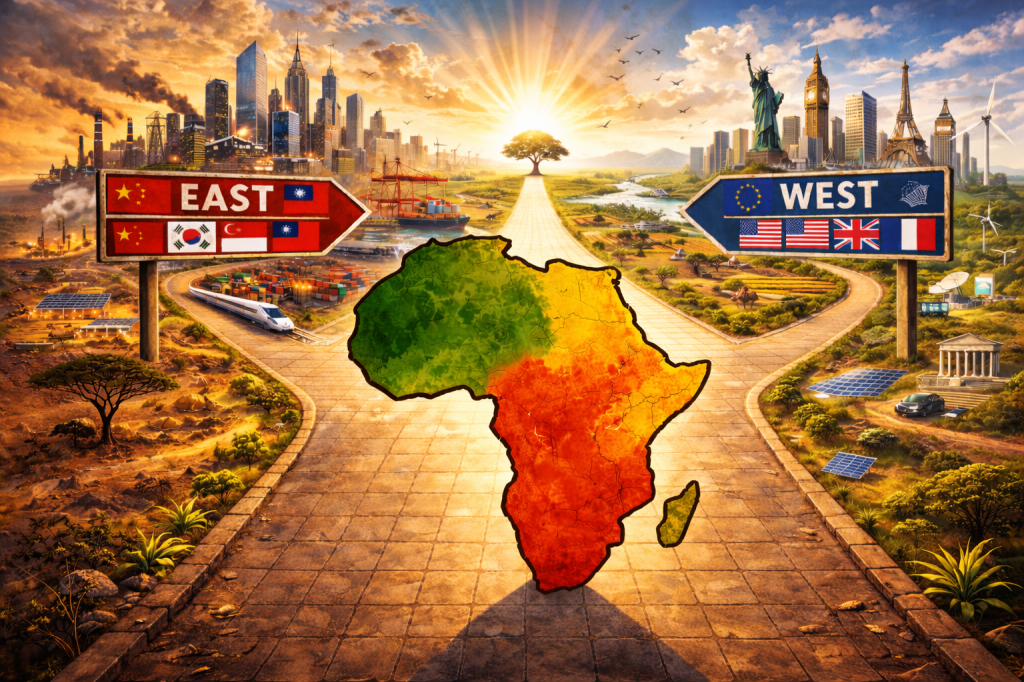
If Africa wants to lift its population out of poverty to prosperity, who offers a better example to learn from: East or West?
If you want to learn about business, speak to a business owner. If you want to learn how to become a millionaire or billionaire, speak to a millionaire or billionaire. For all three you must not speak to a university professor UNLESS they can show how they applied their theories in REAL LIFE to own a business, or become a millionaire or billionaire.
Over the last four decades, the Asian Tigers + China (China, South Korea, Taiwan, Singapore, Hong Kong) have successfully lifted about 860-880 mil people out of poverty (China alone 800 million).
The US population is about 340mil, Europe about 540mil (minus former Soviet territories). So 340mil + 540mil = 880mil. In Africa, the total population is about 1.5bil people, and the number in poverty is about 500 mil. In real terms, the Asian Tigers and China have lifted about 880mil people from poverty… equivalent to the population of the collective West (880mil) and about 280mil more people than the entire African population in poverty! Also, East Asia is the region of the world with the most countries that have rapidly transitioned from undeveloped/developing to advanced in the last 50-100years!
Thus, if Africa wants to successfully lift its people from poverty to prosperity and transition from undeveloped to advanced, then the evidence shows it should mainly draw lessons from (not copy) the Asian Tigers who are analogous to the business practitioner.
In the last several centuries the West has had every advantage: slavery, colonization, neo-colonization, imperialism, World’s reserve currency, World Bank, IMF, WTO, waged wars, coups, sanctions etc. And the result is still the failure to lift its own people out of poverty in the scale that Asia has achieved. And Asia achieved this primarily without the muchly touted democracy and the other advantages.
Also, China suffered Western (British) imperialism during the “Century of Humiliation” in which, after the Opium Wars, unfair foreign treaties (like the loss of Hong Kong) and forced trade concessions were imposed on them in the dissolution of the Qing dynasty and the loss of sovereignty. And yet China rose and is now a global power. So China can relate to Africa through its experiences with imperialism.
Certainly, there are valuable lessons to be drawn from the collective West, of which is the linkage between development and some form of market liberalization (but closely controlled). However, the Asian Tigers (who initially used ‘Authoritarian’ governments) show that democracy is optional in the march to development. So Africa should not seek democracy per se, but must chart its own course by seeking development through a home-grown form of government that aligns its heritage.
Africa should learn from the East and West, but the East offers a more successful example for Africa’s current context. However, Africa must not copy but learn lessons and chart its own original course!
~Dr. Ikenna A. Ezealah JD, PhD, MBA Builder of the African Future
In the following post on LinkedIn, a contributor discussed how African governments are running a “short” on their own currency. He used Ghana as an example and cited how a couple years ago they experienced 52% inflation, and the main contributors were the imports of certain agricultural products since they were brought in dollars. He then urged that Ghana can produce these goods locally to break the cycle.
And the cycle as enumerated by Isaac Marshall in the post was as follows: → Sell local currency to import staples in dollars → Local currency depreciates → Imported goods get more expensive → Inflation spikes → Banks raise interest rates to combat inflation → Local borrowing cost hits 30-40% → Domestic companies can’t compete due to high interest rates → More imports fill the gap
I reflected on the post above, then drafted the following:
I appreciate the speaker discussing the topic of “African governments…running a constant short on their own currency.” However, he starts this horror movie in the middle and not the beginning! What do I mean? Let’s go to work!
First we must research the loan conditions associated with the World Bank and IMF, which often involve removal of subsidies in key productive sectors of the economy required for self-sufficiency. In agriculture it causes domestic produce to be more expensive than foreign ones (which ironically receive subsidies), thus incentivizing imports. It is only FROM HERE that the horror movie the speaker mentions follows of “selling local currency to import staples in dollars”.
The main issue is not just domestic agricultural production, but especially freeing oneself from the nefarious financial conditions of these institutions who incentivize the vicious cycle. As long as you need money from them, your fate is likely this vicious cycle. We must understand the objective of these institutions is to keep your economy in this vicious cycle!
I recently wrote about these institutions in relation to the praise the World Bank gave the Tinubu Administration in Nigeria for their “reforms”, which will soon be experienced as “deforms”. https://lnkd.in/gC64cgxc
As revenues from productive sectors decrease, reliance on imports increase. More currencies must be sold, further depreciating its value. Less revenue is less funding for the national budget, so as loans keep increasing as a percentage of GDP, like a cancer the interest keeps metastasizing. If you struggle to pay the loans, you will be compelled to privatize and sell critical national assets and resources for foreign capital ownership. And a weaker currency means more local assets for fewer foreign currencies in a shrewd form of economic colonization. Here we enter stage 2 of this vicious cycle!
We must be perfectly clear: African countries cannot reach their developmental potential by following the policies of these institutions!
You see, us African nation-builders are like a constellation of eyes…we stay watchful!👀
Osagyego Dr. Kwame Nkrumah already saw this decades ago. Ghana was on the path of self-sufficiency. Then some fools overthrew him in a coup, reversed his initiatives, and plunged Ghana into the abyss of economy infamy from which they are today still trying to resurrect. Today some African governments are taking commendable steps toward sovereignty and self-sufficiency. By the nation-building powers vested in me, I hereby bestow a laurel wreath upon them!
African nation-builders today—those active and in quiet preparation soon to emerge—already understand the assignment! The call is to carefully survey the governance landscape, implement strategy to gain office, and thereafter we know what to do for African nation-building!
Onward & Upward!
~Dr. Ikenna A. Ezealah JD, PhD, MBA Builder of the African Future
As an African leader the best evidence that you are failing your people in the long-run, is if the World Bank and the IMF praise your “reforms”.
Recently a World Bank Delegation visited Nigeria and commended President Tinubu’s reform drives, noting that it is now a global reference point in their discussions with stakeholders.
Sounds great, until you examine the realities of Nigerians on ground and not what institutions say. Then you will realize such praises amount to nothing. Going further, I challenge anyone to:
Research the developmental policies of all advanced countries! Not what they SAY, but what they DID historically to get to where they are today! If you are honest in your research and analysis, you will conclude that not a SINGLE ONE of them wholly followed policies akin to what the World Bank and IMF proposes to Global South countries. Also, there are even no real success stories of the latter emerging from their challenges using these institutional models. See “Bad Samaritans: The Myth of Free Trade and the Secret History of Capitalism” by Ha-Joon Chang.
Despite this, many Africans are sheepishly hailing the World Bank’s praise of Nigeria’s “reforms” as something great! As evidence of development and progress! How delusional and illogical many Africans are when it comes to the capacity of calm objective examination against the backdrop of historical evidence.
I say to you: do you know the best way to achieve African nation-building? Listen to EVERYTHING the World Bank and IMF says, then do the OPPOSITE. Then real sovereignty, prosperity and long-term success will be yours!
Do you really believe these institutions want you to reach your developmental peak, to later become a competitor to the Western countries who fund them? Do you not understand the real goal of all their policy proposals? It is to:
1) Provide enough development to keep you mediocre with enough purchasing power to buy the goods and services of advanced countries;
2) Ensure your country becomes a permanent market for secondary goods;
3) Maintain the low prices of raw materials and their exporting;
4) Skillfully undermine every mass industrialization and manufacturing endeavor.
5) Open domestic sectors and critical assets to the mass privatization of foreign capital ownership.
No one can challenge these words without contradicting themselves. For they stand as immovable truth, as ungainsayable facts of objective reality!
African governments even relying on policy reform advice from these institutions is proof of incompetence. Africa, you must use your own brains, think your own original thoughts, and chart your own course to prosperity! Where are your experts, think tanks, and industry specialists locally and in the diaspora? Why the inferiority complex that is so eager to follow the advice of foreigners instead of your own experts? Africa if we wish to progress, we must change this attitude, look within, and follow home-grown developmental policies. Then we will achieve real sovereignty!
~Dr. Ikenna A. Ezealah JD, PhD, MBA Builder of the African Future
By the Grace of God I was recently invited to speak on a panel as an African Ambassador for the World Peace Forum Leadership Series, hosted by the World Mission Society Church of God. The panel was moderated by the talented Chief White House Correspondent for Africa, Hariana Veras, with whom I am now glad to be professionally connected as well as to the other panelists.
I would also like to acknowledge the other talented panelists I had the pleasure to work with: Dr. Joseph Sany, Former Vice President of the Africa Center at the US Institute of Peace; and Johanna LeBlanc, JD, LLM, Partner at The Adomi Group and Adjuct Professor at Howard University.
I am privileged for this opportunity and see the working of higher guidance from the Lord already on my professional path. I will reiterate that I see everything given to me—spiritual abilities, earthy talents and credentials, and all doors that may open—as first and foremost a Divine loan for service to God, and then subsequently as a tool to be a helper and guardian of the welfare and further development of the African people. Everything else is consequential. May God grant me power and guidance for this work, so that in the discharge of my duty, my life may bring honor to Him and help to my People.
Through blessing and guidance from above, and committed people on Earth prepared to diligently work toward the high goal of African nation-building, Africa will resurrect and rise to unprecedented heights. May God grant it!
Here is a summary video of the event. The background song in the video is fittingly “Eyes of Heaven” by Medwyn Goodall. Onward & Upward!💫
~Dr. Ikenna A. Ezealah JD, PhD, MBA Builder of the African Future
Introducing… Dr. Ikenna A. Ezealah, JD, PhD, MBA Builder of the African Future
Four years ago during the COVID quarantine I did soul searching. I reexamined my life and delved deeply into the culture, history, and rich traditions of my people, the African people. Recognizing the past and present successes, challenges, and current lack of genuine leadership, a question arose within:
“What are you doing to give back and support the development of your people?”
I had no answer and felt ashamed. But I fervently prayed, then firmly resolved to support the African people’s development by focusing my life to fostering economic growth, good governance, indigenous development, and institutional building across Africa.
I then decided to got to law school in order to obtain the skills necessary to be a helper to my people as an international nation-building diplomat. Since then, my professional experiences have been miraculous. Yet I have also faced great challenges I always faced quietly and diligently, unknown to most.
In my darkest hours it was always my faith in God and the commitment to my life’s purpose that gave me strength to keep boldly forging ahead. I only have Plan A and no Plan B; my Plan A is my plan A-Z. For in my heart I believe in only one outcome: unconditional victory!
I spent my first year at Case Western Reserve School of Law. Then, following an inner prompting, I transferred to American University Washington School of Law. My main professional experiences during law school are follows:
UN Immersion for Multilateral Diplomacy; Diplomatic Trainee
International Trade Centre; Int’l Trade Intern (designed model legal framework to establish NECs National Export Councils)
Washington International Diplomatic Academy; Int’l Diplomatic Trainee
Colin Powell Leadership Institute by Black Professionals in International Affairs – BPIA; Fellow
Garvey-Nkrumah Legal Fellowship Program (fostering African/Black leaders to apply Pan-African economic development models); Fellow
Public International Law & Policy Group; Senior Research Associate
Whiteford, Taylor & Preston; Extern (developing an International Investment Manual)
On December 14, 2025, exactly six years to the day I obtained my PhD, I walked across the stage at AUWCL to obtain my JD.
Now through the Grace of God I proudly declare: “It is finished!” To mark graduation, I prepared a short video entitled “A Long Walk to JD (Juris Doctorate)”
I work hard for the opportunity to work harder in service, and know that success is only a Divine loan to be repaid through the service to uplift the African people. I thank God for His Omnipresent Guidance. Also all family, friends, and colleagues who have helped me.
I did it! Now I am ready for the next chapter, focused heavenward and in fulfilling my life’s objective: to be a servant of God, and a helper and guardian of the welfare and further development of the African People!
May God the Father grant me holy power for this work!
💫Onward & Upward!💫
~Dr. Ikenna A. Ezealah, JD, PhD, MBA Builder of the African Future
The failure of African leadership is the issue here. As a leader, you are to form policies that will establish and fund original scientific research and innovation institutions which includes testing centers.
Then based on the intensive research and recommendations of your scientific community, you form national polices that set chemical standards for the importation of goods (“sanitary and phytosanitary measures).
Next, you overhaul the border process of verification and entry and institute stricter measures for the testing and clearance of goods at ports. Additionally, you form punitive policies that ruthlessly punishes corporations who weasel products into your country that violate your standards. Such draconian measures would include revocation of licenses, seizure of assets, imprisonment of key officials, brutal fines etc.
Basically any corporation who flagrantly dares to violate the law, and who sends substandard products with harmful additives to Africa that they would never give Europeans, in order thereby to insult the dignity of the African people must be made to feel the iron-fist in cold pitilessness.
As an African leader, all corporations who approach your country to do business should feel the volcanic earnestness you apply to the sacred duty of being a helper and guardian of your people! The steadfastness and vigilance of your attitude toward your people, in addition to the institutions and systems you establish, will then become a shield of honor around your people that will command respect and compliance from foreign corporations to do well by them! Where are the lions of Africa?
African leaders, if the task of leadership is too much for you, if standing by your people and being a helper and protector of their welfare is too burdensome for you… then resign and vanish from office, so another who is prepared to boldly and diligently serve the common good can step forward and take your place!
African leaders, stand by your people!
~Dr. Ikenna A. Ezealah, PhD, MBA Builder of the African Future JD Candidate ‘25
The Framing Nigerian and African leaders, set politics aside and think strategically about the long-term lessons you can draw from the bellicose tweet that Trump recently sent, which can be applied to develop your people and protect your country from potential future geopolitical intrusions. Think like visionary nation-builders! I will help in this, so let us examine the words!
In response to claims of Christian deaths in Nigeria, Trump tweeted the following. I have bracketed words for logical emphasis: “IF the Nigerian Government continues to allow the killing of Christians, [THEN] the U.S.A. will immediately stop all aid and assistance to Nigeria, and may very well go into that …. Country ‘guns-a-blazing’…”
In this essay I will not be addressing the claim of Christian deaths in Nigeria, but rather will focus on the broader principles to be drawn for African nation-building.
The Mechanisms: The claim of the antecedent IF is followed by the threat of the three-part enforcement mechanisms of THEN: aid, assistance, military. Therefore, your task as nation-builders is to form a long-term national developmental strategy that builds domestic institutions which would immunize you from these foreign mechanisms through self-sufficient productivity.
About Aid & Assistance You have been repeatedly warned that so-called foreign aid and assistance is often a cleverly orchestrated reconquest and control of national infrastructure through dependency. It is given to establish leverage, yet you carelessly overlook this and fall into the trap. So, when enforcement time comes, you are in a weak position. Your fault.
Action? List the different sectors of aid: Health, Humanitarian assistance, Security, Economic Development, Loans, Education etc. Next, form strategic action plans to develop domestic institutions that will make you self-sufficient in each of these sectors of US aid!
Health Assistance: Take health. Nigerians are everywhere in the US healthcare system and even drive innovations. Therefore, it is sheer leadership incompetence and wretchedness that Nigeria does not have one of—if not the best—healthcare industries on earth! Your task is to develop a strategy that will harness all the specialized medical skills and experiences of the Nigerian Diaspora to build a formidable and world-leading medical sector in Nigeria! Any Nigerian leader whose vision is not this big and ambitious for nation-building needs to resign and leave office forevermore.
Money/Loans: Think of money. Often you politicians carelessly get loans denominated in USD, embezzle it, then park the funds and assets in the US and Europe. You yoke your people to a foreign power, rob what little crumbs they receive from loans, then reinvest these stolen funds back to the foreign power. Such foolishness is incomprehensible. How are such human beings even a position of leadership? The US government sees all your monies and assets, where they are invested in their economy, so when these geopolitical situations arise, they can use this leverage to sanction and enforce their will against you. Again, it is carelessness of Nigerian leadership, for you have not created a safe economic environment domestically where assets can be protected, so you do not trust the country that you manage, meaning you do not trust yourselves. And this distrust is a proof and admittance of your own incompetence and failure. It is time to make this good.
Therefore, your task is to create the right regulatory environment that is uncompromisingly fair, devoid of corruption, and safe for the storage and protection assets. But this implies you must be absolutely ruthless and govern under the penalty of capital punishment against measures of corruption. Draconian severity is needed to purify governance. You must place the advancement of your country above everything but the Creator! Above tribe, family, children, above everything. Still fulfilling personal responsibilities, but nothing on earth should mean more to you than the fulfillment of duty to advance your people! Absolutely nothing! Such must be the honor cross of those who wish to serve the cause of African nation-building with their life!
About Military Intervention Foreign powers talk big about democracy, but they do not believe in it, they believe in control and force. They respect democracy to the degree it aligns with their national interests, and when it does not then their military is ready to violate territorial integrity for economic and geopolitical purposes under the banner of a moral cause. You must understand this, for history and current events bear witness to this truth. Therefore, let me ask you: which country in Africa has a robust defense industry? Institutions that develop original defense research and innovations, and then manufactures weapons for national and continental self-defense? Answer: NONE. Therefore, your task is clear as nation-builders: make Nigeria the first African country to develop a robust domestic defense industry that produces research and technologies, manufactures them and exports them throughout Africa.
Once you become self-sufficient through these institutions and can supply what you need, no foreign country will think of “invading at will”, because the cost would potentially be too heavy through high precision “missiles-a-blazing”. Additionally, you would have the capability to overwhelm all domestic terrorists and ensure the security of your people, and the peace and territorial integrity of your country. But today you are weak and cannot defend yourself, and that is why foreign countries easily threaten to invade you at will. Do you understand that your “friendship” with them is conditional on you bowing to their will? And if do not, the economic and military enforcement mechanism are unleashed. So you must counteract this through institution-building!
Concluding Message In summary, your response to Trump’s message should be quiet note-taking on the long-term lessons you can draw for national development. Your resolve should be to develop institutions and mechanisms that will make you nationally self-sufficient, so you remove the leverage that a foreign power has to enforce their will against you. Such should be your focus: developing strategies for aggressive African nation-building for indigenous self-sufficiency!
Despite the great opportunity for progress, you leaders have strayed so far away from the African Cause, have betrayed your people, pillaged resources, become foreign dependent, and even stifled visionary leaders from rising because it was not convenient for your tribalistic and selfish personal interests. But now this must change, because global geopolitics is becoming increasingly unpredictable and any country that lacks self-sufficiency is vulnerable for exploitation and control. A country that cannot feed and defend itself is useless and has no right to expect global respect. Friendly foreign gestures during times of “peace” cannot be trusted to hold during times of differences, for then the leverage they have will be used against you. It is your task to eliminate these leverages and become strong through long-term development planning.
The Call: African leaders, focus on long-term institution building that will make your people grow strong, stand tall, and become self-reliant. Develop enough pride for Africa and love for the people that will enable you to work unceasingly to build institutions and systems for their progress, which will free them from foreign control and make them partners of equal value. Become helpers and guardians of the welfare and further development of the African people. Protect and uplift them and future generations.
African leaders, stand up for your people and build institutions!
Onward & Upward!
~Dr. Ikenna A. Ezealah, Ph.D, MBA J.D. Candidate ’25 Builder of the African Future
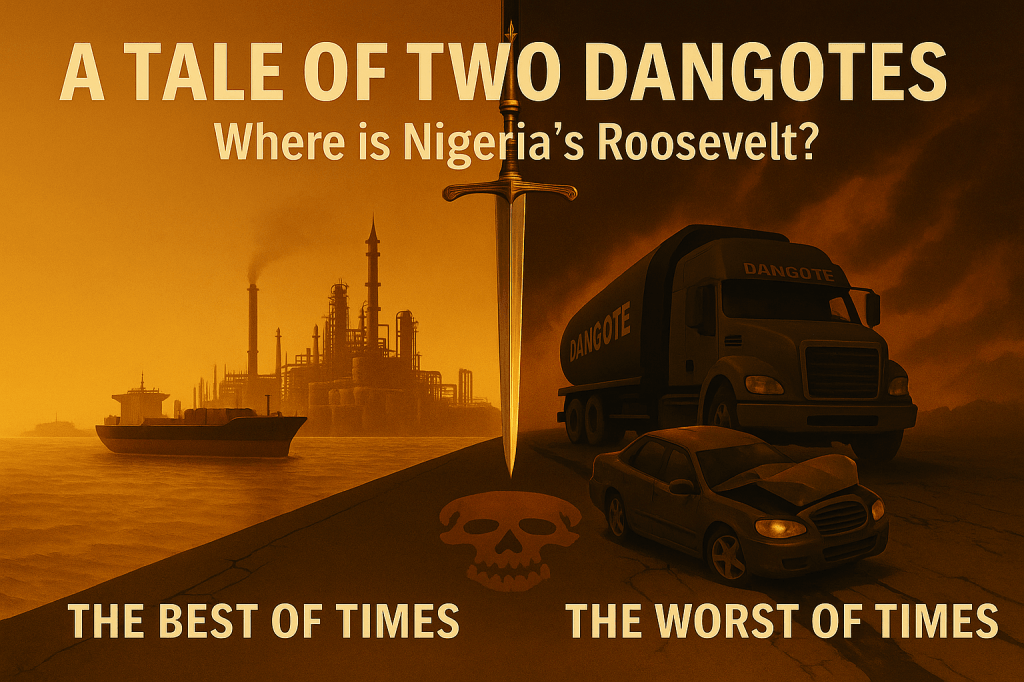
“It was the best of times, it was the worst of times, it was the age of wisdom, it was the age of foolishness, … it was the spring of hope, it was the winter of despair…”
The famous introduction to Charles Dickens’ A Tale of Two Cities that was written to capture the social contradictions in London and Paris before the French Revolution, could just as well describe the Nigerian people’s attitude toward the business activities of billionaire Aliko Dangote. His empire embodies both triumph and tragedy: on one hand, unprecedented industrial achievement; on the other, the daily menace of his trucks, whose accidents leave a trail of injuries and fatalities.
The Best of Times Dangote is praised as the face of African enterprise. His ventures include the monumental Dangote Refinery, a $20 billion facility with capacity for 650,000 barrels per day, which is Africa’s largest and among the biggest single-train refineries in the world. He has also announced plans to build Nigeria’s largest and deepest seaport in Ogun State, a project set to transform exports of fertilizer and industrial products. To many, these feats symbolize Nigeria’s potential, Africa’s rising industrial base, and the triumph of private capital over chronic state inefficiency.
The Worst of Times Yet the very name “Dangote” also conjures images of fatalities on Nigerian highways through his trucks. His cement trucks have become a menace, notorious for reckless driving and deadly accidents. Between 2015 and 2025 alone, a report on Dangote truck accidents estimates about 393 deaths and 1,040 injuries. But anyone familiar with Nigeria knows these numbers are drastically underreported. Security services and government agencies, compromised by collusion, coverups, and corruption, shield such abuses from scrutiny. Multiply those figures by at least ten, and one approaches reality. So the paradox is clear: as Dangote builds monumental projects to power Africa’s future, his trucks simultaneously leave a trail of injuries and coffins on Nigerian roads. Who will hold Dangote accountable?
The Role of Leadership This contradiction highlights the vacuum of political leadership in Nigeria. Visionary governance exists to regulate markets, enforce accountability, and protect citizens from exploitation, while coordinating private achievement toward a national vision. But historically, Nigeria’s leadership has been atrocious… more cabal than custodian, more profiteer than protector.
Where is Nigeria’s Theodore Roosevelt?
Roosevelt’s Example At the dawn of the 20th century, America faced its own Gilded Age of monopolists and “Robber Barons.” President Theodore Roosevelt confronted them directly, earning the title “Trust-Buster.”
He used the Sherman Antitrust Act with unprecedented vigor to break monopolies that strangled competition and exploited consumers.
He targeted giants such as Northern Securities and Standard Oil, forcing courts to dissolve them.
He distinguished between “good trusts” and “bad trusts,” insisting that government regulate where it could not dismantle.
His Square Deal promised fairness: balancing corporate power with the welfare of the people.
Roosevelt was not against enterprise; he was against exploitation. His mission was to ensure that no corporation, however powerful, could trample the public interest.
Nigeria’s Missing Guardian A true Nigerian leader—a nation-building visionary and guardian of the people’s welfare—would never tolerate the impunity of Dangote’s cement trucks. Leadership is not only about setting a vision for industrial growth, for it is also about defending citizens from harm by holding even the most powerful enterprises accountable.
But most of Nigeria’s ruling elite have no such resolve. When leaders themselves are chief exploiters, how can they regulate others? You cannot expect arsonists to serve as firefighters; to do so would be to extinguish the very flames that sustain them. The political class and the oligarchs are in business together, feasting on a climate of underdevelopment that ensures their continued enrichment.
Naturally, this statements do not imply that all Nigerian politicians are ignoble and ineffective or that Dangote trucks always cause harm. Certainly not. For there are promising individuals in the Nigerian political class and Dangote’s enterprise does much good in Nigeria. The statements merely highlight the unchecked status quo: the exploitative political class and the hazards of Dangote cement trucks, both of whom cause harm with little accountability.
Nigeria Needs Its Roosevelt Nigeria’s story need not remain a cycle of “best of times and worst of times.” With the growth of private enterprise, the country urgently needs leadership strong enough to regulate markets, defend the people, and direct industry toward a common good.
This is not a call to imitate a foreign president. It is a call for the emergence of a new leadership class: men and women who are both builders and guardians, who see government not as personal spoils but as a sacred trust. Leadership that is aggressive in nation-building yet unwavering in defending the Nigerian people against harm and exploitation. And this applies to Africa at large. For without such leadership, the continued hazards of Dangote trucks and all they symbolize may one day become the spark of Nigeria’s own reckoning, just as Dickens’ tale foreshadowed the French Revolution. Nigeria needs its Roosevelt.
The Callfor Guardians If Nigeria wishes to avoid that fate, it must change course. It must raise up a leader who is a servant of God, a builder of the African future, and a guardian of the people’s welfare and prosperity.
May the Lions of Progress hear the call of destiny and step forward for service!
Focused Upward, Forever Onward!
~Dr. Ikenna A. Ezealah, Ph.D., MBA Builder of the African Future J.D. Candidate ’25
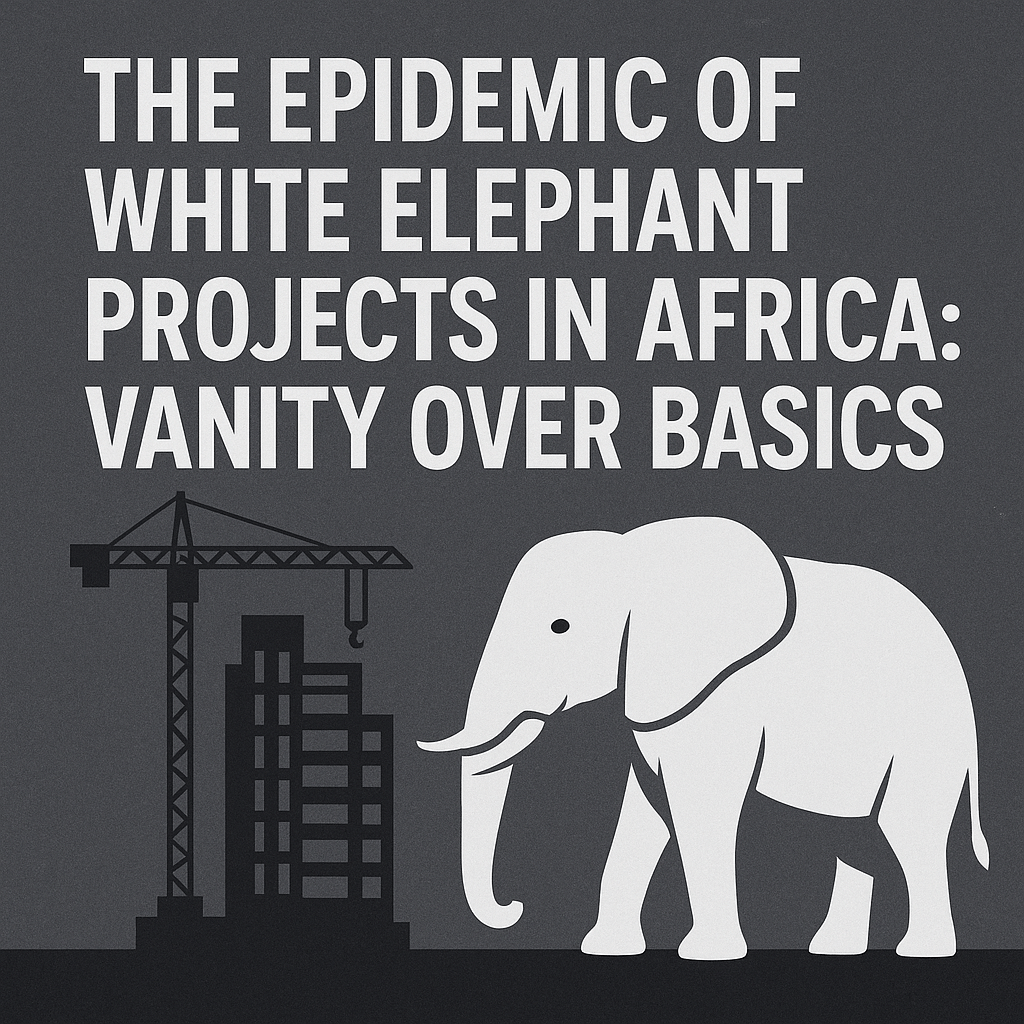
One of Africa’s insidious governance failures is the obsession with white elephant projects (WEPs), which are big, flashy, and often unsuccessful construction projects that add little value but drain national resources.
Take Nigeria’s “white elephant airports”. A Premium Times investigation details how a ₦15 billion airport in Nasarawa State, commissioned in 2015, remains incomplete and dormant. Contracts were awarded, canceled, and re-awarded. Administrations changed. More money flowed. Yet the project remains moribund. And when journalists requested contract and funding details under the Freedom of Information (FOI) Act, officials had the audacity to brazenly ignore them.
WEPs are not real development, but a clever way for many officials to look productive, inflate costs, and steal public money.
Nigeria has 32 airports, but a Nairametrics report reveal that in 2022, five airports carried nearly 90% of Nigeria’s 16 million passengers, while the remaining 27 airports carried only 10%. Such failure of governance shows an unpardonable incompetence and sinister greed.
But this problem is deeper than corruption. It reveals a flawed developmental mindset and even an insecurity complex. Leaders are obsessed with “showy projects” that emulate more developed countries to “prove” Africa is advancing. All while ignoring the basics: clean water and distribution, waste management, reliable roads, stable energy, self-sufficient agriculture, public health, quality public education.
Most African countries have not mastered the basics, yet the people (and diaspora) fantasize about tech revolution, dramatic projects, and fancy silicon valley apps far removed from the immediate needs of the people.
An African nation-builder thinks: Tech relies on energy (plus education). Tech without energy is like harvesting an egg without a chicken. Therefore, energy (and education) FIRST.
Many Africans are in a dreamland, and this delusion reflects in the attitude of their leaders with white elephant projects. So the people get the leadership they deserve. Many African government officials today have not only proven themselves to be useless for nation-building, but are now also pestilential and should be compelled out of office.
Yet there is hope. Across the continent, a new class of earnest Africans are awakening who are committed to real change, who understand that a functioning society is built on basics first, and only then can other advancements be layered on top. It is high time such Builders of the African future step forward, unite, and contest to take over African leadership. Real change will only come when visionaries lead by first focusing on the “boring basics” that support the progress of the African people.
That is the task before us: reject the wasteful delusion of white elephants, and build, brick by brick, the solid foundations of African nation-building.
Onward & Upward!
~Dr. Ikenna A. Ezealah, Ph.D., MBA Builder of the African Future
The rift between Mainland Africans and African Americans is troubling. Each looks suspiciously and accuses the other of ill-treatment, condescension, ancestral betrayal, underperformance, indifference, ethnic isolation and more.
Whining over small matters like children with wounded vanity and false pride. It is a pitiful game of ego and small-minded petulance in which both sides are missing the bigger picture!
Namely, the rift ensures their continued mutual subservience to the same global order that enslaved one and colonized the other, and which still exercises undisputed suzerainty over both through entrenched systems and institutions. Instead of leveraging their strategic advantages and unique strengths for shared advancement toward a high aim, they prefer bickering and licking their wounds.
Both sides live under a sinister delusion that they can advance and reach their potential without the other! However, let me be clear: neither can fully overcome their challenges and reach their developmental potential without working together. You are brothers and sisters, ancestrally derived from the same ethnic groups, separated by tragedy, shaped by unique experiences, yet connected by the blood from the same creative African spirit that still flows through your veins!
Mainland Africans: African Americans technical skills, experiences, and strategic positioning are needed for Africa’s next stage of development. Some of the issues you have can be resolved by your siblings from across the ocean whose help and cooperation you sometimes stubbornly reject.
African Americans: Africa is the headquarters of your identity, your homeland and powerbase. Approach it with humility and make a serious effort to ethnically integrate while avoiding the savior complex. Recognize that in Africa are the minerals, resources, governments, and organizations that can strengthen your economic and political position. Many of the issues you face can be resolved by coordinating with your siblings in Africa from whom you often disassociate.
Will collaboration be easy? No. Will it have great challenges and setbacks? Yes. But it is necessary for the mutual advancement of both parties. Remember that every great aim has difficulties, but it is the unshakeable commitment to the high goal that enables all trials to be successfully overcome!
Mainland Africans and African Americans, it is time to honestly resolve the rift, set aside petty differences and work together for higher aims. We are interdependent, capable of helping each other overcome challenges and advance if we collaborate with openness, respect, and patient determination. We are one people, consanguineously interlocked by the unbroken thread of a common heritage, our destinies are tightly interwoven. Let us focus on higher goals that unites us and move us forward as brothers and sisters!
And remember, no matter how long the prodigal son was away, when he returned to his father, his time apart did not change his place as a reunited son and sibling—embraced without hesitation, restored to family! Remember this and work together!
Onward & Upward!
~Dr. Ikenna A. Ezealah, Ph.D., MBA Builder of the African Future

 Nation Upbuilding