Addressing The Recent Change In Nigeria’s National Anthem

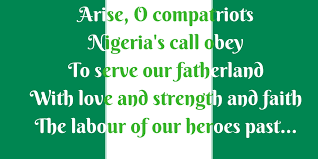
Recently, the Nigerian President led a campaign and signed into law a change in the national anthem. The previous national anthem “Arise, O Compatriots”, created by five Nigerians and then was put to music by Benedict P. Odiase, is now replaced by “Nigeria, We Hail Thee”, which was written in 1960 by British expatriate Lillian Jean Williams and was initially adopted as Nigeria’s national anthem when the country gained independence on October 1, 1960.

“It is my priority” the President said, as citizens were given no input or involvement in the process. A minor issue was prioritized, despite major issues and urgent national priorities troubling the lives of the Nigerian citizens such as inflation, skyrocketing cost of food, inconsistent power, insecurity, dilapidating infrastructure, underfunding of education, departure of multinational firms, the downward spiraling economy, and much more. This move, reflecting misplaced priorities, poor timing, and a myopic insensitivity to the historical backdrop of the British colonial legacy by reimposing an anthem on Nigerians that a foreigner created and not the Nigerian people, is tragic evidence of lack of leadership and vision. An anthem is too personal for a people to be outsourced.

The words of “Nigeria, We Hail Three” were touted as being more inspirational and befitting. But no matter how inspirational the words of any chosen anthem are, the real question is: do the actions of the Nigerian political class as representatives of the citizenry reflect it? No! Can you find traces of respectable value system in most from the political class that gives meaning to the words of the national anthem? No! In the now former anthem, the first word is “Arise”, which is to awaken to higher vision, values, and sense of duty. To transcend ethnicity and petty politics, in order to listen to the call of service that, through diligent implementation, furthers the welfare of the whole. How many citizens and political leaders in Nigeria’s history up to the present can say they have even fulfilled this first word? Words change conditions only when practice empowers them to manifestation. The new anthem will not change the behavior of the political class, so instead of changing anthems the right move would have been to look within and change. If this proved too difficult, then it is the poor leadership and the political class that should have been changed, not the anthem.   

Moving beyond constructive criticism and notwithstanding the atrocious timing of the change in national anthem, I will now offer a solution and explain how a change in the national anthem can be approached that would encourage greater inclusive and a sense of collective ownership. Here are the ten recommended steps to properly changing the national anthem:

  1. Host an open townhall with members of the public from all levels of society, government officials, organizations and civil society.
  2. Make a live case to the people. Describe the origin, meaning, parties, timeline, and development of the anthems within the historical context of the country’s history, then share reasons why a change is necessary.
  3. Invite comments, questions, healthy debate, and exchange of diverse ideas so people are included in the purpose and process.
  4. Announce a “National Anthem Rewrite” initiative in which the Nigerian citizens are encouraged to create and submit a national anthem, and a recitation video to a national commission and on social media. The objective is to empower the Nigerian people to take ownership, unleash their creativity, and ensure the recited words of national pride arise from their spirit!
  5. All created anthems will be reviewed, finalists will be selected, then one chosen; or different elements of some can be combined to create one whole anthem. A citizen’s commission will adjoin the national commission to participate in the decision-making process.
  6. The bill introducing a change to the national anthem will then be presented to the National Assembly, where it should be passed after some discussions.
  7. A signing ceremony will be organized with members of the public from all levels of society, government officials, organizations, and civil society.
  8. A band/group comprising different tribes and regions of the country will be composed to sing, record, and perform the national anthem.
  9. The author(s) of the anthem, the public, and others will be invited to Abuja for the first live performance of the group in a day of national unity. The event will also feature performances by Nigerian artists, poets, and comments by civic and academic leaders. The author(s) in a ceremony will be given an award(s) by the President in recognition of their creative contribution to the country. Then, the multiethnic group garbed in their native attires will sing it live for the first time. Their voices, united with the audience, will reverberate proudly through the Nigerian ether!
  10. The lyrics will be engraved in a large plaque and decoratively mounted tall in a wall in the Statehouse Aso Rock Presidential Villa and the National Assembly Complex.

This way, the Nigerian people are involved, centered, and use their own abilities to define the meaning of their anthem instead of a foreigner. It is indolence, lack of vision, and want of creativity that makes African leaders always ready to adopt foreign ideas, systems, and institutions, without the indigenous impetus to harness the abilities of their people, build on their cultural heritage, and create something original.

Here, many will remonstrate, saying “Nigeria was not named by Nigerians, must we change that too?” If we are serious, yes! How did Nigeria get its name? According to Richard Bourne in his book:

“The name ‘Nigeria’ had been coined by his [Frederick Lugard’s] wife and admirer, Flora Shaw, colonial editor of The Times, in a letter she wrote to her paper in January 1897. She used it to define the territories abutting the River Niger that were then being traded in or claimed by the Royal Niger Company” (Nigeria: A New History of a Turbulent Century; p. 3).

Thus, Nigeria was named not with any historical symbolism, rich cultural meaning, or existential ideal for its future development, but based solely on a colonial convenience of grouping people together in relation to a landmark! And you my people conveniently accept that and even defend against any change because you have grown “accustomed” to it? How deep have we sunk in Africa! Now contrast this with the reason that Dr. Kwame Nkrumah gave in his autobiography about renaming the Gold Coast “Ghana”. He spoke about how in the very early days of the Christian era before England was important, his African ancestors had attained a great empire:

“It is said that lawyers and scholars were much respected in that empire and that the inhabitants of Ghana wore garments of wool, cotton, silk and velvet. Thee was trade in copper, gold and textile fabrics, and jewels and weapons of gold and silver were carried.

“Thus we may take pride in the name of Ghana, not out of romanticism, but as an inspiration for the future. It is right and proper that we should know about our past. For just as the future moves from the present, so the present has emerged from the past. Nor need we be ashamed of our past. There was much in it of glory. What our ancestors achieved in the context of their contemporary society gives us confidence that we can create, out of that past, a glorious future, not in terms of war and military pomp, but in terms of social progress and peace.” (The Autobiography of Kwame Nkrumah; p. 195-96)

What a difference of day and night in the naming of “Ghana” and “Nigeria”! One rich in historical meaning and an inspiration for the future, while the other is just a geographic convenience lacking substance. Perhaps the difference is that Ghana has had the fortune of a visionary leader at the head of government, while Nigeria has not! Nigeria has even historically worked hard to ensure its most talented and industrious citizens are deprived of every opportunity of leading government, so that an avaricious cabal of tribalistic, vacuous, and visionless officials can continue plundering the national coffers while pushing the people in penury toward the abyss of infamy. How will a change in anthem effect a change in this rot? A gargoyle that changes its shirt is just a gargoyle in a beautiful shirt. Except here the shirt is now “foreign made”.

To effect change in Nigeria and Africa, our leaders need to become scholars of history in addition to an elevation in values and thinking, so our present actions build from the past. Follow me therefore on a quick diversion to explain the meaning of “Ghana”.

Ghana was a kingdom of the Soninke people, who are the northernmost people of the great Mande family that occupied a territory close to the Sahara desert. To properly situate Ghana in Ancient Africa, we should be clear of ethnic clusters in that the Soninke, Malinke and Bambara belong to a group referred to as Mandingoes or Mande-speaking (The History of West Africa; p. 15-18). This is important because when interpreting historical records, the same kingdom might have been referenced with slightly different names and meanings by the people, only because the descriptions might arise from different languages of ethnic groups in the same or different broader family. This notion applies to Ghana because historically there are two traditions (perhaps more) that mention a great Soninke kingdom of gold with the names Wagadu and Kaya-Magha, which preceded the Mali Empire and its preeminent leader Mansa Musa!

In one tradition, Wagadu was a prosperous kingdom blessed with vast quantities of gold with its capital at Kumbi, and its kings bore the title of Magha or Manga. The other tradition arose out of Ta’rīkhs (Arabic texts) from Timbuktu that mention the kingdom of Kaya-Magha as predecessor of Mali, one of these texts name the capital city Qunbi (like Kumbi), while the other calls it Ghana. Kaya-Magha in Soninke language means “king of gold”. However, in Malinke, Gãna or Kãna means war chief (The History of West Africa; p. 120). Ghana was called ‘the land of gold’ by some Arab geographers. Although people use the name Ghana interchangeably for both the kingdom and capital, al-Bakrī says in his text that ‘Ghana is the title of their kings’. The ‘ghana’ was the “king of gold” and powerful protector “war chief” who ruled the land of gold, with its thriving people, social order, beauty, systems, and advancements!

Do you see the depth of thought the Osagyefo Kwame Nkrumah gave to the choice of name? How the name and concept can awaken pride in the people? Not flippant and superficial, but deep and introspective. Do you see how he insisted and persisted to reclaim the sovereign right to rename his people according to their rich heritage, and as a signpost for continuous progress? So, why does the Ivory Coast, Nigeria and others still bear their names of colonial humiliation? As a country we gain independence, yet we lack the strength, insight, and self-respect to choose our own name with relevant meaning and create our own original systems. Complacent in the comfort that it has become “customary”, we avoid the discomfort of making changes and instead choose the indolent road of either keeping things the same, or to make a change we look abroad for what we can adopt from others!

Look at Nigeria: a British education and legal system complete with judges still wearing the ridiculous colonial wigs. We are black people in Africa, the British have left, and we still insist on wearing white wigs as a symbol of our “colonial legal tradition”, even though US white American descendants of Europeans, who have a greater claim to wig-wearing due to racial homogeneity no longer perpetuate that custom. Yet it is us as black people who thoughtlessly still insist on wigs. Absolutely incredible! If original thinking is too challenging then, being facetious, we can at least wear a black African wig that resembles African characteristics!

In governance Nigeria initially adopted the British parliamentary system, and then to make a change switched to the US governance system. Where are the original systems of Nigerians and Africans? What new institutions and structures? Are we just copycats who must rely on Europe and the US for everything? And with the emergence of China will we copy them too? Under poor leadership and an apathetic citizenry, instead of looking within to produce originally, to make a change we always look abroad to copy as a certified stamp of personal humiliation. We were given free will and a brain, thus the capacity to choose and think for ourselves… it is time to creatively exercise both! We are a great people, so it is time to give life and cultural expression to our vibrant abilities as a people rich in heritage and potential!

How can an African hold the seat of leadership, then simply continue the status quo and not earnestly strive to make a change, but content with an adopted name, anthem, systems and all. Never should you accept it, for your sovereign right and indigenous pride as an African leader should forbid it! Leaders of Africa, stand up and straighten your backs or give way for others who are willing to! It is high time to awaken to high deeds and work diligently… for the self-respect, welfare and indigenous progress of the people!

The issue stated here is beyond naming, but the earnest process of Africans using their own indigenous abilities and heritage to guide all progressive developments connected with themselves and their environment! It includes name, culture, systems, institutions, architecture, theories, and everything else. The people have the right and sacred duty to participate in the forming of all symbols, systems, and institutions of their country. Here, in addition to misplaced priorities, the Nigerian government woefully failed and deprived its people from cooperating by using their own abilities to creatively form a new anthem and thus design a national meaning from their own inner beings.

Wrong and shameful, poor leadership lacking in vision, this is the sentencing of the Laws of Nature and many Nigerians, for which my words are the iron gavel that pounds in judgment! Wake up…Arise O Compatriots!

~Dr. Ikenna Ezealah
AI Tools For African Development & News

I am reaching out to see if anyone knows of an AI African development/news synthesizer. An AI product that aggregates news, latest developments, historical facts, government actions, policy dialogues, investments, innovations, and geopolitical matters across all reportable sectors in every African country. Included in this should be thought-leaders in podcasts, academia, and civil society.

In one tool I want to reach and vigilantly monitor developments in the entire continent in an all-encompassing manner from the past to present, information consolidated and tightly coordinated, to see everything happening at the same time like an eagle looking at the whole continent from space.

If you know of any existing tools or any such tools in development, please share so I can experiment.

Based on the above description, it is important that African governments enact policies and take actions that rigorously monitor and authenticate the AI data inputs (sources AI is using for its information), but also the outputs (where the gathered information from people is being collected and what the AI company is doing with it). AI should not become a Trojan Horse in the African continent, so it is the task of leadership to ensure the inputs and outputs are under scrutiny through firm policy implementation and monitoring. The best case scenario is Africans building AI technologies that can compete with foreign ones, so they personally control the inputs and outputs.

From a business standpoint, AI companies will be a great investment. From a legal perspective, AI law and regulation will be in high demand and a lucrative career. From a human perspective, AI should support human value systems and be an efficient assistant for productive activities but not dictate or distort them. The AI tsunami has already started and will affect everything, so the focus at this point is how to properly harness it to serve good goals and positive activities that bring value to society.

So, if you know of any such tools mentioned above, please share.

~Dr. Ikenna Ezealah

Africa And Western Liberal Democracy

“We [African countries] made a mistake adopting western liberal democracy” 

…stated Former President Olusegun Obasanjo of Nigeria when he met members of the House of Representatives in Abuja on Monday who are championing the reintroduction of the parliamentary system of government. As reported by The Premium Times Nigeria. 

Obasanjo is stating what for years I have been emphatically saying to African people after deep reflection and comprehensive assessment of past, present, and future. Namely, that the western liberal democratic system is not suitable for the African people who have a different nature and cultural heritage. 

The liberal democratic system is good for the US, and the parliamentary system is good for Europe, but both systems and all other imported foreign systems are ineffective and inefficient for the African people. Even detrimental for progress. I will take it a step further:

“No African country can blossom to its potential by perpetuating the adopted parliamentary or liberal western democratic system!” 

This is an immutable fact of unchangeable objective reality. These systems are beneficial for western countries, but not for Africa. 

“We ruled ourselves before the advent of colonialism. We had empires and striving kingdoms.” Obasanjo said. Thus, there is a knowledge of different African frameworks that African people today have abandoned and need to recover and modernize!

What is the next step? 

My proposal is to call a Continental Constitutional Council (CCC), which will feature key representatives of various ethnic groups, regions, governments, and sectors in African society. Each group will bring knowledge of different governance systems and societal structures of different empires, kingdoms, and ethnic groups throughout African history. 

Next, they should meticulously study these indigenous systems and structures, combine them in new ways, assess present realities, and modernize them into different potential models. Next, they will return to their various countries equipped with this general body of knowledge and potential models, then the specific country or region will engage their citizens and different sectors of society in order to design a system that modifies and localizes the knowledge exchange of the CCC. 

The African people should not adopt or copy, but create a new governance system from their inner beings and by improving past systems. Thus, everything must become new! We must build and create what we need for ourselves. 

I applaud the preliminary effort of the Nigerian officials who are asking questions and exploring a new system. To the Nigerian government I will say: 

“I am fully prepared and committed to join this initiative of Constitutional redesign and governance restructuring for indigenous nation-building. So, if you call requesting my involvement… anytime, anywhere, you will find me energetically action-ready.”

To the African people, true progress for you lies in actively using the abilities of your souls to continuously build on the knowledge of your ancestors. 

Onward & Upward!

~Dr. Ikenna Ezealah

Garvey-Nkrumah Fellowship Program

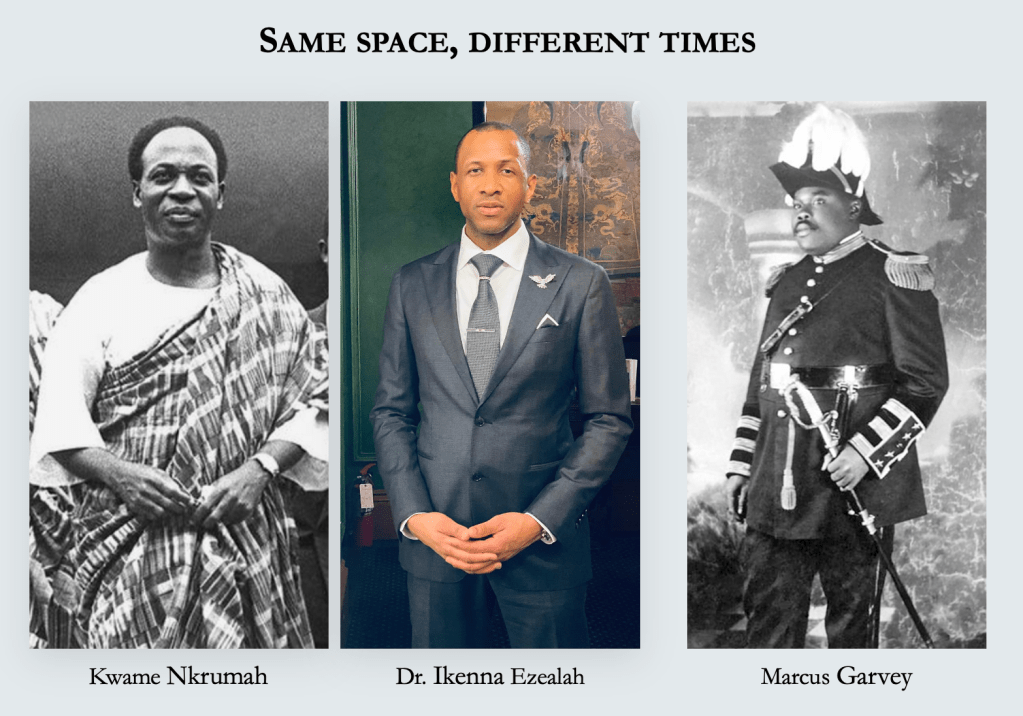
It is with great joy I announce that, this Summer, I will be a Legal Fellow and global cohort class member of the 2024 Garvey-Nkrumah Fellowship Program!

The Garvey-Nkrumah Fellowship Program, established in honor of international civil rights leaders, political theorists, and dignitaries Marcus Garvey and Kwame Nkrumah, is a summer leadership and professional development initiative designed to train aspiring lawyers and future leaders of African descent in the areas of International Trade & Development, Public Policy & Diplomacy, Conflict & Dispute Resolution, and Civil & Human Rights. Fellows will engage in a comprehensive learning experience through a legal internship, a trip to Ghana and Rwanda, and a self-directed capstone project designed to advance solutions that address legal, social, economic, and/or public policy issues within Africa, the Caribbean, and the Americas.

This Legal Fellowship is a big victory, for it strategically builds on my professional experiences from 2023: (1) International Trade Intern at the United Nations International Trade Center in Geneva, Switzerland; (2) International Diplomatic Immersion experience at the Washington International Diplomatic Academy; and (3) Multilateral Diplomacy training at the United Nations Immersion Program for Multilateral Diplomacy.

With unswerving precision it also furthers my professional goal:

To be an international nation-building diplomat who creates and implements policies that drives the indigenous development, progress, self-sufficiency, and economic integration of the African continent.

I resolved to go to law school to answer an inner call to support the emergence of genuine leadership in Africa, to partake in the work of institutional transformation in post-colonial Africa so it reflects the cultural heritage and indigenous nature of the people, and to create frameworks that encourages the creative expression of the natural abilities of the African people for the progress of the African continent.

Yet I knew my designs and efforts alone would be insufficient, for I needed the decisive Grace of God and His Blessing to guide my earnest efforts to reach the goal! Thus, I find success because I try to lean into the guidance of God to know where I am to energetically exert diligent efforts to achieve victory! I am thankful to the Almighty for His Grace that opens doors!

My formula is: The will + higher guidance + strategic diligence /(over) time = unconditional victory! Every element in the equation must be balanced for the victory to be unconditional

I am honored to be a Garvey-Nkrumah Fellow, in the names of two men whose lives are a signpost to my own destiny. Yet I know every success I am afforded is only a Divine loan I am to repay through the service of my life to help my people. Thus, what drives me is not personal success, but to achieve my life’s objective:

To be a servant of God on earth, and a helper and guardian of the welfare and further development of the African people!

Onward & Upward!

~Dr. Ikenna Ezealah

Seven Questions For African Development

Sometimes a danger to real African development are Africans with a lot of formal western education, because many can only think within the foreign framework they learned in schools. So, their idea of development is reproducing on the African people the ideas, institutions, and societal forms that apply to Western societies, to the subordination of their own indigenous systems, believing it will also work for the African people. Thus, they wrongly regard imitation as progress so long as it produces an outwardly visible benefit. But this is not development, just copying and long-term stagnation.

What is development? The concept must first be clarified. To achieve clarity, we must not draw opinions from our thoughts, but observe the Laws of Nature!

In Nature development is endogenic…from within. A rose develops when its inner qualities unfold outwardly, and when the guidance for this unfolding comes exclusively from within. The seed never needs instructions from without, only a supportive environment for what is within to unfold. Thus, development is a progressive unfolding of inner qualities, a sequential expression of indigenous capabilities, and a logical building out of inner components to outward completion, in accord with the inherent nature of the species.

To be “African development”, an initiative must come from within the souls of the African people, as a natural expression and a progressive building out of their indigenous qualities and cultural heritage. It must not come from without, otherwise it is adoption or an unnatural imposition. In Nature, even when something comes from without (water, sunlight), it only neutrally reinforces and helps the species express its inherent qualities.

So when people have big initiatives, plans, and developmental agendas concerning Africa, some questions to ask are:

  1. Is the plan driven by genuine love for the welfare of the African people?
  2. Did the central idea originate from the soul of the African people?
  3. Will the initiative help to unfold and mature the natural abilities of the people?
  4. Is the concept in harmony with their cultural heritage and indigenous nature?
  5. Do the plans build-on and improve their preexisting systems and social frameworks?
  6. Will the African people be uninfluenced implementing the initiatives?
  7. Is the final goal to make them self-sufficient and independent from foreign governments and institutions?

If initiatives are earnestly examined by these questions, and all answers are not a resounding yes, then real African leaders should relentlessly call them to account! African development should not advance foreign norms and institutions on the African people, but it should really operate in strict accord with the concept of development. The “African” welfare and interests coming first to then lead and guide the strategic implementation of “development”.

~Dr. Ikenna Ezealah

The African Issue

Many overanalyze the issues facing Africa, make effects into causes, and try to treat symptoms without focusing on the root issue with the most far-reaching consequences.

The most fundamental issue facing Africa today is simply that leadership, power, and governance are in the wrong hands. Most who have shared office since the wave of post-independence coups, including “elected” officials today, simply lack the vision, ability, and capacity to lead the people in genuine nation-building.

Every initiative, program, policy, and national strategy by domestic and foreign institutions, will either always fail or be limited in the scope of its success unless governance and power returns to the hands of those endowed by Nature with the natural ability and vision to lead the African people.

When a home lacks parental leadership, children can never supplemental the void because they lack the ability and maturity that Nature assigned to parenthood which is needed to provide order, guidance, and support for the collective development. Despite best efforts by the children, the woeful gaps and disorder will become apparent in all domestic processes. The same with Africa today in all institutions. The wrong people are in office, and those with natural leadership ability have either left or in most cases are just quietly pursing a mundane life of personal success.

The other issue are coups led by people who see the issues and are filled with the genuine desire and energy for real change. But the problem is that in almost all cases, these coup leaders might have the enthusiasm and energy, but they lack the genuine vision and ability to lead comprehensive nation-building! The force required to change, is not the same as the vision and strategy to guide lasting change. Thus, despite the genuine will, most overthrowers will in time become the same as previous governments because they themselves lack what is required.

Those with ability and vision in Africa need to step forward and vigorously engage the process. Form coalitions domestically and in the diaspora, harness your collective resources and expertise, infiltrate institutions, and take possession of governance so that power and leadership can return to the right hands and can be properly applied for the welfare and further development of the African people! People with a lot of education sometimes overthink the simplest issues. Here also, advanced degrees will not earn you an opportunity for governance and leadership, but only vigorous action, strategic coalitions, and sustained noble struggle will win the day.

The opportunity for genuine leadership and governance in Africa, to promote the welfare and development of the African people, will never be given. It must be won by coordinated and organized severe exertion, perpetual vigilance, and unflagging assiduity.

Let those who are serious understand that such a noble struggle is naturally incompatible with the comfortable and predictable life that many wish. For to earn such a victory requires personal cost and sacrifice. But it is worth it, because the collective welfare and development of the African people who look to leadership full of hope for a brighter present and future depend on it!

Servants, helpers, and guardians of the welfare of the African people, discard your tentative volition, step forward, and brace yourself for action.

~Dr. Ikenna Ezealah

To Builders of the African Future…

Builders of the African Future,

Do not be distracted by earning degrees, accolades, and prestige here in the West. All these things are merely tools that are meant to serve a higher purpose: Nation-building in Africa. A degree and a profession, no matter how hard-earned, is only a tool, and the value of a tool lies solely in its application to produce lasting value. When you purchase an elaborate tool kit and construction materials with a hammer chiseled from the finest steel, to take pride and classify their acquisition as the achievement is to miss the point.

The decisive question is: What are we using all these materials and tools to build? Destiny presses for an answer.

With all the collective expertise, degrees, and foreign achievements of Africans in the diaspora, I ask: what is the tangible evidence of a corresponding Nation-building back in Africa across all institutions? To be content using all our endowments for a private life abroad so long as we and our personal circle are satisfied, is to narrow the scope of our possibilities and responsibilities. We should set our gaze higher!

We cannot outsource African development to international organizations and governments, no matter how convenient it is. No. Africans must step forward and take the lead in all matters of African development. Must feel personal responsibility in setting the course of the African destiny. Thus, Nation-building is the call of our time.

Will it be easy? No. Will entrenched political interests create severe difficulties? Yes. Will there be failures and setbacks? Yes. But will it be worth it? Yes. Everything worthwhile requires personal sacrifice, and we must be willing to make it. To really make change in Africa, we cannot desire a comfortable life and we must become comfortable with the uncomfortable.

If the specially endowed Africans at home and abroad lack the will, courage, and interest to create a brighter future for the disadvantaged masses, then who will do it? Who is left to struggle for their welfare, to serve their needs, to further their development? Where are the true servants of the people?

To help the African people release their natural abilities, to be productive in indigenous institution and system building, and thereby always be hopeful and happy… is a beautiful goal.

Builders of the African future, refocus your gaze and remember the tools in your hands are not the achievement, but only the means to be applied for a higher purpose. At the crossroads of destiny, the call of our time resounds in one direction: transformative Nation-building in Africa.

May all those who are in earnest come together, pool their expertise and abilities together, work together, and nation-build together.

Onward & Upward!

~Dr. Ikenna Q. Ezealah

True African Development

The one who frames the meaning and sets the vision, frames the mind.
The one who frames the mind, directs the thoughts.
The one who directs the thoughts, guides the actions.
And the one who guides the actions, determines the destiny.

For this reason, the first step for Africa’s long-term progress is to redefine everything for itself, and to set its own vision in a way that reflects its own indigenous nature and qualities. Then, through earnest efforts, build out these meanings into processes, policies, institutions, and initiatives…until they become the fabric of society. Only then will Africa be developing, because its societal progress and destiny would be guided by its own indigenous meaning and vision.

Many developmental initiatives today are well-meaning and appear to be bringing progress, but most are simply building out the concepts and ideas imposed on the people during colonialism. They do not encourage the “breaking through” of indigenous intuitions and capabilities, so these become the defining element of initiatives and upbuilding.

Take a simple example: Education. In Africa, have we asked the questions: what is our unique educational philosophy? What values are we trying to cultivate in our people? What type of identity should our education develop? What cultural knowledge should we document, transfer, and develop through our education institutions? And what methods can help us achieve this?

Instead of these questions, you have a plethora of education institutions throughout Africa today. But many were established during or after colonialism, and do not promote genuine indigenous development and progress. Consequently, they do not cultivate a sense of pride, genuine ethnic identity, and indigenous knowledge development. Instead, despite some benefits they give, they mold the mind to idealize foreign people, ideas, and countries. Are we then surprised when people who mature to adulthood in these institutions desire to go abroad? And others who stay in their countries subconsciously regard everything foreign as better.

Is this development or retrogression?

Outward progress should never occur at the expense of self-sufficiency and indigenous development, but should be a marked expression of it. The call for builders of the African future is to help the people bring their unique ethnic qualities and abilities to the fullest blossom in all forms of society. Everything that develops on African soil in the future should express the natural intuitions of the people, and should support the vision and meanings they establish for themselves.

For this reason, all efforts for African development must ensure the fundamental philosophy is African.

The call for pioneers of the new African upbuilding goes forth. May those who are motivated by the desire to truly help and serve the people hear the call and come together. So that, joining hands in humility and fixed determination, we will diligently work to empower and uplift the people. In that way, through a new meaning and vision, a new destiny will develop for the Africa.

~Dr. Ikenna Q. Ezealah