The Nigerian political infrastructure, with few notable exceptions, has become infected by self-serving, myopic, and low-voltage personalities who govern with callous indifference to the plight and despair of the Nigerian people.
Take a recent example captured in this video!
In Nigeria, amid rising insecurity, escalating terrorist kidnapping of school children, killings of civilians by bandits, the public and humiliating execution of Brigadaire General Musa Uba by ISWAP, the boundless anguish of victimized families, the crippling economic conditions, the diminishing morale of Nigerian soldiers, and the general loss of hope by Nigerian’s for a brighter future…
Amid all of this, what is the priority of the First Lady of Nigeria? Hosting a dinner party for elites! To be feasting and laughing while the people need help and support. How dare you insult the plight of the people with this careless act? And do not gaslight Nigerians by pretending to discuss important matters over “sumptuous dinner”, for the entire historical precedence of the country contradicts this possibility. What we can expect is politicking for 2027 elections!
President Tinubu needs to call himself and the First Lady to order!
One of the few who spoke like a real leader is Senator Abaribe of Abia State at the Senate session, I recommend people watch his speech!
Besides, the “Office of the First Lady” is not even Constitutional in Nigeria, so you have no legal right to use that designation to gather Senators to discuss matters of the State!
But since many Nigerian officials, and also the First Lady have lost recognition of their duty, I am now compelled to speak for the people and remind them!
The First Lady is meant to be guardian of the flame of national values and virtues. She is meant to be the moral compass that points to higher qualities in times of darkness to inspire light, confidence, and hope.
That is the task of a First Lady! Translated to the present context of Nigeria, what can be done is leading a feminine task force with provisions and services to the people in affected areas. If one insists on private dinner, then invite the spouses of soldiers who died fighting terrorism and the families of the kidnapping victims to Aso Rock for an event to honor, commiserate, and strengthen them. To speak life into them and demonstrate that the country sees them, loves them and stands with them! These are two examples how you can ignite the flame of national values in times of darkness. Stand on your duty!
Why do you Nigerian officials forget the people? Why do you not help and protect them? Why are you so numb in the face of such suffering? Wake up and take up your duty or one day the ray of upheaval will reach you! Then, according to the Law of Reciprocity, you will receive the same support you gave Nigerians in their time of suffering … indifference! Remember this and wake up!
In service!
~Dr. Ikenna A. Ezealah, PhD, MBA Builder of the African Future JD loading…
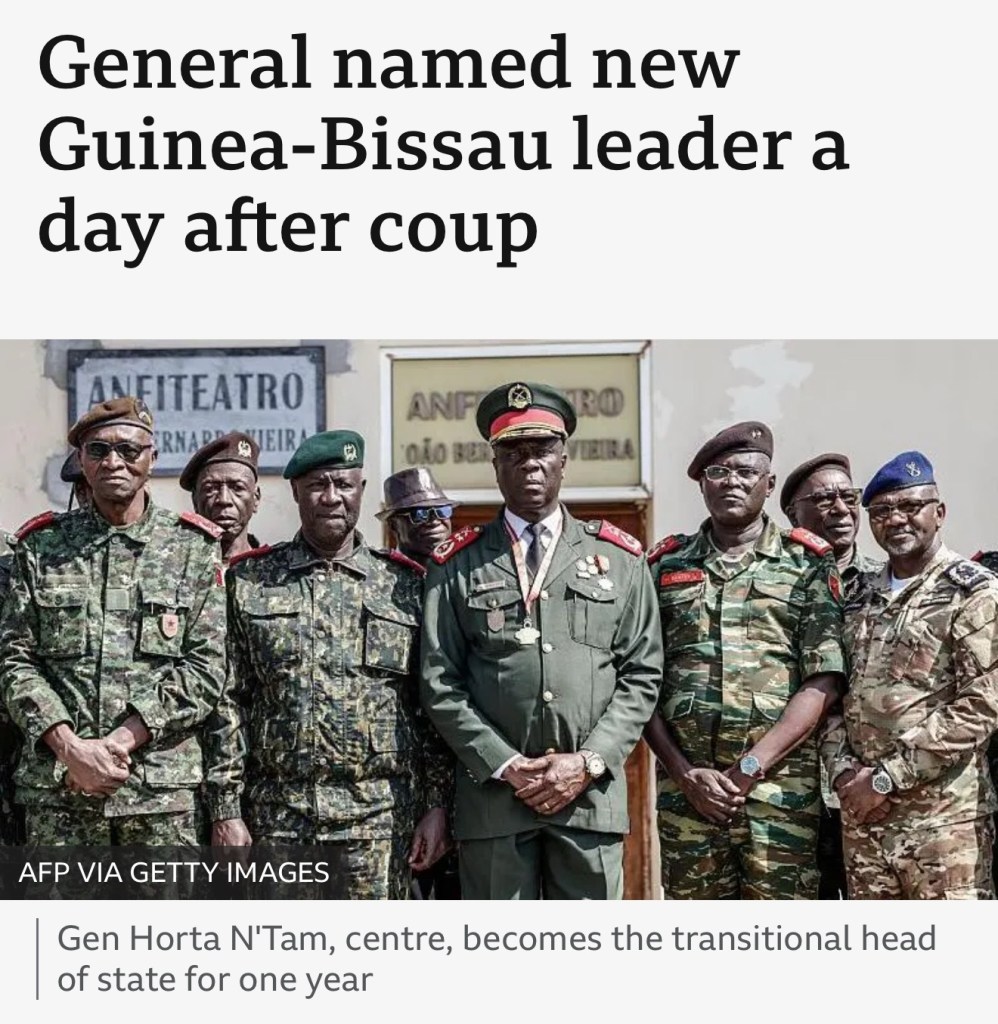
On November 26, 2025 there was a military coup in Guinea-Bissau and, accordingly to reports, General Horta N’Tam has now assumed leadership of the country.
No matter your views, here is the central message for African leaders:
The people of Africa are tired of failed leadership and the excuses why they are not seeing tangible development, yet leaders are living in luxury and comfort. The people are tired of people telling them to just “go to the polls”. Tell me, what are you supposed to do when:
1) The Legislature is self-serving and corrupt. 2) The Executive is nepotistic, exploitative, and king oppressor. 3) The Judiciary delivers judgments for “30 pieces of silver” from the Legislature or Executive. 4) The Security Service are just the paid body guards of the Executive and Legislature who do their bidding unjustly. 5) The electoral commission is rotten, comprised, and rigged. 6) The leadership pipeline is “pay to play” and highly tribalic. 7) Every year conditions keep getting worse. 8) No sector in the national economy is stable and functional. 9) You see generations wasting away in multidimensional poverty. 10) Foreign organizations gaining greater control of minerals and natural resources, shipping the wealth back to their countries, and leaving the locals impoverished. 11) The country drowning in increasing national debt that the generation wasting away is supposed to somehow settle. 12) You pray and hope, take action, try to be civil, but no matter what you do the same government stifles and silences you.
What do you expect the African people to do under these conditions? Just sit there and dissolve? So how dare anyone judge the measures they take to regain control of their country out of dire distress? What boundless audacity to criticize the actions of people who are driven in desperation to near insanity?
I am not advocating coups as the solution. What I am saying is that I understand the motive behind it and sympathize with the feelings. If African leaders continue in wretchedness and incompetence, and fail to come their senses then they should now be prepared for the “Traore effect”.
Enough of this madness in Africa. Something has to give! The people are hungry for development, itching for progress, and ready for aggressive nation-building! Their bones are “rattling for action”.
African Leaders, either rise in leadership or fall by upheaval. Multiple choice option A or B!
Building Africa Onward & Upward!💫
~Dr. Ikenna A. Ezealah, Ph.D., MBA Builder of the African Future JD… loading
The Framing Nigerian and African leaders, set politics aside and think strategically about the long-term lessons you can draw from the bellicose tweet that Trump recently sent, which can be applied to develop your people and protect your country from potential future geopolitical intrusions. Think like visionary nation-builders! I will help in this, so let us examine the words!
In response to claims of Christian deaths in Nigeria, Trump tweeted the following. I have bracketed words for logical emphasis: “IF the Nigerian Government continues to allow the killing of Christians, [THEN] the U.S.A. will immediately stop all aid and assistance to Nigeria, and may very well go into that …. Country ‘guns-a-blazing’…”
In this essay I will not be addressing the claim of Christian deaths in Nigeria, but rather will focus on the broader principles to be drawn for African nation-building.
The Mechanisms: The claim of the antecedent IF is followed by the threat of the three-part enforcement mechanisms of THEN: aid, assistance, military. Therefore, your task as nation-builders is to form a long-term national developmental strategy that builds domestic institutions which would immunize you from these foreign mechanisms through self-sufficient productivity.
About Aid & Assistance You have been repeatedly warned that so-called foreign aid and assistance is often a cleverly orchestrated reconquest and control of national infrastructure through dependency. It is given to establish leverage, yet you carelessly overlook this and fall into the trap. So, when enforcement time comes, you are in a weak position. Your fault.
Action? List the different sectors of aid: Health, Humanitarian assistance, Security, Economic Development, Loans, Education etc. Next, form strategic action plans to develop domestic institutions that will make you self-sufficient in each of these sectors of US aid!
Health Assistance: Take health. Nigerians are everywhere in the US healthcare system and even drive innovations. Therefore, it is sheer leadership incompetence and wretchedness that Nigeria does not have one of—if not the best—healthcare industries on earth! Your task is to develop a strategy that will harness all the specialized medical skills and experiences of the Nigerian Diaspora to build a formidable and world-leading medical sector in Nigeria! Any Nigerian leader whose vision is not this big and ambitious for nation-building needs to resign and leave office forevermore.
Money/Loans: Think of money. Often you politicians carelessly get loans denominated in USD, embezzle it, then park the funds and assets in the US and Europe. You yoke your people to a foreign power, rob what little crumbs they receive from loans, then reinvest these stolen funds back to the foreign power. Such foolishness is incomprehensible. How are such human beings even a position of leadership? The US government sees all your monies and assets, where they are invested in their economy, so when these geopolitical situations arise, they can use this leverage to sanction and enforce their will against you. Again, it is carelessness of Nigerian leadership, for you have not created a safe economic environment domestically where assets can be protected, so you do not trust the country that you manage, meaning you do not trust yourselves. And this distrust is a proof and admittance of your own incompetence and failure. It is time to make this good.
Therefore, your task is to create the right regulatory environment that is uncompromisingly fair, devoid of corruption, and safe for the storage and protection assets. But this implies you must be absolutely ruthless and govern under the penalty of capital punishment against measures of corruption. Draconian severity is needed to purify governance. You must place the advancement of your country above everything but the Creator! Above tribe, family, children, above everything. Still fulfilling personal responsibilities, but nothing on earth should mean more to you than the fulfillment of duty to advance your people! Absolutely nothing! Such must be the honor cross of those who wish to serve the cause of African nation-building with their life!
About Military Intervention Foreign powers talk big about democracy, but they do not believe in it, they believe in control and force. They respect democracy to the degree it aligns with their national interests, and when it does not then their military is ready to violate territorial integrity for economic and geopolitical purposes under the banner of a moral cause. You must understand this, for history and current events bear witness to this truth. Therefore, let me ask you: which country in Africa has a robust defense industry? Institutions that develop original defense research and innovations, and then manufactures weapons for national and continental self-defense? Answer: NONE. Therefore, your task is clear as nation-builders: make Nigeria the first African country to develop a robust domestic defense industry that produces research and technologies, manufactures them and exports them throughout Africa.
Once you become self-sufficient through these institutions and can supply what you need, no foreign country will think of “invading at will”, because the cost would potentially be too heavy through high precision “missiles-a-blazing”. Additionally, you would have the capability to overwhelm all domestic terrorists and ensure the security of your people, and the peace and territorial integrity of your country. But today you are weak and cannot defend yourself, and that is why foreign countries easily threaten to invade you at will. Do you understand that your “friendship” with them is conditional on you bowing to their will? And if do not, the economic and military enforcement mechanism are unleashed. So you must counteract this through institution-building!
Concluding Message In summary, your response to Trump’s message should be quiet note-taking on the long-term lessons you can draw for national development. Your resolve should be to develop institutions and mechanisms that will make you nationally self-sufficient, so you remove the leverage that a foreign power has to enforce their will against you. Such should be your focus: developing strategies for aggressive African nation-building for indigenous self-sufficiency!
Despite the great opportunity for progress, you leaders have strayed so far away from the African Cause, have betrayed your people, pillaged resources, become foreign dependent, and even stifled visionary leaders from rising because it was not convenient for your tribalistic and selfish personal interests. But now this must change, because global geopolitics is becoming increasingly unpredictable and any country that lacks self-sufficiency is vulnerable for exploitation and control. A country that cannot feed and defend itself is useless and has no right to expect global respect. Friendly foreign gestures during times of “peace” cannot be trusted to hold during times of differences, for then the leverage they have will be used against you. It is your task to eliminate these leverages and become strong through long-term development planning.
The Call: African leaders, focus on long-term institution building that will make your people grow strong, stand tall, and become self-reliant. Develop enough pride for Africa and love for the people that will enable you to work unceasingly to build institutions and systems for their progress, which will free them from foreign control and make them partners of equal value. Become helpers and guardians of the welfare and further development of the African people. Protect and uplift them and future generations.
African leaders, stand up for your people and build institutions!
Onward & Upward!
~Dr. Ikenna A. Ezealah, Ph.D, MBA J.D. Candidate ’25 Builder of the African Future
Yes, it is time to resurrect the revolutionary spirit in Africa. Africa needs a new class of revolutionary builders.
Builders who will not just copy socialism of the East or democracy of the West, but who are prepared to search in the African Spirit and heritage then build new systems that specifically works for Africans.
In Africa today, where are the Lions, the revolutionary Thunderhawks, and the nation-building Visionaries with iron in their souls? Whose inner being commands global respect just by its regal nature?
The warriors who live and lead with a great love for their people, and who would rather enter a coffin than to betray the welfare and further development of their people!
But in Africa today a desolate picture presents itself.
What you mostly have, with few exceptions, are African leaders Iscariot who betray their people for 30 pieces of silver (loans and status quo), and pitilessly lead them to socioeconomic crucifixion!
But even as the tombstone of Africa is apparently closed, the world will witness the African Spirit resurrect into a renaissance under the leadership of a new class of emerging Lions, revolutionary Thunderhawks and nation-building Visionaries.
And then “the lukewarm will be spewed out” in leadership, so only those leaders who are serious about bringing value and progress to the African people will remain.
The mandate is clear: perform in office, or be taken out of office. No longer should wretchedness in leadership be tolerated in Africa. The people have to raise their standard to get better leadership, and remember that the best leader for them might come from a different tribal group!
A new class of revolutionary builders are needed with a firm love for God and their people, and an unwavering commitment to ensure the progress and continuous development of Africa for the welfare of the African people and the benefit of the world community.
Lions of Africa, here the call and step forward.
Onward & Upward!
~Dr. Ikenna A. Ezealah, Ph.D., MBA Builder of the African Future JD Candidate ‘25
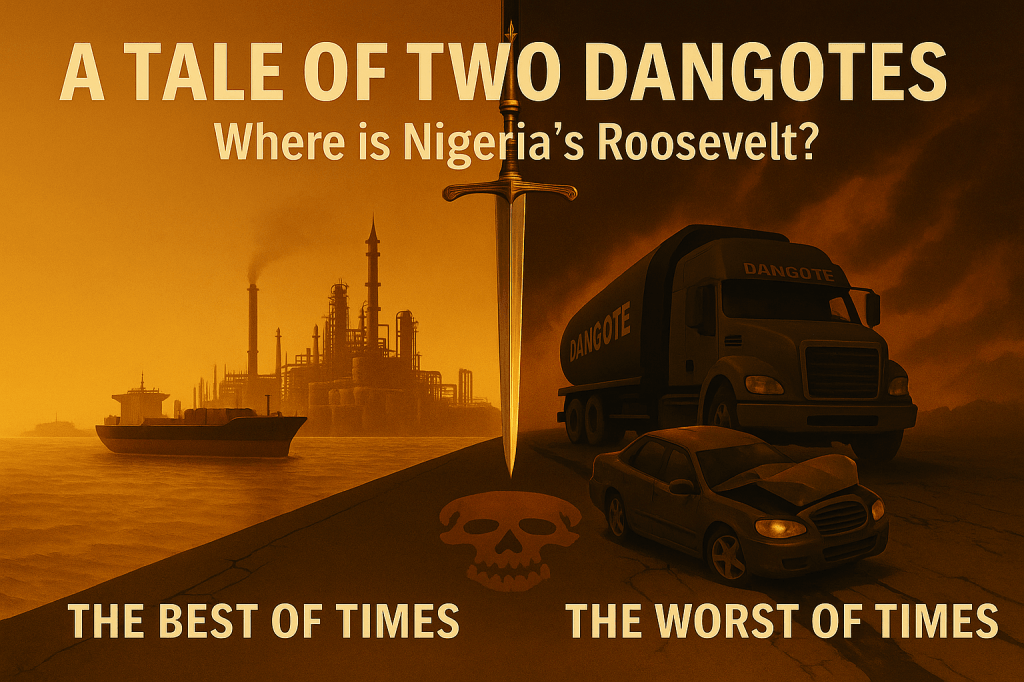
“It was the best of times, it was the worst of times, it was the age of wisdom, it was the age of foolishness, … it was the spring of hope, it was the winter of despair…”
The famous introduction to Charles Dickens’ A Tale of Two Cities that was written to capture the social contradictions in London and Paris before the French Revolution, could just as well describe the Nigerian people’s attitude toward the business activities of billionaire Aliko Dangote. His empire embodies both triumph and tragedy: on one hand, unprecedented industrial achievement; on the other, the daily menace of his trucks, whose accidents leave a trail of injuries and fatalities.
The Best of Times Dangote is praised as the face of African enterprise. His ventures include the monumental Dangote Refinery, a $20 billion facility with capacity for 650,000 barrels per day, which is Africa’s largest and among the biggest single-train refineries in the world. He has also announced plans to build Nigeria’s largest and deepest seaport in Ogun State, a project set to transform exports of fertilizer and industrial products. To many, these feats symbolize Nigeria’s potential, Africa’s rising industrial base, and the triumph of private capital over chronic state inefficiency.
The Worst of Times Yet the very name “Dangote” also conjures images of fatalities on Nigerian highways through his trucks. His cement trucks have become a menace, notorious for reckless driving and deadly accidents. Between 2015 and 2025 alone, a report on Dangote truck accidents estimates about 393 deaths and 1,040 injuries. But anyone familiar with Nigeria knows these numbers are drastically underreported. Security services and government agencies, compromised by collusion, coverups, and corruption, shield such abuses from scrutiny. Multiply those figures by at least ten, and one approaches reality. So the paradox is clear: as Dangote builds monumental projects to power Africa’s future, his trucks simultaneously leave a trail of injuries and coffins on Nigerian roads. Who will hold Dangote accountable?
The Role of Leadership This contradiction highlights the vacuum of political leadership in Nigeria. Visionary governance exists to regulate markets, enforce accountability, and protect citizens from exploitation, while coordinating private achievement toward a national vision. But historically, Nigeria’s leadership has been atrocious… more cabal than custodian, more profiteer than protector.
Where is Nigeria’s Theodore Roosevelt?
Roosevelt’s Example At the dawn of the 20th century, America faced its own Gilded Age of monopolists and “Robber Barons.” President Theodore Roosevelt confronted them directly, earning the title “Trust-Buster.”
He used the Sherman Antitrust Act with unprecedented vigor to break monopolies that strangled competition and exploited consumers.
He targeted giants such as Northern Securities and Standard Oil, forcing courts to dissolve them.
He distinguished between “good trusts” and “bad trusts,” insisting that government regulate where it could not dismantle.
His Square Deal promised fairness: balancing corporate power with the welfare of the people.
Roosevelt was not against enterprise; he was against exploitation. His mission was to ensure that no corporation, however powerful, could trample the public interest.
Nigeria’s Missing Guardian A true Nigerian leader—a nation-building visionary and guardian of the people’s welfare—would never tolerate the impunity of Dangote’s cement trucks. Leadership is not only about setting a vision for industrial growth, for it is also about defending citizens from harm by holding even the most powerful enterprises accountable.
But most of Nigeria’s ruling elite have no such resolve. When leaders themselves are chief exploiters, how can they regulate others? You cannot expect arsonists to serve as firefighters; to do so would be to extinguish the very flames that sustain them. The political class and the oligarchs are in business together, feasting on a climate of underdevelopment that ensures their continued enrichment.
Naturally, this statements do not imply that all Nigerian politicians are ignoble and ineffective or that Dangote trucks always cause harm. Certainly not. For there are promising individuals in the Nigerian political class and Dangote’s enterprise does much good in Nigeria. The statements merely highlight the unchecked status quo: the exploitative political class and the hazards of Dangote cement trucks, both of whom cause harm with little accountability.
Nigeria Needs Its Roosevelt Nigeria’s story need not remain a cycle of “best of times and worst of times.” With the growth of private enterprise, the country urgently needs leadership strong enough to regulate markets, defend the people, and direct industry toward a common good.
This is not a call to imitate a foreign president. It is a call for the emergence of a new leadership class: men and women who are both builders and guardians, who see government not as personal spoils but as a sacred trust. Leadership that is aggressive in nation-building yet unwavering in defending the Nigerian people against harm and exploitation. And this applies to Africa at large. For without such leadership, the continued hazards of Dangote trucks and all they symbolize may one day become the spark of Nigeria’s own reckoning, just as Dickens’ tale foreshadowed the French Revolution. Nigeria needs its Roosevelt.
The Callfor Guardians If Nigeria wishes to avoid that fate, it must change course. It must raise up a leader who is a servant of God, a builder of the African future, and a guardian of the people’s welfare and prosperity.
May the Lions of Progress hear the call of destiny and step forward for service!
Focused Upward, Forever Onward!
~Dr. Ikenna A. Ezealah, Ph.D., MBA Builder of the African Future J.D. Candidate ’25
Among African people, there is too much talking, analysis, and theory of the issues plaguing Africa and what will move it forward. It is wearisome, because it is evident people are not prepared for real vigorous action on ground. All grand ideas and extended analysis remain just words on the internet.
Imagine a group of farmers experiencing famine who gather to analyze the issues of the soil, pontificate about the wind pressure, and enthuse about best practices for planting and yielding the best crops. They feel good, beating their chest with empty pride. But do you know the whole time the soil is unchanged, and the farmers and their families will all eventually perish from hunger… unless they physically ACT.
Africa is the same. Too many Africans are consumed with social media presence, influencing, sounding smart, analysis, publications… meanwhile conditions on ground keep deteriorating. Unlike comfortable analysis, the real action on ground to bring change will be hard, messy, relentless, and a fearsome struggle. There will be heavy costs.
Too much education has convinced an entire generation of Africans that change will follow a “clean sequential democratic method”. But the truth on ground says otherwise.
Let us drop the act and speak frankly: without the physical action of a severe struggle there is no way most African countries will change. Tactically coordinated social upheaval is the pressure that will force a comprehensive reset. All this careful and actionless talking with soft words and curated internet statements will change nothing in Africa.
The qualities that are urgently needed to initiate a reset toward vigorous African nation-building are what I call “revolutionary thunderhawks” who operate with noble aggression and righteous fearsomeness.
There is too much big language and thousandfold academic analysis among Africans today. Yes, careful analysis is necessary and has a time and place, but we have overdosed and gone too far. Using it as a crutch to avoid action.
Now more than ever it is time for action. As I often say we need people in Africa “whose bones are rattling for action”. To take ownership of Africa through a noble struggle that, setting the foundation for aggressive African nation-building, will initiate the next developmental epoch in Africa for the welfare and progress of the African people.
Onward & Upward!
~Dr. Ikenna A. Ezealah, Ph.D., MBA JD Candidate ‘25 Builder of the African Future
One of Africa’s insidious governance failures is the obsession with white elephant projects (WEPs), which are big, flashy, and often unsuccessful construction projects that add little value but drain national resources.
Take Nigeria’s “white elephant airports”. A Premium Times investigation details how a ₦15 billion airport in Nasarawa State, commissioned in 2015, remains incomplete and dormant. Contracts were awarded, canceled, and re-awarded. Administrations changed. More money flowed. Yet the project remains moribund. And when journalists requested contract and funding details under the Freedom of Information (FOI) Act, officials had the audacity to brazenly ignore them.
WEPs are not real development, but a clever way for many officials to look productive, inflate costs, and steal public money.
Nigeria has 32 airports, but a Nairametrics report reveal that in 2022, five airports carried nearly 90% of Nigeria’s 16 million passengers, while the remaining 27 airports carried only 10%. Such failure of governance shows an unpardonable incompetence and sinister greed.
But this problem is deeper than corruption. It reveals a flawed developmental mindset and even an insecurity complex. Leaders are obsessed with “showy projects” that emulate more developed countries to “prove” Africa is advancing. All while ignoring the basics: clean water and distribution, waste management, reliable roads, stable energy, self-sufficient agriculture, public health, quality public education.
Most African countries have not mastered the basics, yet the people (and diaspora) fantasize about tech revolution, dramatic projects, and fancy silicon valley apps far removed from the immediate needs of the people.
An African nation-builder thinks: Tech relies on energy (plus education). Tech without energy is like harvesting an egg without a chicken. Therefore, energy (and education) FIRST.
Many Africans are in a dreamland, and this delusion reflects in the attitude of their leaders with white elephant projects. So the people get the leadership they deserve. Many African government officials today have not only proven themselves to be useless for nation-building, but are now also pestilential and should be compelled out of office.
Yet there is hope. Across the continent, a new class of earnest Africans are awakening who are committed to real change, who understand that a functioning society is built on basics first, and only then can other advancements be layered on top. It is high time such Builders of the African future step forward, unite, and contest to take over African leadership. Real change will only come when visionaries lead by first focusing on the “boring basics” that support the progress of the African people.
That is the task before us: reject the wasteful delusion of white elephants, and build, brick by brick, the solid foundations of African nation-building.
Onward & Upward!
~Dr. Ikenna A. Ezealah, Ph.D., MBA Builder of the African Future
The rift between Mainland Africans and African Americans is troubling. Each looks suspiciously and accuses the other of ill-treatment, condescension, ancestral betrayal, underperformance, indifference, ethnic isolation and more.
Whining over small matters like children with wounded vanity and false pride. It is a pitiful game of ego and small-minded petulance in which both sides are missing the bigger picture!
Namely, the rift ensures their continued mutual subservience to the same global order that enslaved one and colonized the other, and which still exercises undisputed suzerainty over both through entrenched systems and institutions. Instead of leveraging their strategic advantages and unique strengths for shared advancement toward a high aim, they prefer bickering and licking their wounds.
Both sides live under a sinister delusion that they can advance and reach their potential without the other! However, let me be clear: neither can fully overcome their challenges and reach their developmental potential without working together. You are brothers and sisters, ancestrally derived from the same ethnic groups, separated by tragedy, shaped by unique experiences, yet connected by the blood from the same creative African spirit that still flows through your veins!
Mainland Africans: African Americans technical skills, experiences, and strategic positioning are needed for Africa’s next stage of development. Some of the issues you have can be resolved by your siblings from across the ocean whose help and cooperation you sometimes stubbornly reject.
African Americans: Africa is the headquarters of your identity, your homeland and powerbase. Approach it with humility and make a serious effort to ethnically integrate while avoiding the savior complex. Recognize that in Africa are the minerals, resources, governments, and organizations that can strengthen your economic and political position. Many of the issues you face can be resolved by coordinating with your siblings in Africa from whom you often disassociate.
Will collaboration be easy? No. Will it have great challenges and setbacks? Yes. But it is necessary for the mutual advancement of both parties. Remember that every great aim has difficulties, but it is the unshakeable commitment to the high goal that enables all trials to be successfully overcome!
Mainland Africans and African Americans, it is time to honestly resolve the rift, set aside petty differences and work together for higher aims. We are interdependent, capable of helping each other overcome challenges and advance if we collaborate with openness, respect, and patient determination. We are one people, consanguineously interlocked by the unbroken thread of a common heritage, our destinies are tightly interwoven. Let us focus on higher goals that unites us and move us forward as brothers and sisters!
And remember, no matter how long the prodigal son was away, when he returned to his father, his time apart did not change his place as a reunited son and sibling—embraced without hesitation, restored to family! Remember this and work together!
Onward & Upward!
~Dr. Ikenna A. Ezealah, Ph.D., MBA Builder of the African Future
Nigerian-American Dr. Osatohanmwen Osemwengie, dubbed “the US drone builder”, has 4 PhD’s degrees and 7 Master’s degrees. An academic juggernaut in the fields of Robotics and Engineering, he is an indispensable asset to the US Armed Forces where he has shaped the future of military technology as a master drone builder.
So Nigerian leadership let me understand: You struggle with insecurity, have no weapon production industry, and import second-hand military technologies? All while one of your national sons is abroad, working for a foreign government as a robotics and engineering mastermind, and is behind the advanced military technologies for one of the most advanced countries on Earth?
There are no words that can describe such myopia, incompetence, and wretchedness of such abominable leadership and lack of creative vision in view of the immeasurable talents of the people that are being wasted! As an African Statesman once poetically lamented about the persistent habit of African leadership to squander developmental opportunities: “Even when opportunity drops in our laps, we never miss an opportunity to miss an opportunity!”
If Nigeria assembles just five of the highest performing and innovative diasporans abroad (in governments and private sectors) operating in each of the national development sectors, locally build an industry around them in coordination with local talent, then organize their activities around the execution of a comprehensive national vision, then I say unto you and hereby speak the following truth into the universe:
…in only 15 years (max 20 years), Nigeria will rise to the level of the US and China! And will become the developmental standard bearer and coordinator of the global African/Black People!
This is not an opinion, but an ungainsayable fact of objective reality!
But this requires real leadership and vision from governance committed to aggressive nation-building! Progressive Nigerians and Africans need to take possession of their weak governments and compel a change in leadership to visionaries who are ready to work and action-oriented!
Oh Africa, how great you could be and yet how weak and disappointing you currently are. No more excuses, just stand up and take control of your destiny! The time has now come for real change, so either African leadership embrace aggressive nation-building, or any impediments therein should now be swept of the way!
Onward & Upward!
~Dr. Ikenna A. Ezealah, Ph.D., MBA Builder of the African Future
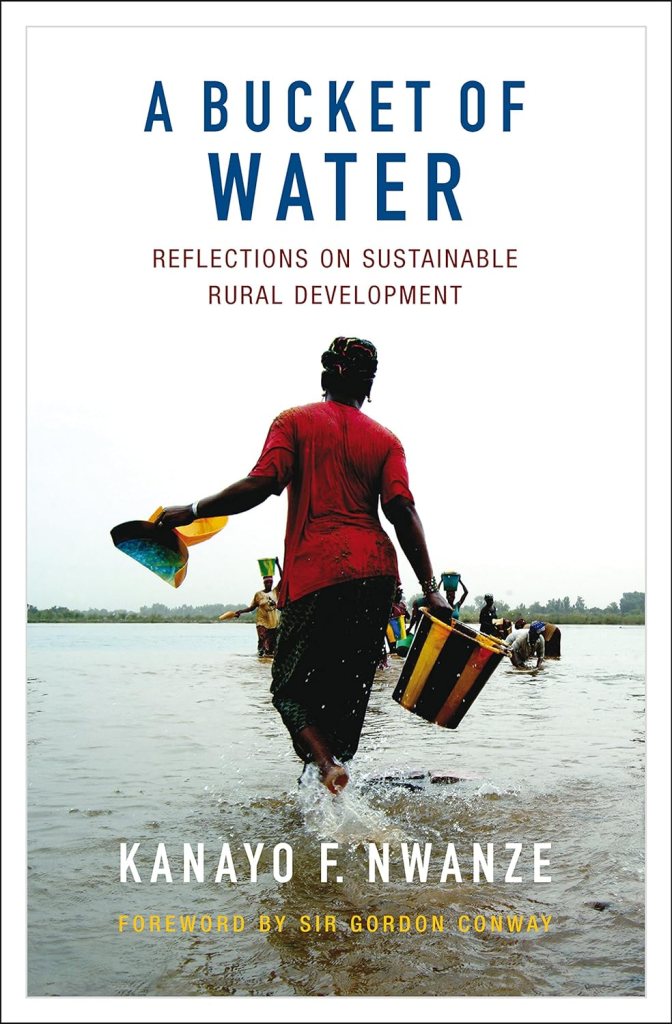
Excerpts from “A Bucket of Water”: Reflections on Sustainable Rural Development by Dr. Kanayo F. Nwanze.
“The three-quarters of the world’s poor who live in rural areas are responsible for up to 80 percent of the food produced in sub-Saharan Africa and parts of Asia (IFAD, 2016c), yet many must buy food for their own table (Christiaensen and Demery, 2007).”
“It is a terrible irony that so many who produce food for others must buy it for themselves. But more than that, it is a travesty because smallholders are penalized at both ends. Lack of access to markets, poor infrastructure, and other causes often prevent smallholder farmers from benefitting from higher food prices. At the same time, they must pay these high prices to feed their own families.”
“Against this backdrop, we must confront the question of how humanity will feed and sustain itself in the future. The world is becoming increasingly urban, yet cities are still fed by people working the land in rural areas. The health of urban dwellers depends on the quality of the water that flows into cities from rural areas. And without strong rural economies that offer decent jobs and dignified living conditions, the exodus to cities will continue unabated, creating social, economic, and environmental instability.” ~(Nwanze, 2017, p. 4-5)
Further Excerpts from “Africa Unchained”: The Blueprint for Africa’s Future by George B.N. Ayittey
“The third, and perhaps the most important, reason for the failure of collective agriculture was the neglect and downright denigration of peasant traditional farmers. These farmers would have responded to the call to increase output had they been given the right incentives. As Times (June 6, 1986) put it:
‘By and large, African peasants are capable farmers. The problem is that … African states provide little incentive to grow more food. The state-set prices are kept low to please city residents, but in many areas they are not high enough to pay farmers for the cost of production. Unable to make a living on the land, farmers join the exodus to the cities, compounding the hunger problem (p.37).’”
“And even the World Bank acknowledged as far back as 1982 in its World Development Report that: ‘Small farmers can be highly productive, typically producing more from each acre than large farmers do, despite the often considerable disadvantages of their limited access to services, markets and production inputs such as fertilizer’ (West Africa, Aug 23, 1982; p. 2147).” (Ayittey, 2005, p. 257)
“… the authorities need to recognize that peasant farmers produce the bulk (over 90 percent) of Africa’s foodstuffs and about 80 percent of these peasant farmers are women.” (Ayittey, 2005, p. 259)
Reflections & Next Steps in relation to African Development by Dr. Ikenna A. Ezealah
A brief overview:
Three-quarters of the world’s poor who live in rural areas in Africa produce about 80-90 percent of Africa’s food, and the majority are women.
Despite producing most of Africa’s food, most of these smallholder farmers must still buy food for their own table and, due to a combination of factors preventing them from selling/benefiting from higher food prices, they still pay these higher prices to feed their families.
Small farmers in Africa can be highly productive and even produce more per acre than large farmers, despite systemic discrimination and considerable disadvantages of limited access to services, markets, and other production inputs.
From this survey, it follows that a well-established agricultural value chain with the foundation of productive smallholder farming in Africa will have the most immediate and comprehensive effect on national economic growth, poverty, and employment of most of the population of African countries. Thus, smallholder farming and rural development must be a primary focus area for national development agendas.
Next Steps for African Governments
The next steps for many African governments is to significantly invest in smallholder farming and build out the various components of the agricultural value chain, with a strategic focus on rural development with linkages to markets. Markets not only within the African country, but also within the continent by leveraging the AfCFTA. The African Union 2003 Maputo Declaration called on member states allocate at least 10 percent of national budgets to agriculture and rural development. Based on the comprehensive effect of the agricultural value chain on the developmental trajectory of African countries, I recommend an allocation of 10-20 percent.
At first glance the recommendation seems high and appears it will encroach on the budgetary allocations for other critical sectors. However, it only appears so until one understands that the entire agricultural value chain embraces other sectors (e.g. roads, transportation, education). An issue with African governance is the lack of long-term national planning and policy coherence between the different sectors, so often money allocated for one sector is not strategically coordinated to have a multiplicity of effects on others! The consequence for Africa is disjointed budgeting, waste, and a bloated and ineffective government with poor implementation. Thus, my recommendation of 10-20 percent investment also presupposes the onset of policy coherence for strategic African nation-building.
Consider roads. Today many African governments concentrate road projects around major cities and often neglect the rural areas. However, as rural areas are the lifeblood of agriculture that feeds Africa, it is important to build road networks (among other things) in rural communities that connect smallholders to markets and which enables parts of the agriculture value chain to easily interact with them. Transporters should not have to battle through hazardous roads just to reach smallholders and deliver their necessary goods to market. If they do, the prices are marked up (officially or unofficially through private payments) which then lowers the margin of smallholders and puts them at an economic disadvantage to sell at a price that may not cover the cost of production. Overtime this issue and others like artificial price suppression, frustrates smallholders and causes many to start leaving farming and pursue other urban opportunities. The consequence is lower food production, higher prices, more agriculture imports, loss of agricultural self-sufficiency, increased urban congestion and slums, higher poverty and unemployment, continual national decline and more!
Roads in a country are analogous to blood vessels in the body, and are networks meant to connect two areas that, once joined, would trigger broader socioeconomic development and have the most wide-ranging effect on the people. Every road build should have a feasibility study that details how it strategically coordinates with and supports the 25–50-year national development plans embracing all sectors. Every action by African government must be both comprehensive and practical. Thus, if the hand that feeds Africa comes from the rural areas, it makes sense to build and maintain effective roads that the hand must pass to figuratively “put food in the urban mouth”.
Summarized Next Steps —> Ensure effective road networks as linkages of smallholder farmers to the value chain and markets. —> Invest 10-20 percent of national budget in building the agricultural value chain. —> Investment should be within the framework of long-term national planning. —> Ensure policy and strategy coherence between the different sectors in budgetary allocations.
~Dr. Ikenna A. Ezealah, Ph.D., MBA Builder of the African Future



 Nation Upbuilding