What is the root of Nigeria’s (and Africa’s) problem?

Addressing the root of Nigeria’s problem.

I watched a video discussing a root of Nigeria’s developmental problem to be inaccurate census data, whereby the government cannot accurately plan and provide support for those it cannot count. Think infrastructure capacity as an example. In response to this video, someone rejected the premise and instead blamed Nigeria’s developmental woes on the familiar villain “corruption”.

I have long since deeply reflected on this topic. So, stirred by the video and the reaction, I penned my reflections. May the inscribed words open new paths of contemplation for Nigerian’s and Africans to progress toward the ideal!

The lady’s points are valid. However, inaccurate census data is not the root problem, but a factor. Corruption too is not and has never been the root problem, but rather only a symptom of the problem. Let me explain. There are three layers of problem analysis: cause, symptom, and factor.

A root cause is the origin; a symptom is the direct effect of the cause; and a factor is the secondary effect of the cause and a direct effect of the symptom. 

So what is the root cause? Simple but fundamental: a lack of genuine love for the people. Most officials in government and the citizens themselves lack a genuine love for the people and country. The burning love that is consuming, infectious, and is directed toward all, and not limited to little family, kin, and tribe! The consequence of this lack of love is the symptom we experience in government as corruption.

Love wants to service and give, lack of love wants to be served and take! Public service turns into the public being at one’s service. Take a simple example:

If a mother has 3 starving children that she loves and you give her $100, what will she do? She will spend every penny to feed them! Because she loves them and wishes only for their welfare. But if she takes it and goes partying, or buys shoes while her children starves, then she lacks real love for them. So the corruption of her extravagance is only because she lacks real love! Then her not keeping up with what the children need (inaccurate data) is only an outgrowth of her extravagance (factor of her corruption). Do you see?

Nigerians have been allowing people (through election or force selection via rigging) in office who do not love the people and are committed to their welfare! The outcome from that is bound to be corruption.

We should not chase factors or symptoms, but go to the root: genuine love! Nigerians should find and support people who have this genuine love that burns within them like a surging ocean of flames 🔥. A love that only desires to serve with whole heart, for the welfare of that which is loved (the people). In love is light and development, just like the rays of the Sun brings to Nature. In love are the creative visions for collective progress, and the victorious strength for their implementation!

(For a few of many good examples of strong nation-building leaders who governed with a firm love for their people, research the details of Osagyefo Dr. Kwame Nkrumah of Ghana, Sir Seretse Khama of Botswana, and Lee Kuan Yew of Singapore!)

Then there is a separate conversation of the needed fashioning of institutions and systems that separate and check powers once the right person who loves is governing. Essay for another day! 

Jesus is written to have said “I am the Way, the Truth, and the Life, no man cometh to the Father but by Me.”

How does this apply here? Jesus is the Love of God, so the way to genuine progress and ascent inwardly and outwardly is through love. For Nigerians to find the way to positive development, they therefore must seek ye first “genuine love”. In love is the way, truth, and the light of progress. This is not an opinion or religious thought, but an explanation of Holy Law governing the Universe and every aspect of human existence for eternity!

So the main thing for Nigerians and Africans to progress is to inwardly turn to God in love, awaken love for their neighbor and country, and support those with a genuine love for the people for leadership. Then the Rays of development, like the luminous rays of the Sun, will shine on Nigeria and Africa, dissolving the impurity of corruption, and leading to a new beginning of robust growth for the welfare of the people.

Then the faces of Nigerians will radiate pride and joy, as a consequence of their own love that is reflected in the deeds of love in leadership. May God grant it!

Onward & Upward!💫

~Dr. Ikenna A. Ezealah, PhD, MBA

Builder of the African Future

JD….loading.

Reclaiming The African Name

Why do African Peoples still use foreign names? And next steps.

I once visited a business and was attended by a Cameroonian lady. During conversation I asked her name, and she said “Jane”. I then asked about her real name…her African name. She smiled and said she does not have one. I was confounded, and this initiated a friendly dialogue between us about the practice of Africans adopting foreign names.

It has become habitual for the Global African People to have and give their children foreign names. Even if they are born and raised in Africa. What is the origin of this practice? And how can we change it?

For Africans it stems from colonization and religious imperialism. For African descendants it is the slave trade in which enslaved Africans were forced to relinquish their original African ethnic groups and adopt a European name.

Religious groups like Christianity encouraged Africans to adopt a biblical name to fully convert. but this was just cultural imperialism masked in religious evangelism. Using two biblical examples: Saul became Paul and Simon became Peter after an inner spiritual change. Their names changed but within the SAME broader ethnic group. Africans see this, miss the point, and change names to a different race. Additionally, African names often even have a direct reference to the Creator in their meaning. So objectively why change it?

Among African Americans, despite achieving freedom for decades very few have bothered to reclaim their ethnic identity and change their names, or at least give their children an African name. Today both groups have become so comfortable with this practice that most will argue till thy kingdom come why they should keep it.

People will give many reasons, but their roots are mostly the same: generational habit, assimilation for social/professional ascension, and deification of all things foreign. You are African… why are you running from an African name? Do you see Europeans or Westerners giving themselves African names? Here are recommended next steps:

-For African descendants: Individuals, families, and marital couples can adopt an African ethnic group, choose a last name, then change names. Or to start small adopt an African first or middle name. When people have children, give them an African name from an adopted African ethnic group. I believe all African descendants on earth should have an African name.

-For Africans and African in the diaspora: No explanations needed. You are African, so just give yourselves and your children African names. The practice of foreign middle names, unless necessary through marriage, should end. You can even choose a “softer” middle name from your ethnic group or one from another African ethnic group.

The message here is for the global African peoples to start reclaiming their ethnic identity through the name, and thus start correcting the erroneous practices that originated from historical cultural disruptions and intrusions by foreign parties.

Names are words, and words have power. Remember in the beginning was the Word, and the Word is the Creator who has a Name that releases Creative Powers. Thus, the ethnic name on earth for human beings is the starting point of personal beingness and power. When your parents call you by your real African name, do you not inwardly feel a mysterious power resounding in it? It is time to reclaim it.

And I practice what I preach! For I was born with an English middle name, but I recently reclaimed my ethnic sovereignty by changing it to an Igbo one. But this is reserved for another post.

~Dr. Ikenna A. Ezealah, Ph.D., MBA
Builder of the African Future

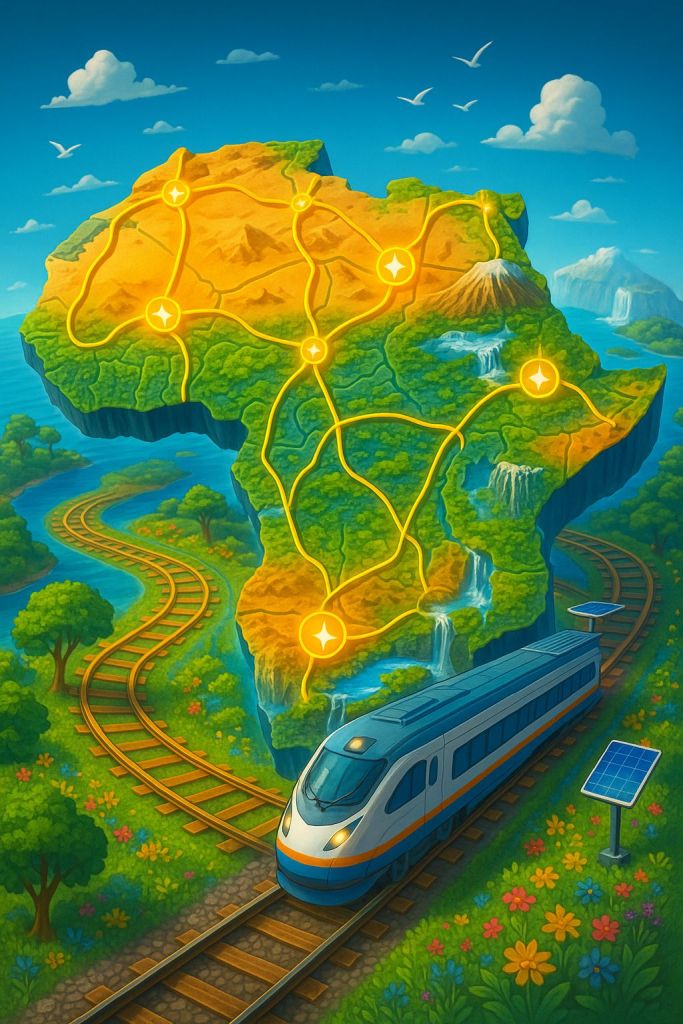
The African Continental Railway System (ACRS)

In Africa, what type of transportation network is best suited to unlock the free movement of persons, seamlessly connect all parts of the continent, and enable the dynamic movement of goods and services?

Before law school, I read the AfCFTA agreement twice and created a series of charts and flowcharts to make the information easily accessible. I reflected on the AfCFTA’s goal of promoting the free movement of people and its aim to enhance economic integration and unity across Africa, and I noticed how it aligns with the African Union’s Agenda 2063 free movement goals.

Considering these objectives, I asked myself what form of transportation would best enable the free movement of people across Africa? And I envisioned a comprehensive and fully integrated African Continental Railway System (ACR). 

Airplanes are important modes of transportation, but to best unlock the movement of people, goods and services in Africa, it is my conviction that an African Continental Railway System is best suited to the African dynamics and disposition.

African leaders could collaborate to create a framework for a Continental Railway System, linking all regions of the continent and allowing citizens to travel freely between countries. First, a continental network could be established, followed by regional railway frameworks aligned with the ACR for seamless connectivity. National governments could then layer their railways in coordination with these regional and continental plans. The economic, political, and social impact of such a system would be transformative, releasing a socioeconomic sonic boom into the future.

A continental railway would facilitate the movement of people, goods, ideas, and resources, allowing Africans to live in one country and work in another. Imagine a person living in Nairobi (Kenya) who can work in Enugu (Nigeria). Consider a developmental project in Abijan (Côte d’Ivoire) that can be partially staffed by technical experts from Yaounde (Cameroon) who would get there daily through a highspeed railway linking the countries.

But it would also create jobs across countries for Africa’s growing population, sparking continent-wide productivity and skills development. Rail construction, operation, engineering, and logistics would involve an unprecedented transfer of skills and training, contracts, public-private partnerships, allowing African youths to play a central role in building and sustaining a unified infrastructure. The ACR would facilitate industrialization and manufacturing by also igniting the steel industry in Africa. For it would be Continental Law in promoting self-sufficiency that the production of all components of this Railway System must happen in Africa! Regional hubs connecting businesses, factories, industrial sites, cities, schools, and cultural centers would open Africa to itself, fostering a rich and reciprocal exchange of culture, resources, and labor. Africans could experience the continent’s natural landscapes, while work and leisure become truly continental. 

Imagine traveling on the ACR from Conakry (Guinea) to Addis Ababa (Ethiopia) or Khartoum (Sudan) to Pretoria (South Africa). On the major pit stops African people from different ethic groups would embark and disembark. Think about the human and cultural connection! Imagine seeing and experiencing the diverse landscapes and natural wonders of Africa as you travel! It is impossible to see and appreciate the natural beauties of the land through air like you would closeup in a railway!

While challenges would undoubtedly arise, such an initiative would require comprehensive planning, precise coordination, tactical execution, public-private partnership, and the continuous engagement of citizens. However, if Africa’s leaders could establish the African Continental Free Trade Area (AfCFTA) to create a single trade market, they can achieve the same framework for the ACR. It just takes a bold vision, firm will, commitment to planning, and a tenacity for execution! The realization of this vision may take some time, but part of a visionary’s work is to establish frameworks for the future. And I believe the African Continental Railway System represents the best means of achieving a connected Africa for the free movements of persons and goods.

Let African leaders, governments, and institutions take note.

Let nation-builders in Africa step forward, bold and courageous, to build the African future! Leaders of Africa, it is high-time to think big and start leading with bold visions and diligent hands that work to realize it for the progress and development of the African people!

Onward & Upward!

~Dr. Ikenna A. Ezealah, Ph.D., MBA
Builder of the African Future

For Africa To Develop, Is Democracy The Right Form Of Government?

Summary: I ask the fundamental question: “For Africa to Develop, Is Democracy the Right Form of Government?” I address it by reexamining the basic principle of the US system, the colonial systems, and some developed countries today. A pattern emerges that shows a different truth than what is sold to Africa. The basic principle which Africa can use to achieve development once it is indigenously adjusted to its context.

Onward & Upward!

~Dr. Ikenna Ezealah

Youtube: https://www.youtube.com/watch?v=eSfMQyHZJdU