Meeting the Vice President of Botswana

During the World Bank/IMF Spring meetings last week in DC, I attended the Africa Night DC Gala Reception on Wednesday, April 23 2025.

Since I am committed to African nation-building, I prioritize events and professional connections that will advance this life objective. Even personal relationships must directly or indirectly serve the goal of African nation-building.

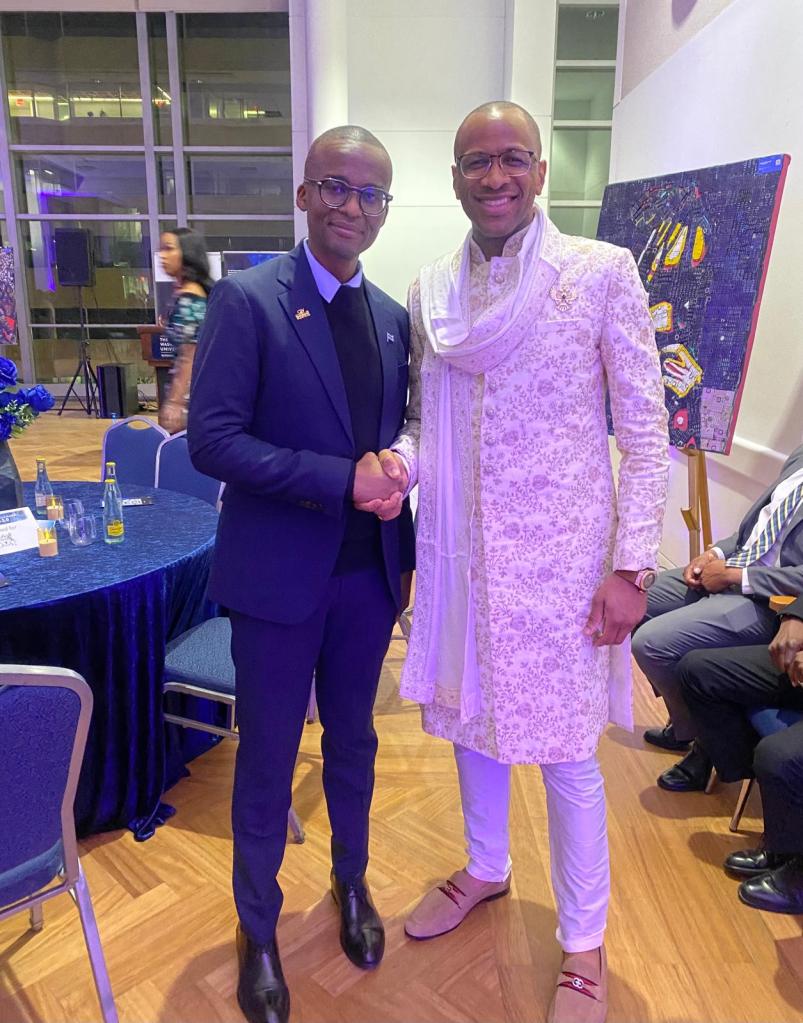
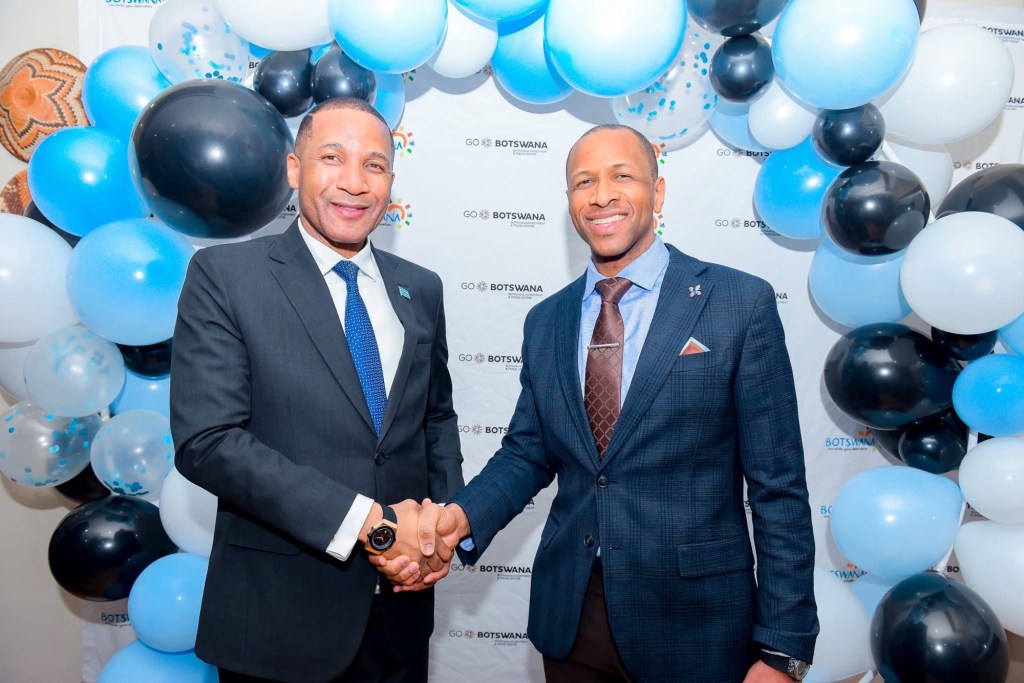
As such, during the Africa Night Gala Reception which was attended by many splendidly dressed people in a convivial atmosphere, I had the pleasure of hearing the Vice President of Botswana, Mr. Ndaba Nkosinathi Gaolathe, deliver a sincere address to the crowd. When he finished, he sat down and was surrounded by his entourage.

My African nation-building antenna picked up an inner signal, so I decided to approach and confidently walked toward him for a personal conversation. As I neared his entourage, they assessed me then soon created an opening for me to pass. I stepped beside the seated VP, extended my arm in warm greeting, and he stood up and reciprocated. Thereupon I introduced myself, thanked him for his speech, and promptly stated my business which was focused on African nation-building in Botswana. I enjoyed our brief dialogue and also informed him that just last month (March 2025) I had met the Botswana President Duma Boko and Minister of Minerals & Energy Bogolo Kenewendo.

See my previous post on meeting President Boko and Minister Kenewendo: https://nationupbuilding.com/2025/03/14/meeting-the-president-of-botswana/

After interacting with the three government officials of Botswana, I am convinced that the future of the country is bright. The young vibrant team is poised to carry and build on the legacy of the first president and transformative leader: Sir Seretse Khama. In the future I hope to also support the developmental agenda of Botswana.

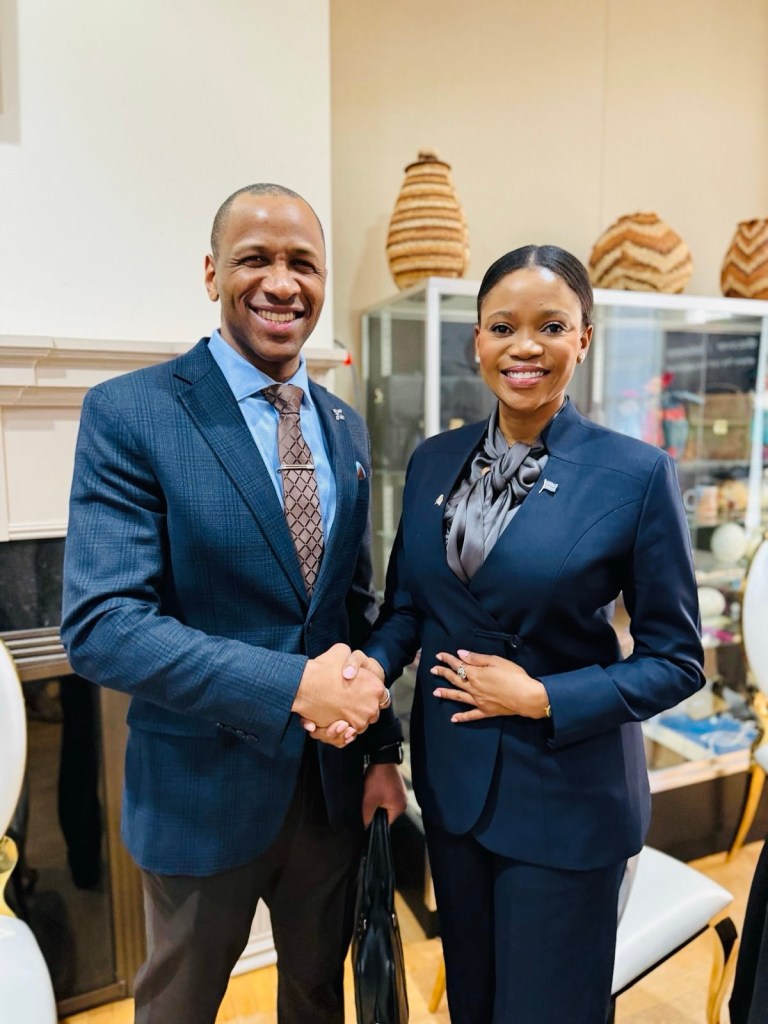
Vice President Ndaba N. Gaolathe of Botswana and Dr. Ikenna A. Ezealah

Onward & Upward!

~Dr. Ikenna A. Ezealah, PhD, MBA
“Builder of the African Future”

Solutions For Nigeria’s Post-Harvest Losses

I appreciate the problem diagnoses of the following article “Nigeria needs 5,000 cold trucks, 100 cold rooms to curb N3.5 trillion post-harvest losses”; but disagree with the approach to the solution.

Why? From the perspective of African nation-building:

Essence is the principle; form is the preference.

A patient with a migraine does not need Tylenol but a solution to their headache which can come in many forms! Solution is the essence; Tylenol is a form. Physicians in Western medical schools are taught to prescribe, so their solutions are typically a “pill-based” reliance on big pharma. Similarly, African people today are taught to buy “ready-made forms” from the West as solutions, instead of developing/exploring different potential forms to address the essence!

The need here is not a “cold truck” (form), but a preserving storage with mobility (essence). Cold trucks are AN option, not THE solution. Cold trucks require inputs that many African countries may not have sufficiently developed (infrastructure, energy, technology etc), so then they rely on Western imports and maintenance.

We first need to see if there are existing indigenous storage systems among the African people that is already suited to the environment and more agile. Next you improve, modernize, and scale it. The people would then own the homegrown technology and not be dependent on imports for their agricultural value chain. Yet I understand there is a transition period which requires a dual approach until you fully build domestic capacity.

More broadly, what Nigeria needs is an aggressive 30-year ASDP—Agricultural Sovereignty Development Plan. A comprehensive plan to domestically buildout all factors of production, inputs, systems, and institutions along the agricultural value chain to establish agricultural sovereignty In Nigeria; whose capacity and productivity will make Nigeria the breadbasket of Africa and the chief supplier of agricultural goods globally.

Such growth can only happen and be maintained when it is built on indigenous systems that come from within the people i.e., when “essence” is developed into indigenous “forms”, and all foreign inputs ( “forms”) are adapted to the cultural context of the African people. However, it takes visionary political leadership with the right concept and approach to development to undertake true African nation-building!

Today Nigerian political leadership is abysmal (and since post-independence has been so with but few exceptions), therefore they are generally incapable of solving this problem. Change will only happen when visionary nation-builders take possession of political office in Nigeria and, with an iron-will for the good and sound strategy, aggressively drive development forward for the complete transformation of Nigeria.

~Dr. Ikenna A. Ezealah, Ph.D., MBA
“Builder of the African Future”

Leaders of Africa, Speak UP!

Many people are discussing Africa as the future—and rightly so, given its immense potential.

Academics, investors, politicians, think tanks, individuals, and governments alike all have something to say about the need to position themselves to benefit from the African growth they believe is coming.

Conferences are held to set global development agendas and define Africa’s role. Others focus on Africa’s place in the geopolitical tensions between the U.S. and China. Some spotlight climate change or other global trends and how Africa can adapt. Still others center on technological innovation and how Africa can catch up. The list goes on.

The voices are loud—talking about Africa, talking for Africa, even trying to set the agenda Africa should follow.

But you know who is silent amid all this clamor? African leaders.

Like palm trees swaying in the wind, many attend conference after conference, adjusting their positions to match whatever the international community is saying.

But no one truly knows the position of African leadership. No one has seen a united front articulating a bold, original vision for the Continent—a vision championed confidently before the world as Africa’s position!

So I ask: African leaders, where do you stand?
What is your conviction?
Where is this continent going under your leadership?
What bold vision have you put forth to shape the future of your people?
What priorities have you established, instead of merely accepting the priorities handed to you by others?

It is with shame, frustration, and fury that I look into the ranks of much of Africa’s leadership—because I am utterly clueless about where the continent is heading. There is no guiding vision.

Everyone is speaking about and for you, Africa. But you, leaders of Africa—why are you silent? Why do you lack conviction and original vision? Why have you become mere followers—puppets—echoing the positions of foreign ventriloquists?

Yes, a few African leaders today stand as exceptions. But most have no business being in office. They should step down and make room for those who do have the capacity and conviction—those ready to serve with their whole heart with an iron-fist for the good, and lead their people forward with original visions brought to life through aggressive nation-building!

Leaders of Africa: Stand up. Straighten your backs.

Speak up. Declare your vision.

Lead your people into a brighter future.

And if you cannot—then respectfully step aside so those whom Heaven has endowed and prepared for these times may step forward to take action!

The African people are tired of lukewarmness and weak leadership, and hunger for something more!

Now is the time for firmness, for strength, for vision, and for bold action.

Leaders of Africa… speak up for your People and Continent!

Leaders of Africa… Speak up!

~Dr. Ikenna A. Ezealah, PhD, MBA
“Builder of the African Future”

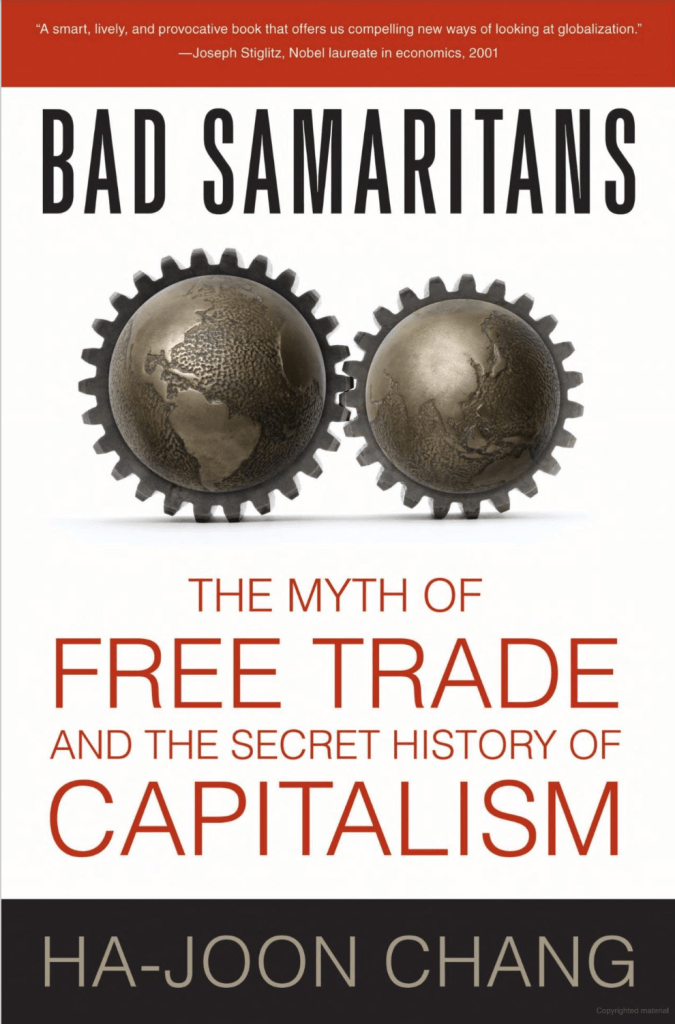
“Bad Samaritans: The Myth of Free Trade…” by Ha-Joon Chang

For me, continuous reading, experience, and reflection are essential for professional development and thus for constantly refining the tools necessary for effective African nation-building.

In line with this objective, I finished reading and reflecting on the book “Bad Samaritans: The Myth of Free Trade and the Secret History of Capitalism” by Ha-Joon Chang —a work I highly recommend! And not being too dramatic but, given the rich content, it should have been titled “The Gospel of Economic Development According to Chang”.

The range of topics, the sharpness of his analysis, and his dynamic use of humor made the examination of economic development both insightful and engaging. His work has enhanced my perspective and sharpened my African nation-building toolkit!

Summary:
Using wit, an engagingly personal style, and a battery of examples, Chang blasts holes in the orthodoxy of Thomas Friedman and other liberal economists who argue that only unfettered capitalism and wide-open international trade can lift struggling countries out of poverty. On the contrary, Chang shows that today’s economic superpowers-from the U.S. to Britain to his native Korea–all attained prosperity by shameless protectionism and government intervention in industry.

He argues that the alliance of advanced countries (acting as ‘Bad Samaritans’) have conveniently forgotten this fact, telling the world a fairy tale about the magic of free trade led by the US and mediated by the ‘Unholy Trinity’ of international economic organizations that they largely control—World Bank, International Monetary Fund, and World Trade Organization; ramming policies that suit them down the throat of the developing world.

Unlike typical economists who construct models of how the marketplace should work, Chang examines the past: what has actually happened. His pungently contrarian history demolishes one pillar after another of free-market mythology. We treat patents and copyrights as sacrosanct―but developed our own industries by studiously copying others’ technologies. We insist that centrally planned economies stifle growth―but many developing countries had higher GDP growth before they were pressured into deregulating their economies. Both justice and common sense, Chang argues, demand that we reevaluate the policies we force on nations that are struggling to follow in our footsteps.

Three Previously Completed Books:
✅ Why Nations Fail: The Origins of Power, Prosperity , and Poverty – Daron Acemoglu and James A. Robinson.
✅  Dead Aid: Why Aid Is Not Working and How There Is a Better Way for Africa – Dambisa Moyo
✅ Africa Unchained; The Blueprint for Africa’s Future – George Ayittey

Onward & Upward!

~Dr. Ikenna Ezealah
“Builder of the African Future”

Meeting the President of Botswana

I am earnestly committed to the Cause of African Nation-building. So I focus my energy on what affects the lives of the African people, and prioritize relationships with people who are earnestly committed to this goal, or who enhance my life in varied ways which enables me to better pursue this goal. 

In this process, life naturally orchestrates connections with people at all levels—even the highest professionally—who also share this goal in their own unique way. 

One such encounter recently occurred on Friday, March 7, 2025 at the Embassy of Botswana in Washington DC. There, I had the pleasure of meeting and interacting with two other nation-builders and rising political stars in Africa: the newly elected President Duma Boko of Botswana, and Bogolo Kenewendo, Minister of Minerals and Energy of Botswana. Of course, all discourses had one theme: African nation-building. After meeting them, my confidence in Botswana’s bright future is reinforced. 

President Duma Boko and Dr. Ikenna Ezealah
Minister Bogolo Kenewendo and Dr. Ikenna Ezealah

Photos are great, but I should emphasize that my aim is beyond photo-ops. It is focused on a broader coalition-building of people who are committed to forming strategies and taking energetic actions that will physically manifest in the continent to directly improve the lives of the African people. 

I hope to unite with such people who are focused on building a brighter African present and future. 

~Dr. Ikenna Ezealah

“Builder of the African Future”

…Dr. Juris-Diplomat

March 6, 1957—The Birth of An Independent Ghana

Happy Independence Day Ghana!

On this momentous day, March 6, 2025, I join the people of Ghana and the Global African community in celebrating the anniversary of Ghana’s independence, achieved under the leadership of the Osagyefo Dr. Kwame Nkrumah! I also honor The Big Six of Ghana (Kwame Nkrumah; Joseph Boakye (‘J.B.’) Danquah; Emmanuel Obetsebi-Lamptey; Ebenezer Ako-Adjei; William Ofori Atta; Edward Akufo-Addo)—and all others who contributed to the struggle for Ghana’s political liberation. Their efforts not only secured Ghana’s independence, but also set a precedence for other independence movements across Africa.  

On March 6, 1957, Ghana became the second African country to gain independence. Although it is widely regarded as the first, historical accuracy gives that distinction to Sudan, which gained independence from British-Egyptian rule on January 1, 1956—making it the first African country to gain independence in the year 1956, before Ghana.

Sudan’s colonial administration was unique —it was governed under an Anglo-Egyptian Condominium (1899-1956), meaning it was jointly ruled by Britain and Egypt, rather than being a direct colony of a single European power. So, while Sudan was the first African country to gain independence in 1956, Ghana (1957) was the first African country to gain independence from direct European colonial rule (British Gold Coast).

As a Garvey-Nkrumah Legal Fellow, our delegation visited Ghana and Rwanda in the Summer 2024. After completing our official business for the trip—including a meeting with the President of Ghana—we visited the Kwame Nkrumah Memorial Park & Mausoleum in Accra. The previous Summer, I had read Dr. Nkrumah’s autobiography and had devoted time to understanding him not just as a leader, but as a person—exploring his deeper aims and motivations. This experience was deeply inspiring and further reinforced my commitment to African nation-building!

On July 19, 2024, I stood beside Dr. Nkrumah’s statue, mirroring his forward-pointing gesture that powerfully embodies his famous words: “Forward ever, backward never.” Then I knelt before his grave, filled with different intuitions. Sometimes in life, the most precious things cannot be shared.

“Osagyefo Dr. Kwame Nkrumah, a thousand thanks for your positive example of visionary African leadership, and your unbending commitment for the welfare and progress of the African people. Most of all, your natural reverence for God. These are noble qualities desperately lacking in African leadership today, and we feel the big gap left by your absence.”

I will carry the torch of African progress forward, working diligently to ensure it burns brighter in this generation—singularly focused on the mission of African nation-building!

Confidently I walk the path of destiny—“Forward ever, backward never”—focused upward, forever onward!

Happy 68th Independence Day Ghana!

~Dr. Ikenna Ezealah
“Builder of the African Future”

African Diaspora Day On The Hill

During CBC week (Congressional Black Caucaus) that took place in DC from September 9-15, I attended the African Diaspora Day on the Hill. Some notable encounters included Dr. Abike Dabiri, CEO of Nigerians in the Diaspora Commission (NiDCOM), and Ms. Anna Mwalagho, Swahili Language and Culture Lecturer at Howard University.

There is a backstory that made my surprise encounter with Ms. Anna Mwalagho magical. During undergrad at Bowling Green State University, I was Treasurer and then President of African Peoples Association (student organization). As President, I exuded a triumphant enthusiasm in vision-setting, mission-forming, and working with my executive team to design and implement programs to promote the African cause on campus. My organization work was the happiest years of my undergraduate experience!

Here is an excerpt from a 2007 school newspaper about African People’s Association:

Otiso, a faculty advisor for the APA, said he was impressed with [Ikenna] Ezealah’s vision and goals coming into office.

“Soon after being elected president a year ago, he proceeded to share his vision for the organization and what he hoped to accomplish in his tenure as president. I was amazed at his grasp of the issues,” said Otiso.

As president, Anyanwu said that Ezealah has had a tremendous impact.

“People are taking the organization more seriously than in the past. Now we are working with the mission statement in mind instead of being just a social group,” he said.

With a mission focused on educating the public about the real image of Africa, the organization has planned several educational events. The Annual Dinner Celebration on April 17th is the biggest event put on by the APA all year. 

https://bgfalconmedia.com/114108/news/bg-news/apa-goals-represented-by-single-growing-plant/

And during my tenure as President, the main performer during the Annual Dinner was…. Ms. Anna Mwalagho! She is a renaissance woman with an inspiring affection for Africa.

After graduating I lost touch with Ms. Anna Mwalagho. Then while reflecting on my life during the COVID, a fire awakened within to participate in the post-colonial nation-building of Africa, so the institutions and systems accord with the indigenous heritage of the African people. I then enrolled in law school and set out on the course to be an international nation-building diplomat. After a foundational first year, I transferred to Washington College of Law in DC. Months later, I attended the African Diaspora Day on the Hill during CBC week. There, in a moment of wonder and nostalgia, I again crossed paths with Ms. Anna Mwalagho from my APA days! Life coming full circle.

In College I was just working joyfully as Treasurer and then President of African People’s Association. But in retrospect it appears the experience was a clue to a future life marked with the objective to be a helper and guardian of the welfare and further development of the African people!

Onward & Upward!

~Dr. Ikenna Ezealah

Top 10 African GDPs v. Elon Musk’s Net Worth (2024)

Just for fun, I asked ChatGPT to compare the current GDPs of African countries with Elon Musk’s net worth (estimated at $248 billion). While the figures should be verified, the preliminary result is:

Elon Musk is the 5th largest economy in Africa, with a net worth greater than 50 African countries. Here’s the numerical breakdown.

Top 10 African GDPs v. Elon Musk Net Worth (2024)

1. South Africa – $373 billion
-Musk’s net worth is 66.5% of South Africa’s GDP
-Difference: South Africa’s GDP exceeds Musk by $125 billion
2. Egypt – $347 billion
-Musk’s net worth is 71.5% of Egypt’s GDP
-Difference: Egypt’s GDP exceeds Musk by $99 billion
3. Algeria – $266 billion
-Musk’s net worth is 93.2% of Algeria’s GDP
-Difference: Algeria’s GDP exceeds Musk by $18 billion
4. Nigeria – $252 billion
-Musk’s net worth is 98.4% of Nigeria’s GDP
-Difference: Nigeria’s GDP is only larger by $4 billion
5. Ethiopia – $205 billion
-Musk’s net worth is 121% of Ethiopia’s GDP
-Difference: Musk’s net worth exceeds Ethiopia’s GDP by $43 billion
6. Morocco – $152 billion
-Musk’s net worth is 163% of Morocco’s GDP
-Difference: Musk’s net worth exceeds Morocco’s GDP by $96 billion
7. Kenya – $104 billion
-Musk’s net worth is 238% of Kenya’s GDP
-Difference: Musk’s net worth exceeds Kenya’s GDP by $144 billion
8. Angola – $92 billion
-Musk’s net worth is 270% of Angola’s GDP
-Difference: Musk’s net worth exceeds Angola’s GDP by $156 billion
9. Cote D’Ivoire – $86 billion
-Musk’s net worth is 288% of Cote D’Ivoire’s GDP
-Difference: Musk’s net worth exceeds Cote D’Ivoire’s GDP by $162 billion
10. Tanzania – $79 billion
-Musk’s net worth is 314% of Tanzania’s GDP
-Difference: Musk’s net worth exceeds Tanzania’s GDP by $169 billion

Imagine if we added large Western multinational firms to the comparison? The result would be disastrous. African people please listen to me… if you do not make big changes soon (starting with your “leadership”) then in the next 10years you will be completely swallowed by the global economy. Already now you are mashed up at the edge of the throat. One “throat-thrust” and you will fall headlong in the stomach to be digested.

There is but one way out…to heed the clarion call for vigorous nation-building!

Onward & Upward!

~Dr. Ikenna Ezealah

The Call To The Global African Peoples!

Observing this Chinese Political Scientist speak, do you see how much pride he feels when he authoritatively speaks of China’s development and rise from an agrarian society to an economic behemoth? And how this commands silence from other professionals?

Who among the global African people can boast the same of Africa today? We must struggle today for the burning pride of realized growth as a people! The pride of facing centuries of setbacks and oppression and still soaring to luminous developmental heights like a phoenix!

Africans cannot fully gain that unflinching pride and confidence as a people unless they build something indigenously unique in Africa today, whose beauty and refinement matches and even exceeds foreign developments! Until then, there will always be a lingering doubt in the intuition of the African that needs to either look back to ancient glories to justify itself or look overseas at Africans doing big things in foreign countries! The latter deserves recognition, but it only reinforces the notion that you could only achieve greatness through foreign systems and societies… not yours!

China also boasted of a rich ancient history! But the world mocked: “If you were so great in ancient times, then prove yourself in the modern era!” Under Deng Xiaoping, who became paramount leader in 1978, China responded by initiating revolutionary economic reforms that catalyzed their transformation into the behemoth we see today! The ancient dragon of China resurrected and silenced all doubt!

Now Africa, the world smirks and mocks you as being a developmental pariah! What is your response? Debates of slavery and colonization are losing their luster! Valorizing ancient African glories has value, but those were achievements of our ancestors, we in the modern era must prove ourselves! The Law of Universal Movement demands continual proof of capacity through constant progress and development! Onwards, ever onwards must be the forward drive to prove ourselves ever anew!

Only applied potential and realized capacity that brings a new standard of excellence through ennobled indigenous developments will empower African people with radiant pride and confidence, and also silence the mocking and doubts! Only deeds and original accomplishments as a people will do this!

Builders of the African Future, there is absolutely no other way to achieve this but through diligently harnessing the immense talents and capacity of the global African peoples, then strategically applying its unified power in the organized framework of a developmental vision that unleashes Africa’s modern potential and gives the world a marvel to behold! No matter how daunting the challenge, let us stand up courageously and brace ourselves to meet it as a united force for the transformative good! For Africa can and must rise!

…Hence the call to nation-building!

Onward & Upward!

~Dr. Ikenna Ezealah

Addressing The Recent Change In Nigeria’s National Anthem

Recently, the Nigerian President led a campaign and signed into law a change in the national anthem. The previous national anthem “Arise, O Compatriots”, created by five Nigerians and then was put to music by Benedict P. Odiase, is now replaced by “Nigeria, We Hail Thee”, which was written in 1960 by British expatriate Lillian Jean Williams and was initially adopted as Nigeria’s national anthem when the country gained independence on October 1, 1960.

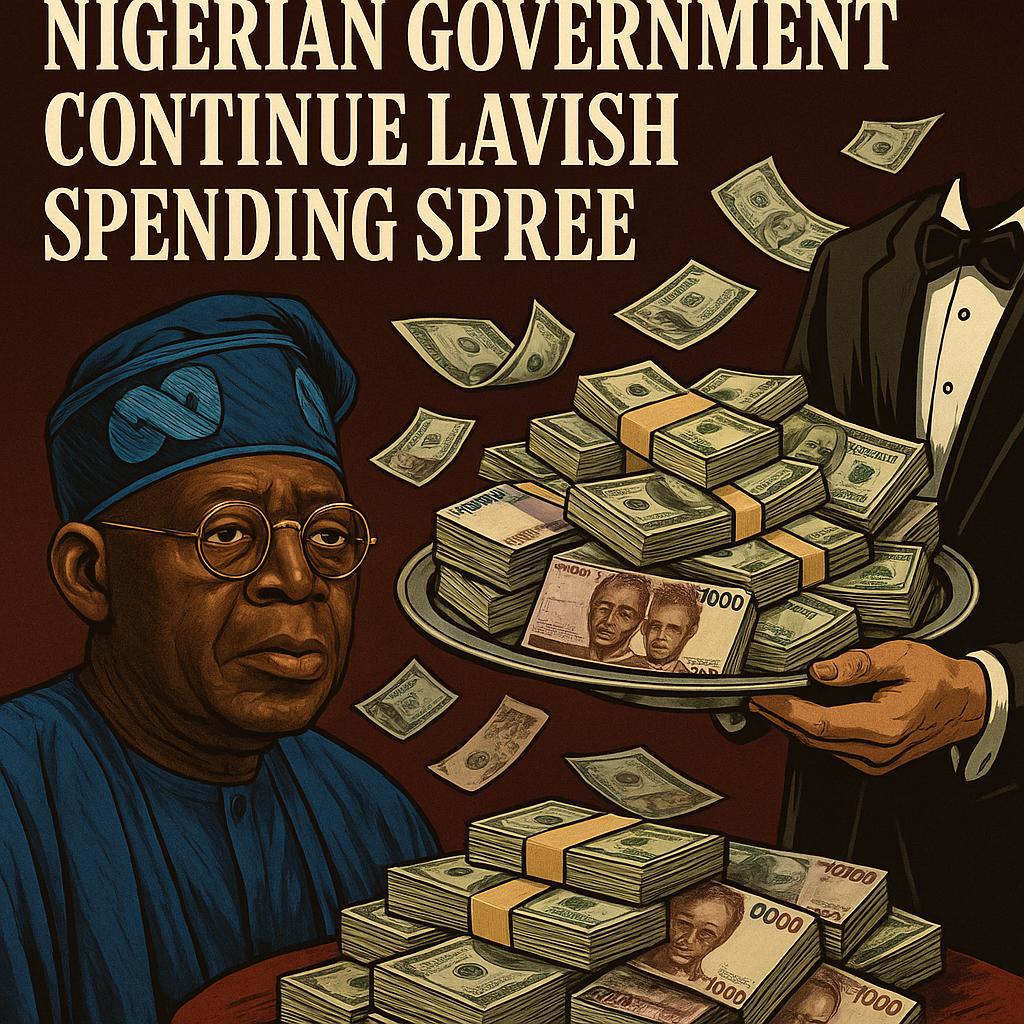
“It is my priority” the President said, as citizens were given no input or involvement in the process. A minor issue was prioritized, despite major issues and urgent national priorities troubling the lives of the Nigerian citizens such as inflation, skyrocketing cost of food, inconsistent power, insecurity, dilapidating infrastructure, underfunding of education, departure of multinational firms, the downward spiraling economy, and much more. This move, reflecting misplaced priorities, poor timing, and a myopic insensitivity to the historical backdrop of the British colonial legacy by reimposing an anthem on Nigerians that a foreigner created and not the Nigerian people, is tragic evidence of lack of leadership and vision. An anthem is too personal for a people to be outsourced.

The words of “Nigeria, We Hail Three” were touted as being more inspirational and befitting. But no matter how inspirational the words of any chosen anthem are, the real question is: do the actions of the Nigerian political class as representatives of the citizenry reflect it? No! Can you find traces of respectable value system in most from the political class that gives meaning to the words of the national anthem? No! In the now former anthem, the first word is “Arise”, which is to awaken to higher vision, values, and sense of duty. To transcend ethnicity and petty politics, in order to listen to the call of service that, through diligent implementation, furthers the welfare of the whole. How many citizens and political leaders in Nigeria’s history up to the present can say they have even fulfilled this first word? Words change conditions only when practice empowers them to manifestation. The new anthem will not change the behavior of the political class, so instead of changing anthems the right move would have been to look within and change. If this proved too difficult, then it is the poor leadership and the political class that should have been changed, not the anthem.   

Moving beyond constructive criticism and notwithstanding the atrocious timing of the change in national anthem, I will now offer a solution and explain how a change in the national anthem can be approached that would encourage greater inclusive and a sense of collective ownership. Here are the ten recommended steps to properly changing the national anthem:

  1. Host an open townhall with members of the public from all levels of society, government officials, organizations and civil society.
  2. Make a live case to the people. Describe the origin, meaning, parties, timeline, and development of the anthems within the historical context of the country’s history, then share reasons why a change is necessary.
  3. Invite comments, questions, healthy debate, and exchange of diverse ideas so people are included in the purpose and process.
  4. Announce a “National Anthem Rewrite” initiative in which the Nigerian citizens are encouraged to create and submit a national anthem, and a recitation video to a national commission and on social media. The objective is to empower the Nigerian people to take ownership, unleash their creativity, and ensure the recited words of national pride arise from their spirit!
  5. All created anthems will be reviewed, finalists will be selected, then one chosen; or different elements of some can be combined to create one whole anthem. A citizen’s commission will adjoin the national commission to participate in the decision-making process.
  6. The bill introducing a change to the national anthem will then be presented to the National Assembly, where it should be passed after some discussions.
  7. A signing ceremony will be organized with members of the public from all levels of society, government officials, organizations, and civil society.
  8. A band/group comprising different tribes and regions of the country will be composed to sing, record, and perform the national anthem.
  9. The author(s) of the anthem, the public, and others will be invited to Abuja for the first live performance of the group in a day of national unity. The event will also feature performances by Nigerian artists, poets, and comments by civic and academic leaders. The author(s) in a ceremony will be given an award(s) by the President in recognition of their creative contribution to the country. Then, the multiethnic group garbed in their native attires will sing it live for the first time. Their voices, united with the audience, will reverberate proudly through the Nigerian ether!
  10. The lyrics will be engraved in a large plaque and decoratively mounted tall in a wall in the Statehouse Aso Rock Presidential Villa and the National Assembly Complex.

This way, the Nigerian people are involved, centered, and use their own abilities to define the meaning of their anthem instead of a foreigner. It is indolence, lack of vision, and want of creativity that makes African leaders always ready to adopt foreign ideas, systems, and institutions, without the indigenous impetus to harness the abilities of their people, build on their cultural heritage, and create something original.

Here, many will remonstrate, saying “Nigeria was not named by Nigerians, must we change that too?” If we are serious, yes! How did Nigeria get its name? According to Richard Bourne in his book:

“The name ‘Nigeria’ had been coined by his [Frederick Lugard’s] wife and admirer, Flora Shaw, colonial editor of The Times, in a letter she wrote to her paper in January 1897. She used it to define the territories abutting the River Niger that were then being traded in or claimed by the Royal Niger Company” (Nigeria: A New History of a Turbulent Century; p. 3).

Thus, Nigeria was named not with any historical symbolism, rich cultural meaning, or existential ideal for its future development, but based solely on a colonial convenience of grouping people together in relation to a landmark! And you my people conveniently accept that and even defend against any change because you have grown “accustomed” to it? How deep have we sunk in Africa! Now contrast this with the reason that Dr. Kwame Nkrumah gave in his autobiography about renaming the Gold Coast “Ghana”. He spoke about how in the very early days of the Christian era before England was important, his African ancestors had attained a great empire:

“It is said that lawyers and scholars were much respected in that empire and that the inhabitants of Ghana wore garments of wool, cotton, silk and velvet. Thee was trade in copper, gold and textile fabrics, and jewels and weapons of gold and silver were carried.

“Thus we may take pride in the name of Ghana, not out of romanticism, but as an inspiration for the future. It is right and proper that we should know about our past. For just as the future moves from the present, so the present has emerged from the past. Nor need we be ashamed of our past. There was much in it of glory. What our ancestors achieved in the context of their contemporary society gives us confidence that we can create, out of that past, a glorious future, not in terms of war and military pomp, but in terms of social progress and peace.” (The Autobiography of Kwame Nkrumah; p. 195-96)

What a difference of day and night in the naming of “Ghana” and “Nigeria”! One rich in historical meaning and an inspiration for the future, while the other is just a geographic convenience lacking substance. Perhaps the difference is that Ghana has had the fortune of a visionary leader at the head of government, while Nigeria has not! Nigeria has even historically worked hard to ensure its most talented and industrious citizens are deprived of every opportunity of leading government, so that an avaricious cabal of tribalistic, vacuous, and visionless officials can continue plundering the national coffers while pushing the people in penury toward the abyss of infamy. How will a change in anthem effect a change in this rot? A gargoyle that changes its shirt is just a gargoyle in a beautiful shirt. Except here the shirt is now “foreign made”.

To effect change in Nigeria and Africa, our leaders need to become scholars of history in addition to an elevation in values and thinking, so our present actions build from the past. Follow me therefore on a quick diversion to explain the meaning of “Ghana”.

Ghana was a kingdom of the Soninke people, who are the northernmost people of the great Mande family that occupied a territory close to the Sahara desert. To properly situate Ghana in Ancient Africa, we should be clear of ethnic clusters in that the Soninke, Malinke and Bambara belong to a group referred to as Mandingoes or Mande-speaking (The History of West Africa; p. 15-18). This is important because when interpreting historical records, the same kingdom might have been referenced with slightly different names and meanings by the people, only because the descriptions might arise from different languages of ethnic groups in the same or different broader family. This notion applies to Ghana because historically there are two traditions (perhaps more) that mention a great Soninke kingdom of gold with the names Wagadu and Kaya-Magha, which preceded the Mali Empire and its preeminent leader Mansa Musa!

In one tradition, Wagadu was a prosperous kingdom blessed with vast quantities of gold with its capital at Kumbi, and its kings bore the title of Magha or Manga. The other tradition arose out of Ta’rīkhs (Arabic texts) from Timbuktu that mention the kingdom of Kaya-Magha as predecessor of Mali, one of these texts name the capital city Qunbi (like Kumbi), while the other calls it Ghana. Kaya-Magha in Soninke language means “king of gold”. However, in Malinke, Gãna or Kãna means war chief (The History of West Africa; p. 120). Ghana was called ‘the land of gold’ by some Arab geographers. Although people use the name Ghana interchangeably for both the kingdom and capital, al-Bakrī says in his text that ‘Ghana is the title of their kings’. The ‘ghana’ was the “king of gold” and powerful protector “war chief” who ruled the land of gold, with its thriving people, social order, beauty, systems, and advancements!

Do you see the depth of thought the Osagyefo Kwame Nkrumah gave to the choice of name? How the name and concept can awaken pride in the people? Not flippant and superficial, but deep and introspective. Do you see how he insisted and persisted to reclaim the sovereign right to rename his people according to their rich heritage, and as a signpost for continuous progress? So, why does the Ivory Coast, Nigeria and others still bear their names of colonial humiliation? As a country we gain independence, yet we lack the strength, insight, and self-respect to choose our own name with relevant meaning and create our own original systems. Complacent in the comfort that it has become “customary”, we avoid the discomfort of making changes and instead choose the indolent road of either keeping things the same, or to make a change we look abroad for what we can adopt from others!

Look at Nigeria: a British education and legal system complete with judges still wearing the ridiculous colonial wigs. We are black people in Africa, the British have left, and we still insist on wearing white wigs as a symbol of our “colonial legal tradition”, even though US white American descendants of Europeans, who have a greater claim to wig-wearing due to racial homogeneity no longer perpetuate that custom. Yet it is us as black people who thoughtlessly still insist on wigs. Absolutely incredible! If original thinking is too challenging then, being facetious, we can at least wear a black African wig that resembles African characteristics!

In governance Nigeria initially adopted the British parliamentary system, and then to make a change switched to the US governance system. Where are the original systems of Nigerians and Africans? What new institutions and structures? Are we just copycats who must rely on Europe and the US for everything? And with the emergence of China will we copy them too? Under poor leadership and an apathetic citizenry, instead of looking within to produce originally, to make a change we always look abroad to copy as a certified stamp of personal humiliation. We were given free will and a brain, thus the capacity to choose and think for ourselves… it is time to creatively exercise both! We are a great people, so it is time to give life and cultural expression to our vibrant abilities as a people rich in heritage and potential!

How can an African hold the seat of leadership, then simply continue the status quo and not earnestly strive to make a change, but content with an adopted name, anthem, systems and all. Never should you accept it, for your sovereign right and indigenous pride as an African leader should forbid it! Leaders of Africa, stand up and straighten your backs or give way for others who are willing to! It is high time to awaken to high deeds and work diligently… for the self-respect, welfare and indigenous progress of the people!

The issue stated here is beyond naming, but the earnest process of Africans using their own indigenous abilities and heritage to guide all progressive developments connected with themselves and their environment! It includes name, culture, systems, institutions, architecture, theories, and everything else. The people have the right and sacred duty to participate in the forming of all symbols, systems, and institutions of their country. Here, in addition to misplaced priorities, the Nigerian government woefully failed and deprived its people from cooperating by using their own abilities to creatively form a new anthem and thus design a national meaning from their own inner beings.

Wrong and shameful, poor leadership lacking in vision, this is the sentencing of the Laws of Nature and many Nigerians, for which my words are the iron gavel that pounds in judgment! Wake up…Arise O Compatriots!

~Dr. Ikenna Ezealah