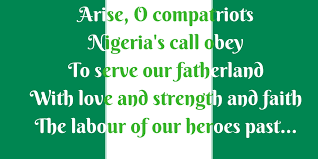
Recently, the Nigerian President led a campaign and signed into law a change in the national anthem. The previous national anthem “Arise, O Compatriots”, created by five Nigerians and then was put to music by Benedict P. Odiase, is now replaced by “Nigeria, We Hail Thee”, which was written in 1960 by British expatriate Lillian Jean Williams and was initially adopted as Nigeria’s national anthem when the country gained independence on October 1, 1960.
“It is my priority” the President said, as citizens were given no input or involvement in the process. A minor issue was prioritized, despite major issues and urgent national priorities troubling the lives of the Nigerian citizens such as inflation, skyrocketing cost of food, inconsistent power, insecurity, dilapidating infrastructure, underfunding of education, departure of multinational firms, the downward spiraling economy, and much more. This move, reflecting misplaced priorities, poor timing, and a myopic insensitivity to the historical backdrop of the British colonial legacy by reimposing an anthem on Nigerians that a foreigner created and not the Nigerian people, is tragic evidence of lack of leadership and vision. An anthem is too personal for a people to be outsourced.
The words of “Nigeria, We Hail Three” were touted as being more inspirational and befitting. But no matter how inspirational the words of any chosen anthem are, the real question is: do the actions of the Nigerian political class as representatives of the citizenry reflect it? No! Can you find traces of respectable value system in most from the political class that gives meaning to the words of the national anthem? No! In the now former anthem, the first word is “Arise”, which is to awaken to higher vision, values, and sense of duty. To transcend ethnicity and petty politics, in order to listen to the call of service that, through diligent implementation, furthers the welfare of the whole. How many citizens and political leaders in Nigeria’s history up to the present can say they have even fulfilled this first word? Words change conditions only when practice empowers them to manifestation. The new anthem will not change the behavior of the political class, so instead of changing anthems the right move would have been to look within and change. If this proved too difficult, then it is the poor leadership and the political class that should have been changed, not the anthem.
Moving beyond constructive criticism and notwithstanding the atrocious timing of the change in national anthem, I will now offer a solution and explain how a change in the national anthem can be approached that would encourage greater inclusive and a sense of collective ownership. Here are the ten recommended steps to properly changing the national anthem:
- Host an open townhall with members of the public from all levels of society, government officials, organizations and civil society.
- Make a live case to the people. Describe the origin, meaning, parties, timeline, and development of the anthems within the historical context of the country’s history, then share reasons why a change is necessary.
- Invite comments, questions, healthy debate, and exchange of diverse ideas so people are included in the purpose and process.
- Announce a “National Anthem Rewrite” initiative in which the Nigerian citizens are encouraged to create and submit a national anthem, and a recitation video to a national commission and on social media. The objective is to empower the Nigerian people to take ownership, unleash their creativity, and ensure the recited words of national pride arise from their spirit!
- All created anthems will be reviewed, finalists will be selected, then one chosen; or different elements of some can be combined to create one whole anthem. A citizen’s commission will adjoin the national commission to participate in the decision-making process.
- The bill introducing a change to the national anthem will then be presented to the National Assembly, where it should be passed after some discussions.
- A signing ceremony will be organized with members of the public from all levels of society, government officials, organizations, and civil society.
- A band/group comprising different tribes and regions of the country will be composed to sing, record, and perform the national anthem.
- The author(s) of the anthem, the public, and others will be invited to Abuja for the first live performance of the group in a day of national unity. The event will also feature performances by Nigerian artists, poets, and comments by civic and academic leaders. The author(s) in a ceremony will be given an award(s) by the President in recognition of their creative contribution to the country. Then, the multiethnic group garbed in their native attires will sing it live for the first time. Their voices, united with the audience, will reverberate proudly through the Nigerian ether!
- The lyrics will be engraved in a large plaque and decoratively mounted tall in a wall in the Statehouse Aso Rock Presidential Villa and the National Assembly Complex.
This way, the Nigerian people are involved, centered, and use their own abilities to define the meaning of their anthem instead of a foreigner. It is indolence, lack of vision, and want of creativity that makes African leaders always ready to adopt foreign ideas, systems, and institutions, without the indigenous impetus to harness the abilities of their people, build on their cultural heritage, and create something original.
Here, many will remonstrate, saying “Nigeria was not named by Nigerians, must we change that too?” If we are serious, yes! How did Nigeria get its name? According to Richard Bourne in his book:
“The name ‘Nigeria’ had been coined by his [Frederick Lugard’s] wife and admirer, Flora Shaw, colonial editor of The Times, in a letter she wrote to her paper in January 1897. She used it to define the territories abutting the River Niger that were then being traded in or claimed by the Royal Niger Company” (Nigeria: A New History of a Turbulent Century; p. 3).
Thus, Nigeria was named not with any historical symbolism, rich cultural meaning, or existential ideal for its future development, but based solely on a colonial convenience of grouping people together in relation to a landmark! And you my people conveniently accept that and even defend against any change because you have grown “accustomed” to it? How deep have we sunk in Africa! Now contrast this with the reason that Dr. Kwame Nkrumah gave in his autobiography about renaming the Gold Coast “Ghana”. He spoke about how in the very early days of the Christian era before England was important, his African ancestors had attained a great empire:
“It is said that lawyers and scholars were much respected in that empire and that the inhabitants of Ghana wore garments of wool, cotton, silk and velvet. Thee was trade in copper, gold and textile fabrics, and jewels and weapons of gold and silver were carried.
“Thus we may take pride in the name of Ghana, not out of romanticism, but as an inspiration for the future. It is right and proper that we should know about our past. For just as the future moves from the present, so the present has emerged from the past. Nor need we be ashamed of our past. There was much in it of glory. What our ancestors achieved in the context of their contemporary society gives us confidence that we can create, out of that past, a glorious future, not in terms of war and military pomp, but in terms of social progress and peace.” (The Autobiography of Kwame Nkrumah; p. 195-96)
What a difference of day and night in the naming of “Ghana” and “Nigeria”! One rich in historical meaning and an inspiration for the future, while the other is just a geographic convenience lacking substance. Perhaps the difference is that Ghana has had the fortune of a visionary leader at the head of government, while Nigeria has not! Nigeria has even historically worked hard to ensure its most talented and industrious citizens are deprived of every opportunity of leading government, so that an avaricious cabal of tribalistic, vacuous, and visionless officials can continue plundering the national coffers while pushing the people in penury toward the abyss of infamy. How will a change in anthem effect a change in this rot? A gargoyle that changes its shirt is just a gargoyle in a beautiful shirt. Except here the shirt is now “foreign made”.
To effect change in Nigeria and Africa, our leaders need to become scholars of history in addition to an elevation in values and thinking, so our present actions build from the past. Follow me therefore on a quick diversion to explain the meaning of “Ghana”.
Ghana was a kingdom of the Soninke people, who are the northernmost people of the great Mande family that occupied a territory close to the Sahara desert. To properly situate Ghana in Ancient Africa, we should be clear of ethnic clusters in that the Soninke, Malinke and Bambara belong to a group referred to as Mandingoes or Mande-speaking (The History of West Africa; p. 15-18). This is important because when interpreting historical records, the same kingdom might have been referenced with slightly different names and meanings by the people, only because the descriptions might arise from different languages of ethnic groups in the same or different broader family. This notion applies to Ghana because historically there are two traditions (perhaps more) that mention a great Soninke kingdom of gold with the names Wagadu and Kaya-Magha, which preceded the Mali Empire and its preeminent leader Mansa Musa!
In one tradition, Wagadu was a prosperous kingdom blessed with vast quantities of gold with its capital at Kumbi, and its kings bore the title of Magha or Manga. The other tradition arose out of Ta’rīkhs (Arabic texts) from Timbuktu that mention the kingdom of Kaya-Magha as predecessor of Mali, one of these texts name the capital city Qunbi (like Kumbi), while the other calls it Ghana. Kaya-Magha in Soninke language means “king of gold”. However, in Malinke, Gãna or Kãna means war chief (The History of West Africa; p. 120). Ghana was called ‘the land of gold’ by some Arab geographers. Although people use the name Ghana interchangeably for both the kingdom and capital, al-Bakrī says in his text that ‘Ghana is the title of their kings’. The ‘ghana’ was the “king of gold” and powerful protector “war chief” who ruled the land of gold, with its thriving people, social order, beauty, systems, and advancements!
Do you see the depth of thought the Osagyefo Kwame Nkrumah gave to the choice of name? How the name and concept can awaken pride in the people? Not flippant and superficial, but deep and introspective. Do you see how he insisted and persisted to reclaim the sovereign right to rename his people according to their rich heritage, and as a signpost for continuous progress? So, why does the Ivory Coast, Nigeria and others still bear their names of colonial humiliation? As a country we gain independence, yet we lack the strength, insight, and self-respect to choose our own name with relevant meaning and create our own original systems. Complacent in the comfort that it has become “customary”, we avoid the discomfort of making changes and instead choose the indolent road of either keeping things the same, or to make a change we look abroad for what we can adopt from others!
Look at Nigeria: a British education and legal system complete with judges still wearing the ridiculous colonial wigs. We are black people in Africa, the British have left, and we still insist on wearing white wigs as a symbol of our “colonial legal tradition”, even though US white American descendants of Europeans, who have a greater claim to wig-wearing due to racial homogeneity no longer perpetuate that custom. Yet it is us as black people who thoughtlessly still insist on wigs. Absolutely incredible! If original thinking is too challenging then, being facetious, we can at least wear a black African wig that resembles African characteristics!
In governance Nigeria initially adopted the British parliamentary system, and then to make a change switched to the US governance system. Where are the original systems of Nigerians and Africans? What new institutions and structures? Are we just copycats who must rely on Europe and the US for everything? And with the emergence of China will we copy them too? Under poor leadership and an apathetic citizenry, instead of looking within to produce originally, to make a change we always look abroad to copy as a certified stamp of personal humiliation. We were given free will and a brain, thus the capacity to choose and think for ourselves… it is time to creatively exercise both! We are a great people, so it is time to give life and cultural expression to our vibrant abilities as a people rich in heritage and potential!
How can an African hold the seat of leadership, then simply continue the status quo and not earnestly strive to make a change, but content with an adopted name, anthem, systems and all. Never should you accept it, for your sovereign right and indigenous pride as an African leader should forbid it! Leaders of Africa, stand up and straighten your backs or give way for others who are willing to! It is high time to awaken to high deeds and work diligently… for the self-respect, welfare and indigenous progress of the people!
The issue stated here is beyond naming, but the earnest process of Africans using their own indigenous abilities and heritage to guide all progressive developments connected with themselves and their environment! It includes name, culture, systems, institutions, architecture, theories, and everything else. The people have the right and sacred duty to participate in the forming of all symbols, systems, and institutions of their country. Here, in addition to misplaced priorities, the Nigerian government woefully failed and deprived its people from cooperating by using their own abilities to creatively form a new anthem and thus design a national meaning from their own inner beings.
Wrong and shameful, poor leadership lacking in vision, this is the sentencing of the Laws of Nature and many Nigerians, for which my words are the iron gavel that pounds in judgment! Wake up…Arise O Compatriots!
~Dr. Ikenna Ezealah


 Nation Upbuilding